Into the Expanse: A Security Leader’s Guide to the Agent Frontier
Read more


AI risk is owned by one accountable executive who holds the whole portfolio, supported by named owners for each class of risk inside it. In most companies, that executive is the CISO, the CIO, or a purpose-built AI risk owner. The title is the least interesting part. Ownership becomes real only when the owner can see what AI is running, stop it, fund the fix, and personally lose something when it fails. Miss any one of those, and you have a name on a chart, not an accountable owner.
Ask five executives at the same company who owns AI risk, and you will get five confident answers that do not match. Security assumes Legal has the regulatory piece. Legal assumes Security has the technical piece. The team that deployed the tool assumes somebody reviewed it. Nobody is lying. The problem is that accountability was never clearly assigned. The question gets answered for the first time during an incident, once it has turned into a question about blame.
Here is the whole model in one picture: one accountable executive, eight risk classes mapped to the owners who already own the non-AI version of each, a named human owner for every autonomous system, and the four conditions that make ownership real.
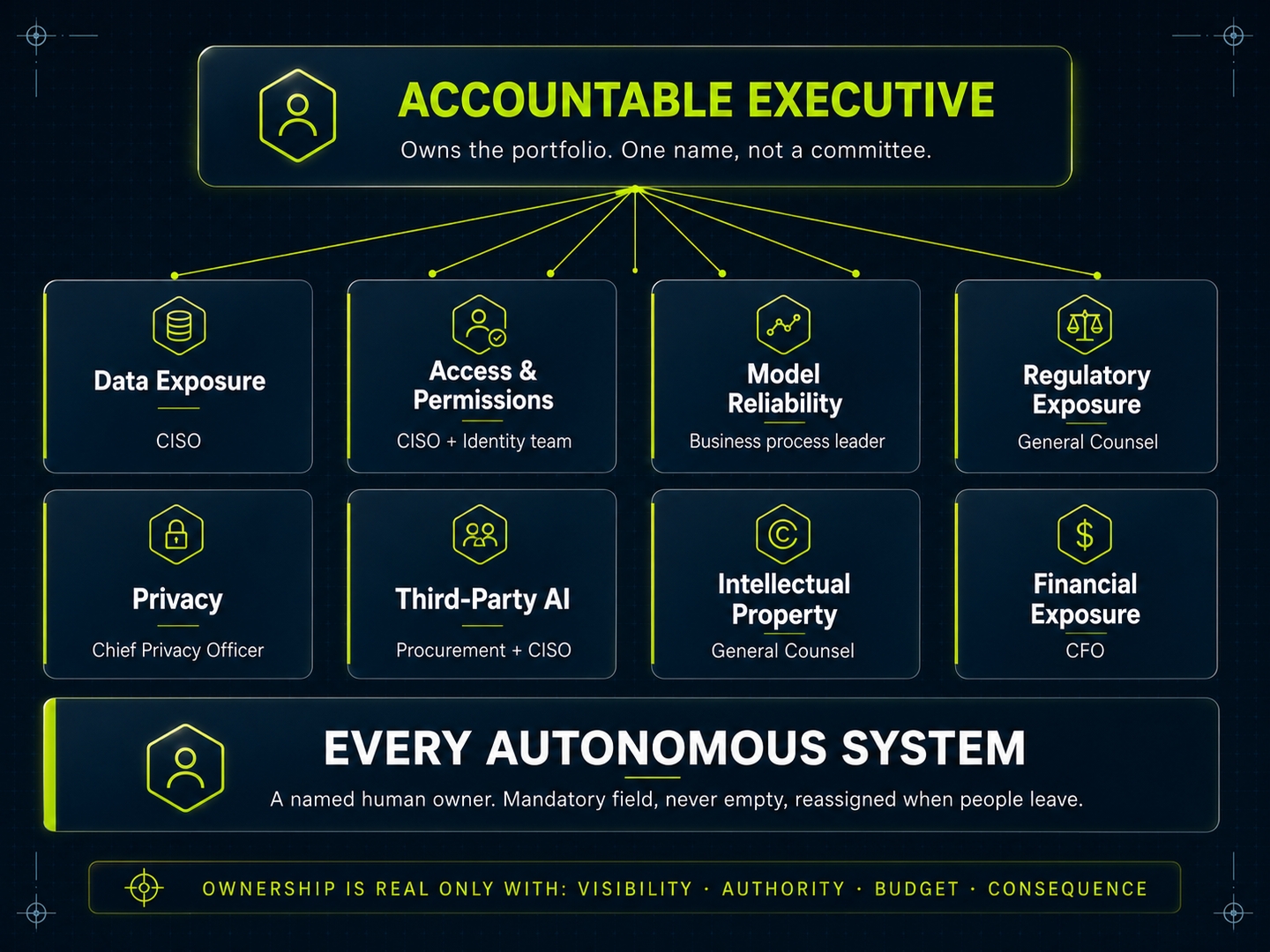
The rest of this article breaks down each layer, starting with why most companies have no clear AI risk ownership model.
Nobody does, and the org chart disagrees. Four common patterns explain why.
A committee can advise. It cannot be accountable, because you cannot fire a committee.
A committee produces meetings, minutes, and a policy. It does not produce a person who will be called at midnight.
The CISO is the most common answer, but it is only partially correct. The CISO owns security risks from AI: data leaving through prompts, permissions granted to systems nobody reviewed, and credentials sitting in automations built by people who have moved teams. That is a real and large slice. It is not the whole thing.
The CISO cannot own whether a model gives a customer the wrong answer, whether a hiring tool produces discriminatory outcomes, whether the outputs you sell are yours to sell, or whether your use of AI has to be disclosed. None of those are security problems.
Name the CISO owner of everything AI touches, and you have not assigned AI risk. You have assigned the blame.
The mirror image fails just as badly. Hand the bundle to a Chief AI Officer or the General Counsel and the technical risks go unowned by anyone who can see them. Whether a dedicated AI security lead fixes this is a separate question.
AI did not invent new categories of risk. It found new routes into the ones you already had.
The rule: whoever owns a risk in its non-AI form owns it in its AI form. You do not need new owners. You need to recognize that AI has become another entry point for the risks they already own.
Assigning a name is easy. The name means nothing without four things behind it.
Visibility fails first and hardest. AI arrives through browser extensions, corporate cards, connectors approved in thirty seconds, and features quietly switched on inside tools you already bought. An owner accountable for a surface they have never seen is a hostage, not an owner. It is also the fastest to fix: Reco's AI Agent Security discovers every AI app, agent, and connected identity on a daily cycle and attaches each one to an owner and a risk level. Audit what is running before assigning ownership.
Authority is granted in principle and withdrawn in practice: the test is not whether the owner can say no, but whether their no survives a business unit that wants the tool this quarter. The budget is the quiet one. An owner with findings and no funding produces documentation of the risk, not less risk, so arguing for the spend is part of the mandate. Consequence is the one nobody says out loud. If the owner's year is unaffected by a serious AI failure, they are not the owner. Somebody else is, and it is usually the CEO.
The 2 am test: One person must be able to shut down any AI system unilaterally, at 2 am, without a meeting. If that decision requires consensus, the ownership model is decorative.
Action: Take the person currently accountable for AI risk in your company. Score them one point for each condition they genuinely have. Anything below four reveals the ownership gap you're actually managing.
The EU AI Act splits obligations between providers (who build AI systems) and deployers (who use them). If you licensed the tool rather than built it, you are a deployer, and obligations attach to you regardless of what your vendor promised. Article 26 goes further and specifies who inside your company does the work: deployers of high-risk systems must assign human oversight to people with both the competence and the authority to intervene. That is a regulator writing two of the four conditions above into law.
ISO/IEC 42001 places accountability explicitly on top management, not on a committee. NIST's AI Risk Management Framework begins with organizational accountability rather than technical controls. Three bodies, one answer.
Note on timelines: EU AI Act enforcement dates have moved more than once, so check the current text before planning around specific deadlines. The structure has not moved: the obligation follows use, not authorship.
Here the old models genuinely break. Every accountability structure you have used assumed that a human took the action: a tool has a user, and the user answers for what they did with it. An autonomous system breaks that. It acts on a schedule nobody chose, on inputs nobody reviewed, using permissions somebody granted months ago and has long since forgotten. So who owns the action? Not the vendor, not the model provider, not the employee who wrote the original prompt. It belongs to the person who deployed the system.
No autonomous system runs without a named human owner.
Treat that as a hard rule and the rest follows. The owner field is mandatory and never empty. The owner answers for the system the way a manager answers for their team. The owner can be woken up. Ownership must also transfer when people leave, because that is where most organizations fail.
Warning: The most common unowned system in any company is the one built by someone who has since left. It still runs. It still holds every permission it was granted. It appears in no risk register because its owner left the company months ago.
Boards do not want your RACI. They want three things, in under a minute: one name, the limits of that person's authority, and the escalation threshold. If you cannot deliver all three without a slide, you have a diagram, not an ownership model. A practical ownership model sounds like this:
"[Name] is accountable for AI risk across the company. They can block AI adoption and shut down any AI system unilaterally. Anything touching customer data, a regulated decision, or a system acting without human approval must be escalated to this board within [X] days."
Three sentences. If you cannot say yours yet, that is the finding, and it belongs in the next board report ahead of any metric. The question has a bad answer and a good one. The bad answer is just a name. The good answer is a name, plus the authority to act.
Most companies do not have an AI problem. They have an ownership problem. The technology is moving faster than the accountability around it, which is why the same questions keep appearing after every incident. Who approved this? Who knew it was running? Who could have stopped it?
Those questions should never be answered after the fact. Every AI system should have a visible owner. Every class of AI risk should belong to the executive who already owns that risk. One person should be accountable for the whole program. If you cannot point to all three today, your biggest AI risk is not the model. It is the fact that nobody truly owns it.

%201.svg)
Gal is the Cofounder & CPO of Reco. Gal is a former Lieutenant Colonel in the Israeli Prime Minister's Office. He is a tech enthusiast, with a background of Security Researcher and Hacker. Gal has led teams in multiple cybersecurity areas with an expertise in the human element.