


Your security record looks perfect. No breaches. No incidents. No headlines. And that's exactly why your CFO just killed your AI security budget request.
"If our current security is working, why spend more?" It's a reasonable question from someone who measures risk in quarterly reports and audits. But here's what your CFO doesn't see: the absence of a breach isn't evidence of protection. It's evidence of luck, or worse, blindness. 71% of your employees are already using unauthorized AI tools. The data exposure is happening right now. You just haven't discovered it yet.
The conventional security budget conversation assumes you're protecting against future threats. That framing guarantees you lose. AI security isn't about preventing something that might happen. It's about discovering the exposure that's been compounding for months while traditional tools reported "all clear."
The data backs this up. Organizations that extensively deploy AI and automation in security operations save an average of $2.2 million per breach compared to those without these capabilities. They detect threats 100 days faster. The ROI isn't hypothetical. It's the difference between discovering shadow AI after 400+ days of data exposure versus catching it in weeks.
CFOs approve investments with clear returns. Here's how to present AI security in terms they'll fund.
Your CFO sees clean audit reports. Here's what those reports miss.
The average data breach now costs $4.88 million, up 10% from 2023 and the largest year-over-year increase since the pandemic. But that's the average. Breaches involving shadow data, which includes unauthorized AI tools, cost significantly more and take longer to contain.
Source: IBM Cost of a Data Breach Report 2024
Your "no incidents" record likely means one of two things. Either you're genuinely protected (unlikely given 71% shadow AI usage rates), or your detection capabilities can't see the exposure that already exists.
Most organizations discover shadow AI tools after 400+ days of continuous use. By then, these tools are embedded in critical workflows, processing customer data, handling proprietary information, and creating breach liability that doesn't show up until it's too late.
CFOs don't fund "security improvements." They fund risk reduction with measurable returns.
Here's the reframe that works:
The key: every claim must attach to a dollar figure or a measurable timeline.
Start with what your CFO can't see. Use this framework:
Step 1: Estimate shadow AI exposure
Step 2: Calculate data at risk
Step 3: Factor in detection delay
Present this as: "We currently have zero visibility into an estimated $9M exposure that's been compounding for months."
CFOs approve investments with positive ROI. AI security automation delivers it.
Cost reduction data (IBM 2024):
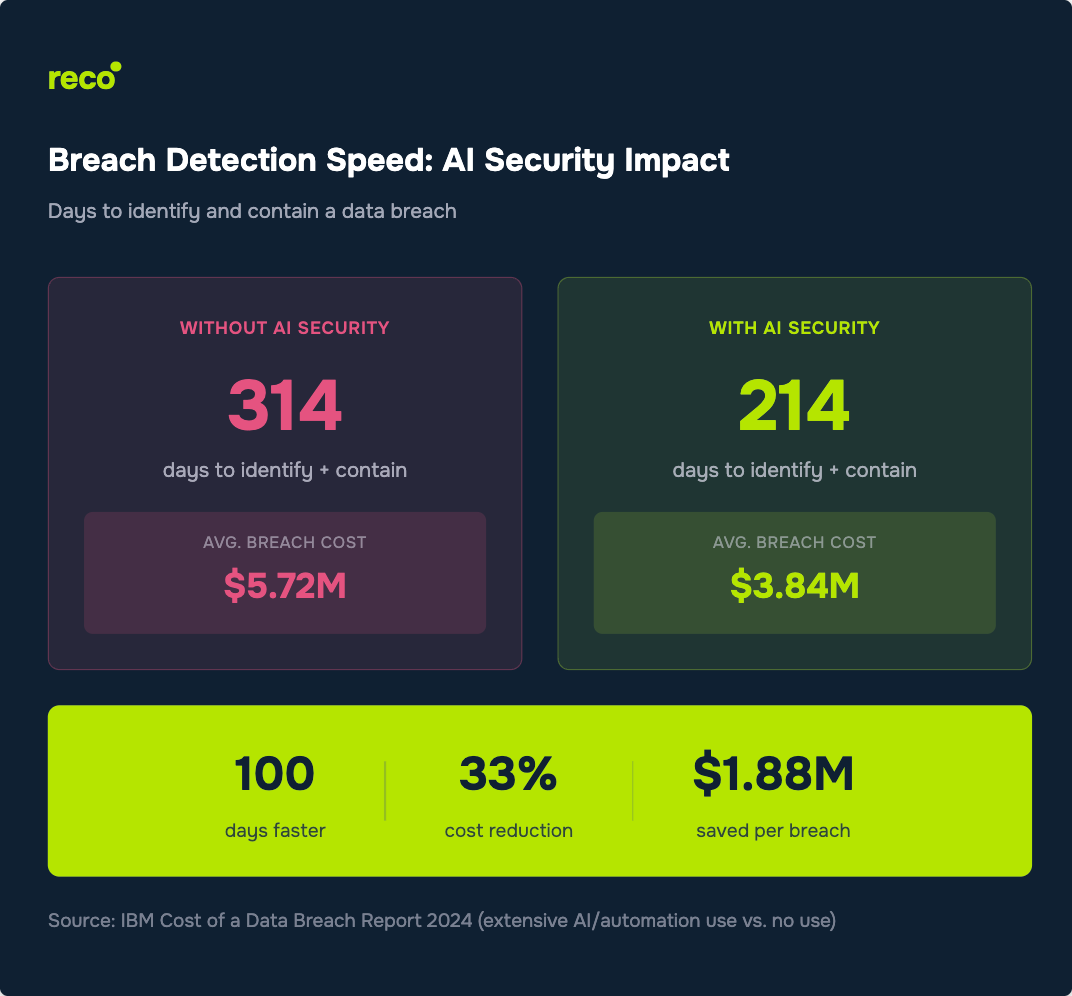
Organizations with extensive security AI and automation had average breach costs of $3.84 million compared to $5.72 million for those without. That's a 33% cost reduction.
Detection speed also improves dramatically. Organizations using AI extensively identified and contained breaches in approximately 214 days, compared to 314 days for those without AI. That's 100 days faster detection and containment.
Present the math simply:
This is where most CISOs lose the conversation. Your CFO says: "We haven't had a breach, so our current approach works."
Your response needs to reframe the logic:
Point 1: Absence of detection ≠ absence of exposure
"Our current tools report zero shadow AI. But 71% of employees across industries use unauthorized AI tools. Either we're a statistical anomaly, or our tools can't see what's actually happening. I'm not confident we're the exception."
Point 2: Discovery timeline creates compound risk
"Shadow AI tools average 400+ days of use before discovery. If exposure started 12 months ago and we find it tomorrow, we're liable for 12 months of data processing, 12 months of potential GDPR/CCPA violations, and 12 months of embedded risk in our workflows."
Point 3: The cost of waiting exceeds the cost of acting
"A breach involving shadow data costs 16% more than average. That's $5.6M versus $4.88M. Our investment request is $400K. We're spending 7% of potential loss to eliminate the exposure entirely."
CFOs understand risk management. Frame AI security investment as transferring risk from "unknown, uncontrolled, unlimited" to "known, managed, insured."
The CFO's real question isn't "Is this worth the money?" It's "What happens if I don't approve this and we get breached?"
Your answer: "You'll explain to the board why we didn't invest $400K to prevent a $5-10M loss when the warning signs were clear."
If full budget is rejected, propose a 90-day proof of concept:
Most CFOs who see their actual shadow AI exposure fund the full solution. The discovery phase removes the "this won't happen to us" objection permanently.
Dynamic SaaS security platforms like Reco change the budget conversation fundamentally.
Instead of asking for funds to protect against theoretical risks, you're requesting investment to close documented gaps. Reco's App Factory discovers new AI tools within days of employee adoption, not quarters later during manual audits. The Knowledge Graph maps exactly which data flows to which tools, converting vague "shadow AI exposure" into specific dollar figures your CFO can evaluate.
The pitch shifts from "we need better security" to "here are the 47 AI tools we discovered, the 1.2M records they've accessed, and the $8.4M exposure we can close for $400K."
That's a conversation CFOs approve.

%201.svg)
Gal is the Cofounder & CPO of Reco. Gal is a former Lieutenant Colonel in the Israeli Prime Minister's Office. He is a tech enthusiast, with a background of Security Researcher and Hacker. Gal has led teams in multiple cybersecurity areas with an expertise in the human element.


%201.svg)


.svg)