Into the Expanse: A Security Leader’s Guide to the Agent Frontier
Read more


Most CISOs approach this as a budget question. It is not.
The conversation typically follows a familiar path: AI adoption is accelerating, the risk surface is expanding, the board is asking for assurances, and a dedicated role seems like the logical next step. That reasoning is understandable, but it bypasses the more important question: what that hire would actually be responsible for on day one.
Without clear visibility into which AI tools exist in the environment, a dedicated AI security hire will spend their first six months auditing tools that may have been operating for more than a year. That is not a hiring failure. It is a discovery gap framed as a headcount decision.
The hiring decision only becomes rational once there is clarity on what the role is expected to manage.
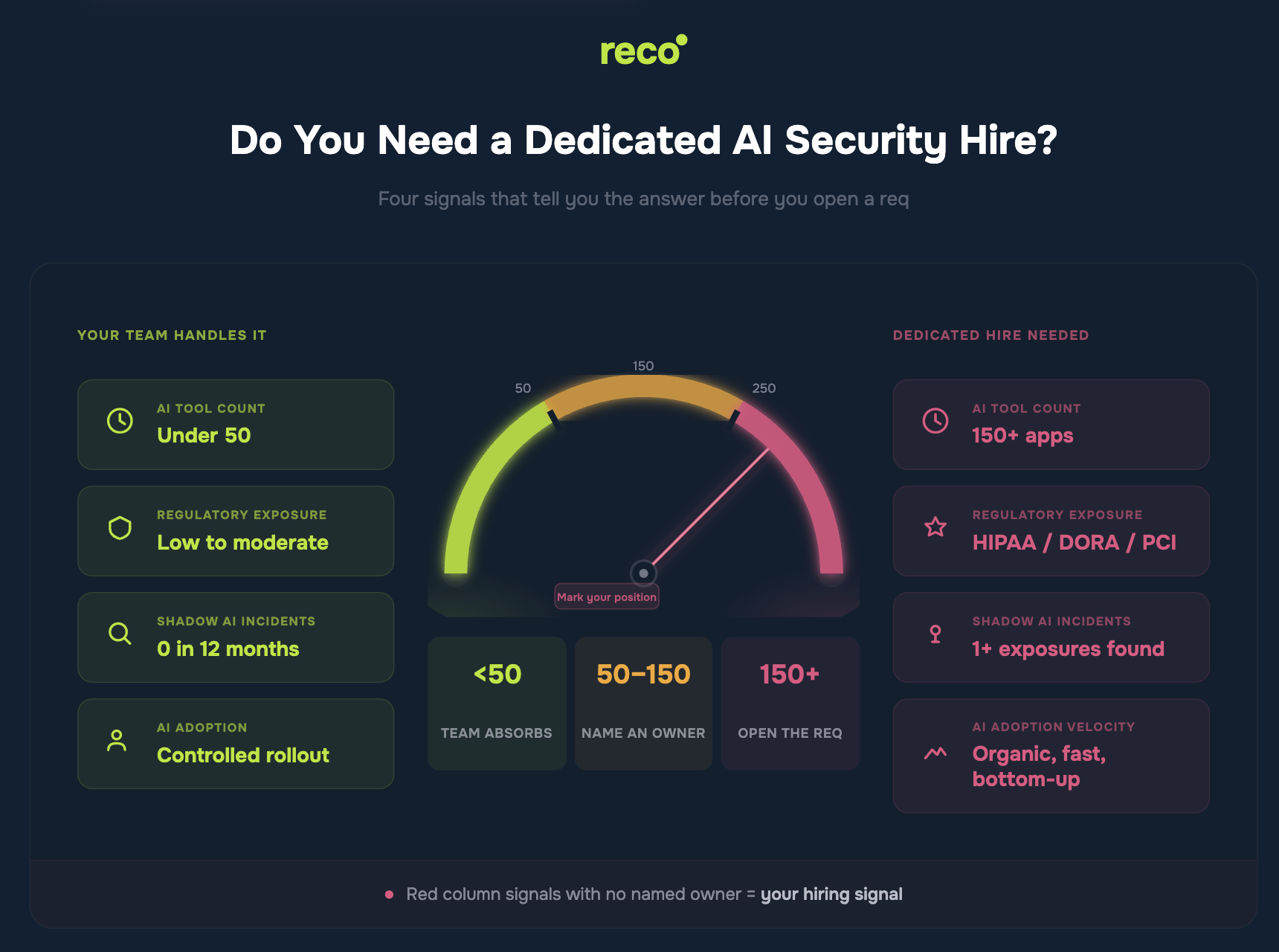
The framework that follows outlines four signals to determine whether to open a dedicated role, assign ownership within an existing team, or address discovery gaps first.
Before scoping a hire, scope the role itself. In a typical enterprise environment, an AI security function encompasses four distinct responsibilities.
Discovery is a foundational requirement for the remaining responsibilities. Without it, downstream governance, enforcement, and response functions cannot operate effectively.
Of the four responsibilities, three are inherently platform-dependent, while only one is primarily human-driven. A common failure mode is to staff the role before establishing the underlying platform, resulting in the hire spending a disproportionate amount of time on manual discovery and retrospective audits rather than governance and risk reduction.
Tool count is the primary scaling factor. Organizations with fewer than 50 AI applications can typically distribute ownership across existing security roles with explicit accountability. Between 50 and 150 tools, centralized ownership within the existing team becomes necessary. Beyond 150 tools, the scope exceeds what part-time ownership models can govern effectively.
Regulatory exposure and adoption velocity further compress these thresholds. An organization operating 80 AI tools under HIPAA obligations faces materially different governance requirements than an organization with the same tool count but no regulated data exposure.
Shadow AI tools are not short-lived experiments. Reco’s 2025 State of Shadow AI Report found that certain AI tools remained active for 400 days or more before being identified. When a new AI security hire joins under these conditions, they are not entering a clean environment. They inherit months of accumulated exposure that cannot be assessed without dedicated discovery capabilities.
This creates a predictable failure pattern. The hire may be experienced and highly capable, yet the first quarter is dominated by manual audits, informal Slack surveys to inventory tool usage, and ad hoc OAuth reviews. Progress appears slow, governance initiatives stall, and the organization misinterprets the outcome as a staffing inefficiency rather than a tooling gap.
The sequencing problem is structural, not personal. A dedicated role can scale governance and response, but it cannot replace discovery.
In organizations with mature AI governance, security teams operate from a continuously updated system of record rather than periodic inventories. This inventory captures every AI tool connected via OAuth, the specific data objects each tool can access, the associated user population, and the elapsed time since the last policy review. This level of visibility cannot be constructed or maintained manually. It is an inherently platform-driven capability.
Reco’s Knowledge Graph operationalizes this model by continuously correlating OAuth authorizations, SaaS telemetry, and behavioral signals. When an employee connects a new AI tool to a production SaaS environment, it appears in the inventory within hours. This enables security teams to assess data exposure and access scope before the tool becomes embedded in business workflows. As a result, the role’s focus shifts immediately to governance and response rather than retrospective discovery.
App Factory extends this capability by closing integration gaps at operational speed. When a new AI tool reaches enterprise adoption, Reco delivers full integration coverage within 3–5 days, compared to the six- to nine-month timelines common to static SSPM approaches. This allows security teams to stay aligned with adoption velocity instead of reacting after risk has already accumulated.
Before opening a requisition, organizations should follow a defined sequencing model. First, establish discovery by confirming that every AI tool currently operating in the environment can be enumerated. Second, establish ownership by assigning clear accountability for AI tool governance, even if that responsibility initially resides within an existing role. Third, establish policy by defining approval workflows, classification criteria, and enforcement mechanisms. Only then should scale be evaluated to determine whether the volume and complexity justify dedicated headcount.
Most organizations invert this sequence and move directly to staffing. Organizations that follow the correct order build AI security programs that function operationally, regardless of whether a dedicated role exists on day one.
The contrarian conclusion is straightforward: If an organization cannot identify which AI tools employees used last week, a dedicated AI security hire will spend their first six months manually answering that question. Discovery must come first. Headcount decisions should follow.
Adding dedicated AI security headcount should follow evidence of operational scale, not uncertainty about emerging risk. When discovery is incomplete, new roles are consumed by manual inventory work rather than governance and response. Effective programs treat visibility as a prerequisite, ownership as an operating control, and staffing as a scaling decision.
Reco provides continuous visibility into AI tool adoption and data exposure, enabling teams to focus on policy enforcement instead of retrospective discovery. When AI usage can be observed and assessed as it emerges, adding headcount strengthens governance rather than compensating for blind spots. In AI security, staffing delivers value only after the underlying discovery and control capabilities are established.
References

%201.svg)
Gal is the Cofounder & CPO of Reco. Gal is a former Lieutenant Colonel in the Israeli Prime Minister's Office. He is a tech enthusiast, with a background of Security Researcher and Hacker. Gal has led teams in multiple cybersecurity areas with an expertise in the human element.