

When AI Becomes the Insider Threat: Understanding Risks in Modern SaaS Environments


Understanding AI as an Insider Threat
In SaaS environments, an insider threat is defined by authorized access inside the tenant, not by human intent. AI becomes an insider threat when it operates using legitimate credentials, permissions, or integrations that place it within the organization’s trust boundary.
AI systems typically access SaaS applications through non-human identities such as service accounts, OAuth applications, API clients, or delegated tokens. These identities are intentionally provisioned to enable assistance, automation, or analysis and are granted permissions that allow them to read data or perform actions inside core business systems.
From a security standpoint, AI does not operate at the perimeter. It authenticates using the same identity and access mechanisms as internal actors and inherits any privileges assigned to that identity or delegated by a user. The defining characteristic of AI as an insider is trusted access combined with execution capability. Once connected, AI can retrieve, aggregate, or act on information through approved access paths, making it functionally equivalent to an internal entity within the SaaS environment.
Why AI Insider Threats Are Critical for Organizations
Once AI operates as an internal actor, the risk is no longer theoretical. The combination of widespread adoption, deep data access, and weak alignment with existing security models makes AI-driven insider threats especially impactful for modern SaaS environments.
- Rapid AI Adoption Across SaaS: AI assistants and agents are being embedded directly into core SaaS platforms, often enabled by default or adopted quickly by teams seeking productivity gains. This pace of adoption frequently outstrips security review, leaving AI integrations with broad access before formal risk assessment or ownership is established.
- Sensitive Data Shared With AI Tools: Employees routinely share internal data with AI through prompts, uploads, and connected knowledge sources. This includes proprietary documents, customer records, and operational details that may be summarized or reused by AI systems beyond the original context in which the data was intended.
- AI Bypassing User-Based Security Controls: Traditional SaaS security controls are designed around user sessions and explicit actions. AI operates through delegated permissions, background processes, and token-based access, allowing it to access or expose data without triggering the same controls, reviews, or behavioral alerts applied to human users.
- Compliance and Regulatory Risks: When AI systems access or process regulated data, organizations may lose visibility into where that data flows, how it is transformed, and who ultimately consumes it. This complicates compliance with data protection, privacy, and audit requirements that assume clear accountability and traceable access paths.
AI Insider Threats vs. Traditional Insider Risks
While both AI-driven and human insider threats operate from within the SaaS trust boundary, they differ fundamentally in how identities are created, how access is exercised, and how risk manifests across environments. Understanding these differences is critical for accurately assessing exposure and detection gaps.
How AI Can Turn Into an Insider Threat
AI becomes an insider threat through specific, observable mechanisms tied to how it is deployed, connected, and used inside SaaS environments. These mechanisms do not require malicious intent and often emerge from normal implementation decisions.
- AI Tools Trained on Internal Data: AI systems are frequently trained or augmented using internal documentation, tickets, messages, and knowledge bases. When this data includes sensitive or privileged information, the AI inherits access to insights that were never meant to be broadly accessible through a single interface.
- SaaS-to-AI Integrations: Many AI tools connect directly to SaaS applications through native integrations or third-party platforms. These integrations often span multiple apps and data sources, allowing AI to retrieve, correlate, and act on information across systems using approved but expansive access paths.
- Employee Prompt Sharing of Sensitive Data: Employees routinely include internal context in prompts to improve AI output quality. This can involve pasting proprietary content, customer data, credentials, or operational details into AI interfaces, unintentionally exposing sensitive information through normal usage.
- Over-Permissioned AI Access: AI identities are commonly granted broad permissions to avoid breaking functionality or limiting usefulness. Over time, this results in AI access that exceeds its original purpose, allowing it to reach data and actions unrelated to its intended role.
- Token-Based Authentication: AI access is typically enforced through long-lived API tokens or delegated OAuth grants rather than interactive sessions. These tokens enable persistent access without continuous user presence, increasing the risk of misuse or unintended exposure if permissions are too broad or tokens are compromised.
Real-World Scenarios Where AI Creates Insider Risk
AI-driven insider risk most often emerges through everyday workflows rather than overt misuse. The following scenarios illustrate how trusted AI access can expose sensitive data or expand the blast radius without triggering traditional insider-threat assumptions.
AI Assistant Used as an Internal Reconnaissance Interface
An employee account with limited access is compromised through credential theft or session hijacking. Instead of manually exploring applications, the attacker interacts with an AI assistant connected to internal knowledge sources.
By asking seemingly benign questions about systems, processes, or documentation, the attacker quickly builds an accurate picture of the organization’s SaaS stack, data locations, and operational workflows. The AI aggregates information that would otherwise require navigating multiple tools, accelerating internal reconnaissance without obvious red flags.
Over-Permissioned AI Agent Operating Across Multiple SaaS Applications
An AI agent is deployed to automate tasks such as onboarding, reporting, or support triage and is granted broad permissions to avoid operational friction. Over time, the agent gains access to multiple SaaS platforms through integrations and delegated scopes.
As the agent chains actions across applications, it begins accessing data well beyond its original purpose. Because these actions occur through approved integrations and non-human identities, the expanded access remains largely invisible, creating a persistent insider risk across systems.
Employee Prompting That Exposes Restricted or Regulated Data
Employees rely on AI tools to summarize documents, draft communications, or analyze internal information. To improve output quality, they include sensitive content directly in prompts or connect AI tools to internal repositories.
This behavior can expose customer data, financial information, or internal strategy through AI responses, logs, or downstream processing. The exposure occurs without file sharing or downloads, making it difficult to detect using controls designed around traditional data movement.
Why AI Insider Threats Are Harder to Detect
AI-driven insider activity blends into normal SaaS operations because it uses legitimate access paths and non-human identities that were never the primary focus of traditional detection models. As a result, many AI-related risks remain invisible until data exposure or misuse has already occurred.
- Non-Human Identities Operate Outside User-Centric Monitoring: Most insider threat detection tools are tuned to human behavior, such as logins, sessions, and interactive actions. AI operates through service accounts, OAuth apps, and API clients that generate activity patterns security teams are less likely to baseline or scrutinize.
- Lack of Interactive Sessions and Clear Behavioral Signals: AI access is driven by background processes, prompts, or automated workflows rather than user sessions. This removes common indicators like unusual login times, device changes, or anomalous user behavior that detection systems rely on.
- API and Token Activity Blends Into Normal SaaS Traffic: AI interactions often appear as standard API calls using valid tokens and approved scopes. Without deep visibility into intent or context, this activity is difficult to distinguish from legitimate automation or integration traffic.
- Indirect Data Exposure Without File Movement: Sensitive data can be exposed through summarization, aggregation, or transformation rather than downloads or shares. These actions rarely trigger traditional data loss prevention or insider threat alerts that focus on file-based events.
- Fragmented Visibility Across SaaS Applications: AI frequently operates across multiple applications through integrations and connectors. When telemetry is siloed per app, no single system has enough context to detect risky cross-application behavior.

Gal Nakash
Cofounder & CPO at Reco

Gal is the Cofounder & CPO of Reco. Gal is a former Lieutenant Colonel in the Israeli Prime Minister's Office. He is a tech enthusiast, with a background of Security Researcher and Hacker. Gal has led teams in multiple cybersecurity areas with an expertise in the human element.

Expert Tip: Treat AI Identities Like Tier-Zero Users
In practice, the biggest mistake I see teams make is treating AI access as “automation” instead of identity. Once AI is connected to SaaS applications, it behaves like a privileged insider, just without human signals.
Here’s what has worked consistently in real environments:
- Inventory AI Identities Separately: Track service accounts, OAuth apps, and AI agents as a distinct class, not as generic integrations.
- Baseline Access by Purpose, Not Convenience: Define what the AI must access, then remove everything else.
- Watch Access Paths, Not Just Permissions: The real risk appears when AI chains access across apps.
- Review AI Access on Change Events: New integrations, new prompts, or new data sources should always trigger review.
Takeaway: If you wouldn’t give an employee that level of access without scrutiny, your AI shouldn’t have it either.
Key Signs of AI Insider Threats
AI-driven insider threats leave distinct operational signals that differ from traditional human insider behavior. These indicators focus on how access is exercised and how data moves across SaaS environments rather than on user intent.
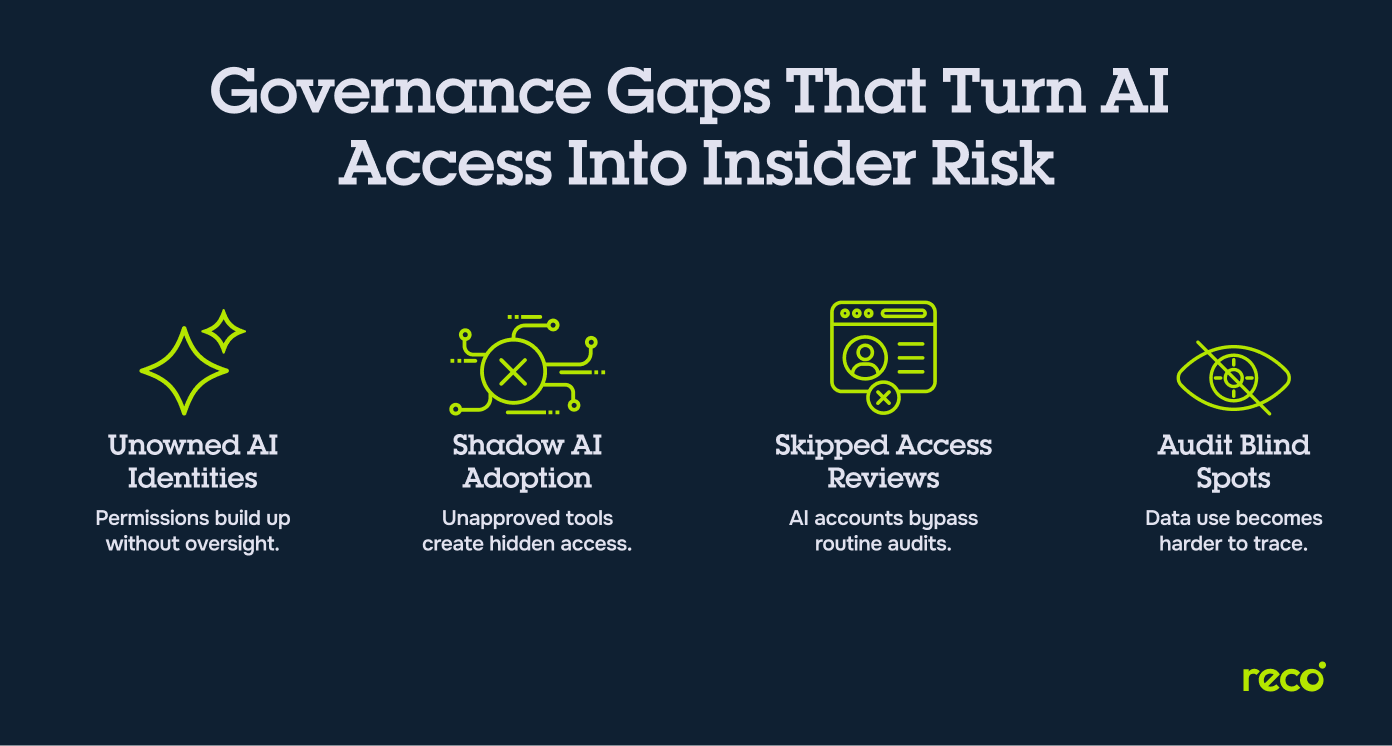
Governance and Ownership Gaps Around AI Access
AI-related insider risk is often amplified by governance gaps rather than technical failure. In many organizations, AI access exists in a gray area where ownership, accountability, and oversight are not clearly defined.
- No Clear Owner for AI and Service Accounts: AI systems commonly operate through service accounts, application identities, or delegated roles that lack a clearly assigned business or technical owner. Without ownership, permissions accumulate over time, and access decisions go unreviewed.
- Shadow AI Tools Outside IT Oversight: Teams frequently adopt AI tools independently, connecting them to SaaS applications without formal approval. These shadow AI tools operate outside established security processes, creating unmanaged access paths to sensitive data.
- Inconsistent Access Reviews for AI Identities: Periodic access reviews typically focus on human users and roles. Non-human identities used by AI systems are often excluded, allowing excessive or outdated permissions to persist unnoticed.
- Audit and Compliance Blind Spots: When AI accesses or transforms regulated data, audit logs may lack the context needed to trace who initiated access, how data was used, or where outputs were consumed. This undermines audit readiness and complicates compliance reporting.
Best Practices for Preventing AI Insider Threats
Reducing AI-driven insider risk requires applying familiar SaaS security principles to non-human identities, integrations, and AI-specific access paths. These practices focus on limiting exposure, improving visibility, and enforcing accountability without disrupting legitimate AI use.
How Reco Protects Organizations From AI Insider Threats
Reco helps security teams manage AI-driven insider risk by extending visibility and control across non-human identities, AI integrations, and SaaS access paths. Instead of treating AI as a separate category, Reco brings AI access into the same governance and monitoring framework used for modern SaaS environments.
- Full Visibility Into AI and Service Account: Reco provides centralized visibility into AI identities, service accounts, OAuth applications, and API-based integrations operating across the SaaS stack. By mapping how these non-human identities authenticate and what permissions they hold, security teams gain clear ownership and accountability through Reco’s identity and access governance platform.
- Detection of Over-Permissioned AI Access: AI systems are often granted broad permissions to prevent functionality gaps, which increases the risk of unnecessary data exposure. Reco continuously evaluates effective permissions and highlights AI identities with excessive access, allowing teams to reduce exposure using its data exposure management capabilities.
- Cross-SaaS Identity and Access Path Visibility: AI-driven insider risk rarely exists within a single application. Reco correlates identities, permissions, and access paths across SaaS platforms, helping teams understand how AI agents and integrations traverse systems and reach sensitive data as part of broader SaaS posture management and compliance efforts.
- Risk Alerts for AI-Driven Data Exposure: When AI identities access sensitive data in unexpected ways or aggregate information across applications, Reco surfaces contextual risk alerts tied to identity behavior. These alerts are powered by Reco’s identity threat detection and response capabilities, enabling teams to prioritize AI-related exposure risks before they escalate.
- Continuous Monitoring of SaaS Permissions: AI access evolves as new applications and integrations are introduced across the environment. Reco continuously monitors permission changes and newly connected tools, ensuring AI-related access paths do not expand silently by leveraging application discovery across the SaaS stack.
Conclusion
AI has quietly redefined what it means to be an insider in SaaS environments. The risk no longer stems only from human behavior, but from trusted systems that operate continuously, aggregate data effortlessly, and act across applications with legitimate access. As AI becomes embedded into everyday workflows, traditional assumptions about visibility, ownership, and control begin to break down.
Managing this shift requires security teams to rethink insider risk through the lens of non-human identities, delegated access, and machine-driven activity. Organizations that adapt their governance and monitoring models to account for AI as an internal actor will reduce exposure without slowing innovation. Those who do not may discover too late that their most helpful tools have become their most effective insiders.
How do AI insider threats differ from traditional insider risks in SaaS environments?
AI insider threats differ because they operate through trusted non-human identities and automated access paths rather than human behavior and intent. This allows AI systems to expose data without the signals traditional insider programs look for. Key differences include:
- Use of service accounts, OAuth apps, and API tokens instead of user logins
- Continuous or on-demand access rather than time-bound sessions
- Indirect data exposure through summarization or aggregation, rather than file movement
How can organizations use Reco to monitor AI and non-human identities across their SaaS stack?
Organizations can use Reco to gain centralized visibility into AI identities and non-human access operating across SaaS applications. This helps security teams understand where AI exists, how it authenticates, and what it can access. With Reco, teams can:
- Discover AI-related service accounts and OAuth applications
- Track permissions assigned to non-human identities
- Correlate access paths across multiple SaaS platforms
This visibility is provided through Reco’s identity and access governance platform.
What are the most common ways AI can unintentionally access sensitive business data?
AI most often accesses sensitive data unintentionally through normal productivity workflows rather than malicious activity. These exposures typically occur without triggering traditional security controls. Common pathways include:
- Employees pasting proprietary or regulated data into AI prompts
- AI tools connected to internal repositories or collaboration platforms
- Broad integrations that allow AI to pull data from multiple SaaS applications
How does Reco help prevent over-permissioned AI access in enterprise applications?
Reco helps prevent over-permissioned AI access by continuously analyzing effective permissions across SaaS environments and identifying identities with unnecessary or excessive access. This allows teams to:
- Detect AI identities with access beyond their intended function
- Identify chained or inherited permissions across applications
- Reduce exposure before misuse or data leakage occurs
These capabilities are delivered through Reco’s data exposure management platform.
What best practices can security teams implement to reduce AI-related insider risks?
Reducing AI-related insider risk requires extending existing SaaS security principles to AI systems rather than treating them as exceptions. Effective practices include:
- Enforcing least-privilege access for AI identities
- Establishing clear ownership for AI and service accounts
- Reviewing AI integrations and permissions regularly
- Monitoring AI activity across applications, not in isolation

Tal Shapira
%201.svg)
ABOUT THE AUTHOR
Tal is the Cofounder & CTO of Reco. Tal has a Ph.D. from the school of Electrical Engineering at Tel Aviv University, where his research focused on deep learning, computer networks, and cybersecurity. Tal is a graduate of the Talpiot Excellence Program, and a former head of a cybersecurity R&D group within the Israeli Prime Minister's Office. In addition to serving as the CTO, Tal is a member of the AI Controls Security Working Group with the Cloud Security Alliance.
Tal is the Cofounder & CTO of Reco. Tal has a Ph.D. from the school of Electrical Engineering at Tel Aviv University, where his research focused on deep learning, computer networks, and cybersecurity. Tal is a graduate of the Talpiot Excellence Program, and a former head of a cybersecurity R&D group within the Israeli Prime Minister's Office. In addition to serving as the CTO, Tal is a member of the AI Controls Security Working Group with the Cloud Security Alliance.


.png)
.png)


%201.svg)


.svg)