Into the Expanse: A Security Leader’s Guide to the Agent Frontier
Read more


Your standard RFP process will not help you evaluate AI security vendors. It was designed for an earlier era of software procurement, when adoption cycles were slow, integrations were relatively static, and vendors had months to prepare controlled demos. None of those assumptions will hold in today’s AI landscape.
Following a year where the global AI in cybersecurity market was estimated at $25.35 billion, the sector is maintaining a robust 24.4% annual growth rate as it heads toward a projected $93.75 billion by 2030. In response, nearly every security vendor now includes “AI security” in its pitch. The result is a crowded market where differentiation is masked by near-identical feature lists, and where commonly used evaluation criteria actively conceal the risks that matter most.
The real question is not which vendor supports the most integrations. It is which vendor can detect what employees adopted yesterday, translate that activity into business impact, and enforce policy before exposure turns into an incident. Most cannot. Standard RFPs are structurally incapable of revealing that.
What follows is an evaluation framework that can.
The framework that follows outlines the 12 questions to run in every AI security vendor demo, the five capability categories that determine real coverage, and the red flags that should end an evaluation immediately.
Traditional procurement processes emphasize compliance certifications, integration counts, and dashboard screenshots. In the context of AI security, these criteria miss the core issue entirely: AI tool adoption consistently outpaces security coverage.
An employee can connect a new AI tool to a business application in minutes. Vendors that rely on hard-coded integrations often require six to nine months to add support for a new application. The gap between what is adopted and what is visible to security is where shadow AI risk accumulates. An RFP that asks “how many applications do you support?” measures the wrong dimension. The more relevant question is how quickly a vendor can support what employees are adopting in real time.
The second failure is a lack of context. Most AI security tools generate technical outputs such as misconfiguration counts, permission flags, and policy violations. CISOs do not need more findings. They need findings translated into business impact so they can prioritize, escalate, and act. Vendors that fail to provide this context create alert fatigue rather than meaningful security outcomes.
AI security vendors tend to cluster around five distinct capability areas. Most specialize in one or two while leaving the others partially or entirely unaddressed. Understanding this full capability landscape helps prevent organizations from purchasing a point solution and mistaking it for a comprehensive program.
Before your next vendor demo, use the three-tier framework below to score each response. “Best in class” should be the minimum bar. Any response below that threshold warrants a follow-up question or should end the evaluation.
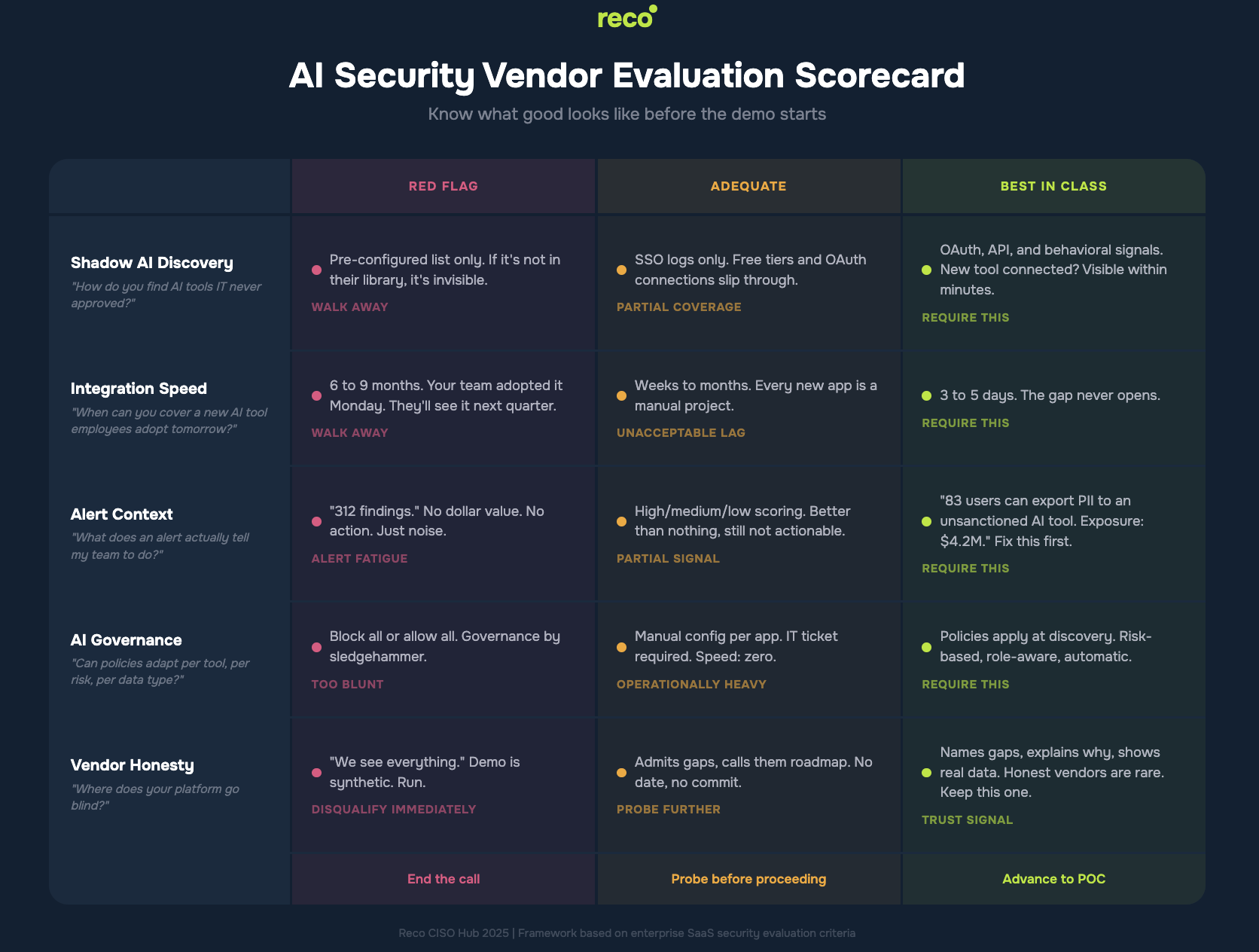
These questions are ranked by predictive value rather than vendor comfort. The first two alone will disqualify more vendors than all remaining questions combined.
Immediate Disqualifiers
Yellow Flags: Probe Before Proceeding
Most POCs are designed to measure what vendors prefer to showcase. Structure yours around the gaps that are least likely to surface.
Week 1: Baseline Discovery
How many AI tools does the solution identify in your environment that you were not previously aware of? That number represents your visibility gap.
Week 2: Introduce an Unknown AI Tool
Without notifying the vendor, connect a new AI tool to a business application via OAuth. Measure how long it takes to appear in the solution. This is your true detection window.
Week 3: Assess Alert Quality
For each finding that has surfaced, determine what action is required and whether the associated business impact is clear. High-volume outputs with little context fail this test.
Week 4: Operational Fit
Can your team operate the solution without a dedicated analyst? Does it integrate into existing workflows, or does it require a parallel process?
Reco was designed to address the discovery gap inherent in AI tool adoption. The solution continuously monitors OAuth authorizations, API connections, SaaS logs, and behavioral patterns. When an employee connects a new AI tool, it becomes visible within minutes rather than at the next scheduled audit. The App Factory adds support for new applications within 3 to 5 days, closing the gap between adoption and security visibility before it turns into exposure.
The Knowledge Graph translates each finding into a business context, including the user involved, the affected application, the data accessible, and the associated financial exposure. This distinction separates operational dashboards from tools that support real security decisions.
A good 76% of CISOs expect a material cyberattack within the next 12 months. Vendors that can provide accurate, real-time visibility into current activity rather than retrospective reporting are the ones worth evaluating seriously.
Evaluating AI security vendors requires a shift in mindset as much as a shift in process. Static checklists and feature comparisons cannot keep pace with tools that are adopted and connected in real time, often outside formal approval paths. CISOs need evaluation frameworks that expose visibility gaps, quantify business impact, and surface operational limitations early in the buying process.
The goal is not comprehensive coverage on paper, but actionable coverage in practice. Platforms such as Reco, which emphasize rapid discovery, contextual risk analysis, and operational integration, reflect the direction this category is moving. In a landscape defined by speed and autonomy, the ability to see what is happening now matters more than promises about what might be supported later.

%201.svg)
Gal is the Cofounder & CPO of Reco. Gal is a former Lieutenant Colonel in the Israeli Prime Minister's Office. He is a tech enthusiast, with a background of Security Researcher and Hacker. Gal has led teams in multiple cybersecurity areas with an expertise in the human element.