


Your CFO just forwarded an analyst report claiming "10-15% of security budget" is the new AI security benchmark. Before you build a budget request around that number, consider what it's actually measuring.
That benchmark aggregates organizations that know exactly what AI tools their employees use with organizations that have no idea. It averages companies with real-time detection alongside companies running quarterly audits. It treats "AI security spending" as one category when it actually spans four distinct functions with wildly different ROI profiles.
The result: CISOs copy a percentage that reflects someone else's risk profile, then discover 18 months later they invested heavily in threat defense while shadow AI silently exposed customer data through tools they never knew existed.
This article provides a framework for calculating your specific AI security allocation based on your organization's actual AI exposure, not arbitrary benchmarks.
Global cybersecurity spending will hit $240 billion in 2026, according to Gartner. Cybersecurity budgets grew just 4% in 2025, down from 8% the previous year (IANS Research 2025). Yet 99% of CISOs agree AI will transform cloud security (Wiz 2026 CISO Budget Benchmark).
The math doesn't add up. If AI is transformational, why aren't budgets reflecting that urgency?
Because CISOs are caught between two pressures: boards demanding AI governance and CFOs demanding efficiency. The result? Incremental AI investments hidden across existing budget lines rather than explicit AI security allocations.
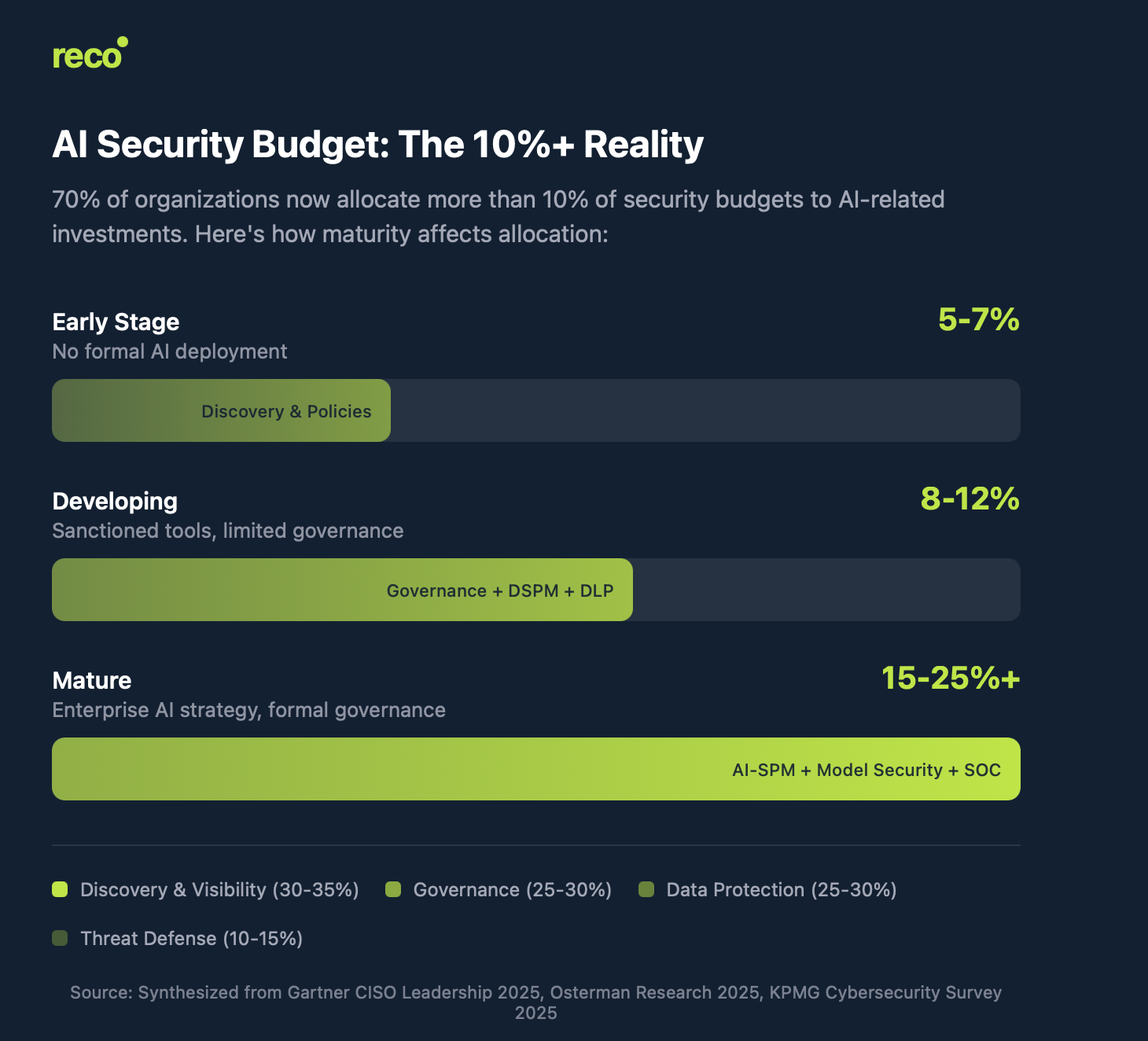
Based on 2025-2026 research across CISO surveys, budget benchmarks, and investment priorities, 70% of organizations now dedicate more than 10% of their security budgets to AI-related investments. Here's how maturity affects that allocation:
Source: Synthesized from Gartner CISO Leadership Perspectives 2025, Osterman Research 2025, KPMG Cybersecurity Survey 2025
The reason for this range: AI security isn't a single budget line. It spans discovery (what AI tools exist), governance (policies and controls), data protection (preventing leakage), and threat defense (AI-powered attacks).
Here's what budget benchmarks miss: shadow AI exposure varies wildly between organizations.

The average enterprise has 71% of employees using unauthorized AI tools, with an average of 400+ days before these tools are discovered (Reco 2025 State of Shadow AI Report). Organizations with high shadow AI exposure face $670,000 in additional breach costs (IBM 2025).
If your organization has minimal shadow AI (strong DLP, limited SaaS adoption, technical workforce), 5% might be sufficient. If you're a mid-market company with rapid SaaS growth and no AI governance, 15% might not be enough.
Industry frameworks recommend allocating 30-35% to discovery, 25-30% to governance, 25-30% to data protection, and 10-15% to threat defense. Most organizations do the opposite: they over-invest in threat defense (the visible, vendor-marketed category) while under-investing in discovery (the foundation everything else depends on).
Here's why that's backwards: You can't govern what you haven't discovered. You can't protect data flowing to tools you don't know exist. You can't defend against threats from applications outside your visibility. Organizations spending 40% on AI threat detection while allocating 10% to discovery are building sophisticated defenses around 30% of their actual attack surface.
The uncomfortable truth: if you can't answer "how many AI tools are active in my environment right now?" then your AI security budget allocation is almost certainly wrong, regardless of the total percentage.
Instead of copying competitors, calculate your AI security budget based on four exposure factors:
Factor 1: AI Tool Proliferation Count known AI tools. Multiply by 3x for estimated shadow AI (conservative based on discovery data). Each tool represents potential data exposure requiring governance.
Factor 2: Data Sensitivity What data do employees have access to? Customer PII, financial data, and health records require stronger AI controls than general business data.
Factor 3: Current Detection Gap How quickly can you detect unauthorized AI usage? Organizations relying on quarterly reviews face 90-day exposure windows. Real-time monitoring closes this to hours.
Factor 4: Regulatory Environment EU AI Act compliance, GDPR implications for AI-processed data, and industry-specific requirements (HIPAA, SOX) drive mandatory investments regardless of risk appetite.
If you're allocating 10% of your security budget to AI security, here's how to distribute it based on 2025-2026 investment priorities:
When presenting AI security budget requests, frame around three metrics boards understand:
Traditional security tools weren't built for AI sprawl. Static SSPM reviews SaaS configurations quarterly. AI governance platforms audit models you build internally.
Neither catches the AI tools employees adopt weekly without security approval.
Reco's approach spans discovery, governance, and protection across both traditional SaaS and AI tools. The Knowledge Graph maps connections between users, apps, and data in real-time, catching what quarterly reviews miss. When a new AI tool appears (and they appear constantly), Reco detects it through OAuth connections, behavioral patterns, and SaaS-to-SaaS data flows.
This isn't about replacing existing investments. It's about closing the gap between what you protect and what's already bypassing your defenses.
The Real Question Isn't "How Much" but "Where"
The percentage debate is a distraction. Two organizations can both allocate 12% to AI security and end up in completely different positions: one with comprehensive visibility and governance, the other with expensive threat detection tools watching a fraction of their actual AI footprint.
10-15% is a defensible baseline. 15-25%+ makes sense for mature AI adopters. But the allocation matters more than the total.
Before your next budget cycle, answer three questions:
The organizations that get AI security budgeting right in 2026 won't be the ones who copied the "correct" percentage. They'll be the ones who invested in visibility first, then built governance and protection on a foundation of knowing what actually exists in their environment.

%201.svg)
Gal is the Cofounder & CPO of Reco. Gal is a former Lieutenant Colonel in the Israeli Prime Minister's Office. He is a tech enthusiast, with a background of Security Researcher and Hacker. Gal has led teams in multiple cybersecurity areas with an expertise in the human element.


%201.svg)


.svg)