

LLM Security: How to Govern AI Tools, Agents & Data Exposure


What Is LLM Security?
LLM security is the set of practices, policies, and technologies used to protect large language models and the applications, data, identities, integrations, and AI agents connected to them. Unlike traditional application security, LLM security addresses risks created by natural language inputs, model outputs, third-party integrations, and AI agents with access to enterprise systems. It helps organizations reduce sensitive data exposure, excessive access, manipulation, and unauthorized actions as AI adoption scales.
LLM Security vs. AI Security
Why AI Tool and Agent Sprawl Creates Blind Spots for Security Teams
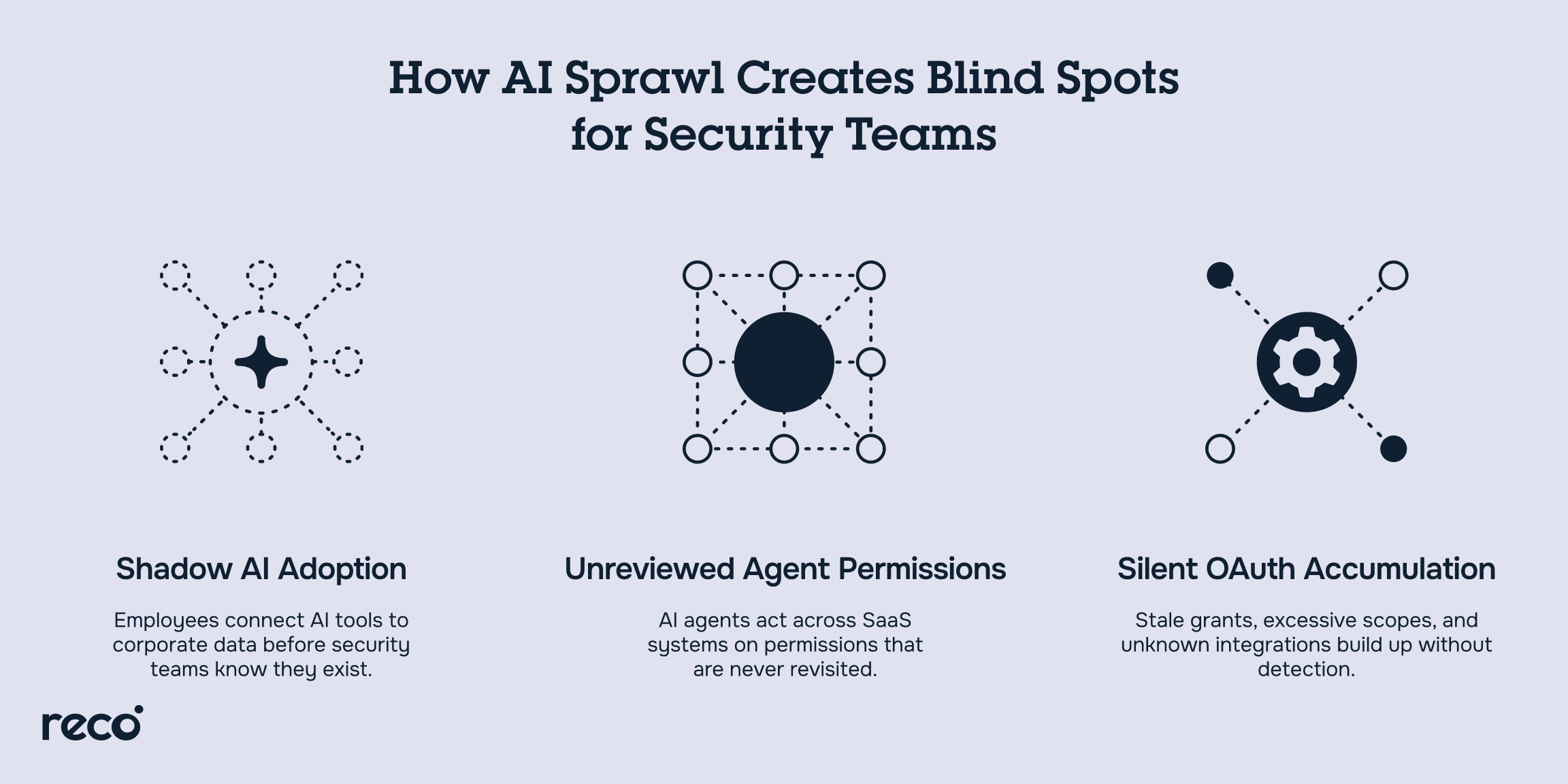
AI tools and agents can enter the enterprise faster than security teams can discover and assess them. The result is an expanding layer of applications, identities, permissions, and data connections outside established governance processes.
How Quickly AI Applications Are Adopted Outside Procurement
Employees can adopt AI tools in minutes through free accounts, browser extensions, and "Sign in with Google" workflows. Many of these applications reach corporate email, files, calendars, source code, or customer data before security teams know they exist. Procurement and security reviews depend on applications entering formal approval processes. Shadow AI bypasses those controls, leaving security teams with incomplete application inventories and no reliable view of where business data is flowing.
AI Agents Operating With Permissions Security Teams Never Reviewed
AI agents increase the risk because they can act on enterprise systems, not just process information. Depending on their access, an agent may read records, send messages, modify files, update tickets, or trigger workflows across multiple SaaS applications. Microsoft's 2026 Work Trend Index found that active agents across the Microsoft 365 ecosystem grew 15 times year over year, a figure that climbs to 18 times at large enterprises.
Those actions may rely on permissions granted once and never reviewed again. As an agent's role expands, its access can remain excessive or extend beyond its original purpose without triggering traditional identity governance controls.
OAuth Grants and Shadow AI Connections That Accumulate Silently
AI tools and agents often connect to SaaS applications through OAuth grants, API credentials, service accounts, and other persistent identities. These connections can retain access long after the user, project, or workflow that created them has changed.
Without continuous discovery and monitoring, stale grants, excessive scopes, and unknown integrations accumulate. Each one creates another potential path to sensitive data, and another identity or connection security teams must govern.
LLM Security Risks in the SaaS and Identity Layer
LLM security risks do not stop at the model. Once AI tools and agents connect to SaaS applications, sensitive data, permissions, and integrations create an additional attack surface that security teams must discover and govern.
OWASP Top 10 for LLM Applications
The OWASP Top 10 for LLM and GenAI Applications identifies critical security risks affecting LLM-powered systems. The 2025 framework helps security teams prioritize controls across models, applications, data, integrations, and AI agents.
- LLM01. Prompt Injection: Attackers manipulate direct prompts or external content processed by an LLM to override instructions, expose data, or trigger unintended actions.
- LLM02. Sensitive Information Disclosure: LLM applications can expose personal data, credentials, proprietary information, or other sensitive content through model outputs and connected workflows.
- LLM03. Supply Chain: Vulnerabilities in third-party models, datasets, libraries, plugins, and services can compromise LLM applications and the enterprise systems connected to them.
- LLM04. Data and Model Poisoning: Manipulated training, fine-tuning, or retrieval data can introduce biases, vulnerabilities, backdoors, and other unwanted model behaviors.
- LLM05. Improper Output Handling: Passing LLM-generated content to downstream systems without validation or sanitization can enable cross-site scripting (XSS), code execution, and other attacks.
- LLM06. Excessive Agency: LLM applications and agents with excessive functionality, permissions, or autonomy can perform damaging actions beyond what is required for their intended tasks.
- LLM07. System Prompt Leakage: Exposed system prompts can reveal sensitive instructions, application logic, security controls, or other information useful to attackers.
- LLM08. Vector and Embedding Weaknesses: Weaknesses in retrieval-augmented generation (RAG) systems and vector databases can allow unauthorized data access, poisoned content retrieval, and manipulation of model outputs.
- LLM09. Misinformation: LLMs can generate false or misleading information that users or downstream systems may trust, creating security, operational, legal, and reputational risks.
- LLM10. Unbounded Consumption: Uncontrolled prompts, inference requests, and resource-intensive operations can enable denial-of-service conditions, high costs, and theft of model functionality.
Steps to Build an LLM Security Strategy
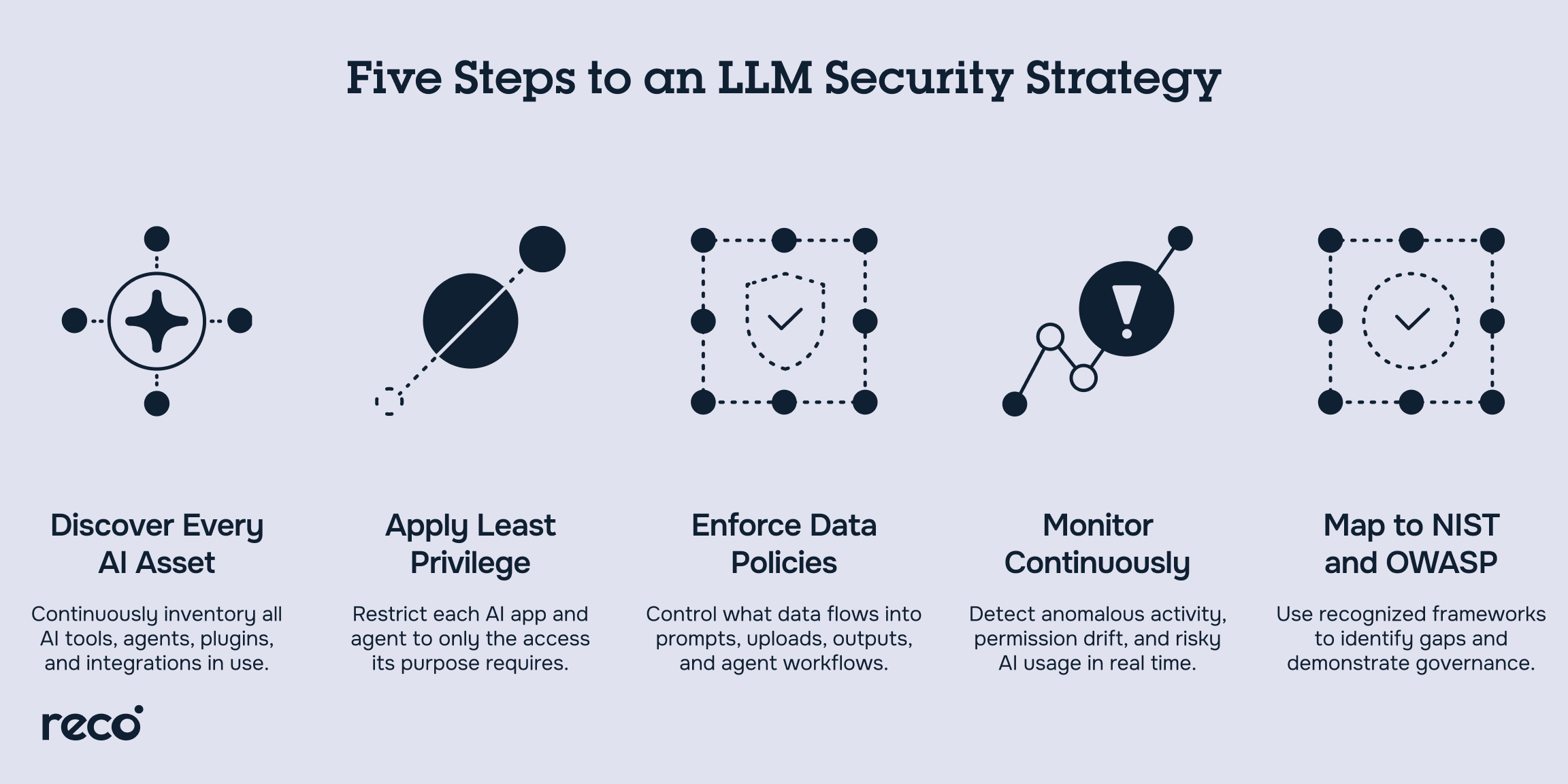
An effective LLM security strategy starts with visibility and extends through access governance, data protection, continuous monitoring, and alignment with recognized security frameworks.
1. Discover Every AI Tool and Agent in Use
Maintain a current inventory of AI applications, browser extensions, plugins, agents, and integrations across the organization, including tools adopted outside procurement. Discovery must be continuous. New AI applications can enter the environment through OAuth grants, user sign-ups, and third-party integrations without triggering traditional security reviews.
2. Apply Least-Privilege Access to AI Applications
Limit each AI application and agent to the data, systems, and actions required for its intended purpose. Review OAuth scopes, API permissions, service accounts, and other identities for unnecessary or persistent access. Treat AI agents as non-human identities with defined owners, access policies, and recurring permission reviews. Revoke unused connections and reduce excessive privileges as applications and workflows change.
3. Enforce Data Protection Policies Across AI Workflows
Define which data employees and agents can send to LLM applications and how sensitive information can be processed, stored, retrieved, and shared. Enforce those policies across prompts, uploads, model outputs, connected data sources, and agent workflows. Use data classification, exposure monitoring, input and output controls, and restrictions on high-risk applications rather than relying on employee judgment alone.
4. Monitor AI Activity and User Behavior Continuously
Monitor how users, applications, and agents access data and interact with connected systems. Look for anomalous activity, unexpected permission changes, unusual data access, and sensitive information moving into unapproved AI tools. Continuous monitoring helps security teams detect permission drift, compromised identities, and risky AI usage before they lead to broader data exposure.
5. Map Controls to NIST AI RMF and OWASP LLM Top 10
Map LLM security controls to established frameworks to identify coverage gaps, prioritize improvements, and demonstrate governance. Use the NIST AI Risk Management Framework to structure AI risk management across the Govern, Map, Measure, and Manage functions. Map technical controls to the OWASP Top 10 for LLM Applications to address risks such as prompt injection, sensitive information disclosure, excessive agency, and supply chain vulnerabilities.

Gal Nakash
Cofounder & CPO at Reco

Gal is the Cofounder & CPO of Reco. Gal is a former Lieutenant Colonel in the Israeli Prime Minister's Office. He is a tech enthusiast, with a background of Security Researcher and Hacker. Gal has led teams in multiple cybersecurity areas with an expertise in the human element.

Expert Insight: Prioritize AI Risk Paths, Not Individual Findings
In my experience, one of the biggest mistakes security teams make is treating every discovered AI application, agent, or OAuth grant as an isolated finding. Large environments quickly generate more issues than teams can investigate manually, so prioritization should focus on combinations of risk.
Start with AI tools and agents that:
- Have broad permissions or high-risk OAuth scopes
- Can access sensitive or business-critical data
- Show unusual activity or access patterns
- Lack a clear owner or business purpose
- Retain permissions despite little or no recent usage
An unknown AI application is worth investigating, but an unknown application with persistent access to sensitive data and suspicious activity deserves immediate attention.
The key is to evaluate the full risk path across applications, identities, permissions, activity, and data exposure rather than prioritizing findings based on a single risk signal.
LLM Security Best Practices
LLM security requires continuous governance as AI applications, agents, permissions, and data connections change. These practices help security and IT teams maintain visibility and reduce exposure as AI adoption scales.
How Reco Secures LLM Tool and Agent Usage Across the Business
Reco helps security teams discover AI applications and agents, govern their access, and identify data exposure across the SaaS environment. Continuous monitoring and risk prioritization extend those controls as AI usage changes.
- Generative AI Discovery Across 260+ Apps and Agents: Reco continuously discovers generative AI applications, browser extensions, and agents connected to the SaaS environment, with coverage spanning more than 260 AI applications and agents. As new tools emerge, Reco Factory accelerates support for new applications and integrations, helping security teams maintain visibility as AI adoption expands.
- Shadow AI Detection and Governance: Reco identifies sanctioned, unsanctioned, and unknown AI applications and evaluates their connections to users, business systems, and sensitive data. Using SaaS posture management and compliance capabilities, security teams can investigate shadow AI alongside other SaaS risks and apply governance policies based on application access and exposure.
- Identity and Access Governance Across AI Tools: Reco provides visibility into AI agents, OAuth grants, service accounts, and other non-human identities connected to SaaS applications. Through identity and access governance, security teams can identify excessive permissions, stale access, and gaps between an agent's intended purpose and its actual privileges, then reduce access or revoke unnecessary connections.
- Data Exposure Management for LLM-Connected Apps: Reco's data exposure management maps sensitive data across connected SaaS applications and identifies where AI tools and agents can access information beyond what their business purpose requires. This context helps security teams prioritize excessive access to sensitive data instead of evaluating application permissions in isolation.
- Reco Graph Prioritization of AI-Related Risk Paths: Reco's Graph connects applications, identities, permissions, activity, and data to provide context around AI-related risks. By identifying risk paths that combine sensitive data exposure, excessive access, and suspicious behavior, the platform’s identity threat detection and response capabilities help security teams prioritize findings with the greatest potential impact.
- 1,000+ Pre-Built Detections for AI Tool Threats and Policy Violations: Reco provides 1,000+ pre-built detections for SaaS threats and policy violations, including risks involving AI applications, identities, permissions, and suspicious activity. These detections continuously analyze SaaS activity and access context, helping security teams identify risky behavior without building and maintaining detection logic from scratch.
Conclusion
LLM security becomes harder as AI tools gain access to more applications, data, and business processes. Security teams need continuous visibility into which tools and agents are connected, what they can access, and how that access changes over time. As AI agents become more autonomous, governing their identities, permissions, and data exposure will become a core part of enterprise security. Organizations that extend existing SaaS security controls to the AI layer will be better positioned to adopt LLM applications without allowing new access paths and security blind spots to scale with them.
FAQs
What compliance frameworks apply to enterprise use of large language model applications?
Enterprise LLM use may be subject to the NIST AI Risk Management Framework (AI RMF), ISO/IEC 42001, GDPR, HIPAA, and other industry- or region-specific requirements. Security teams can also use the OWASP Top 10 for LLM Applications to identify technical risks such as prompt injection, sensitive information disclosure, and excessive agency.
How does Reco help security teams govern AI agent and tool usage without disrupting productivity?
Reco provides continuous visibility into AI applications, agents, identities, and data access so security teams can govern risky usage without relying on blanket restrictions.
- Discover sanctioned, unsanctioned, and unknown AI applications across the SaaS environment.
- Identify excessive permissions, stale OAuth grants, and risky non-human identities.
- Prioritize AI-related risks based on access to sensitive data and observed activity.
Learn more about Reco's application discovery capabilities.
What makes AI agents different from traditional SaaS applications for access governance?
AI agents can retain persistent permissions, access data, invoke tools, and perform actions across connected SaaS applications. This requires security teams to govern them as non-human identities rather than treating them only as software integrations.
- Assign every AI agent a defined owner and business purpose.
- Apply least-privilege access based on the agent's required tasks.
- Continuously monitor permissions, OAuth grants, and activity for access drift.
- Revoke unnecessary access when an agent or workflow is no longer required.
Tal Shapira


%201.svg)
ABOUT THE AUTHOR
Tal is the Cofounder & CTO of Reco. Tal has a Ph.D. from the school of Electrical Engineering at Tel Aviv University, where his research focused on deep learning, computer networks, and cybersecurity. Tal is a graduate of the Talpiot Excellence Program, and a former head of a cybersecurity R&D group within the Israeli Prime Minister's Office. In addition to serving as the CTO, Tal is a member of the AI Controls Security Working Group with the Cloud Security Alliance.