


What Claude Mythos Found: AI Vulnerability Discovery Explained

What Claude Mythos's Vulnerability Discovery Revealed
Claude Mythos, now in its fifth iteration as Claude Mythos 5, marked a turning point in AI-driven security research. In its initial Project Glasswing update, Anthropic disclosed that Claude Mythos Preview and roughly 50 partners surfaced more than 10,000 high- or critical-severity vulnerabilities across the world's most systemically important software, while the model also developed working exploits for many of the flaws it uncovered
The significance extends beyond the vulnerabilities themselves. Mythos showed that AI can now perform vulnerability discovery at a scale and speed that traditional security processes were never built to handle. For security teams, the challenge is no longer finding weaknesses. It is validating, prioritizing, and remediating them before they become exploitable attack paths.
Why AI-Scale Discovery Changes How Security Teams Must Operate
Claude Mythos demonstrated that vulnerability discovery is entering a new era. As AI systems identify security weaknesses autonomously and at scale, security teams must adapt to a reality where the volume and velocity of findings can outpace traditional security operations.
- Speed Gap Between Human and AI Detection Cycles: AI can identify vulnerabilities in hours or days, while validation, prioritization, remediation, and patch deployment often take weeks or months. As discovery accelerates, security teams face growing pressure to close the gap between identifying and addressing risk.
- Surge in Security Findings Across Modern Systems: AI-driven discovery can uncover vulnerabilities across cloud infrastructure, SaaS applications, open source dependencies, operating systems, and browsers at unprecedented scale. This increase in findings can overwhelm teams that still rely on manual triage and fragmented workflows.
- Shift From Static CVE Tracking to Dynamic Risk Prioritization: Traditional vulnerability management often focuses on CVE severity scores. However, AI-scale discovery requires a more contextual approach that considers exploitability, asset criticality, identity exposure, data sensitivity, and potential attack paths when determining remediation priorities.
- Validation Challenges for AI-Generated Security Findings: While AI can significantly accelerate vulnerability discovery, organizations still need processes to validate findings and assess their real-world impact. Security teams must separate exploitable risks from lower-priority issues and focus resources on exposures that pose the greatest threat to the business.

What SaaS Environments Expose to AI-Scale Vulnerability Discovery
While Mythos focused on software vulnerabilities, the same discovery capability applied to SaaS environments would surface a different class of weakness: misconfigured identities, overpermissioned integrations, and drift across critical apps. The table below maps the most common exposure areas to the risks they create.
Why Traditional Security Tools Cannot Keep Pace With AI-Scale Discovery
The security industry has spent decades building tools to help teams identify and manage vulnerabilities. However, most of these tools were designed for a world where discovery occurred at the human scale. As AI accelerates vulnerability identification, many existing security workflows struggle to keep pace with the volume, complexity, and speed of new findings.
Alert Overload From High-Volume Security Findings
Most organizations already process findings from vulnerability scanners, cloud security tools, identity platforms, and threat detection systems. AI-powered discovery can significantly increase that volume, creating more alerts than security teams can realistically investigate. Without automated prioritization, important findings risk being buried among thousands of lower-value alerts.
Lack of Context for Effective Risk Prioritization
Traditional tools typically evaluate vulnerabilities in isolation, focusing on severity scores and technical characteristics. However, a critical vulnerability does not always represent the greatest business risk, which is why federal guidance now emphasizes risk-based prioritization over raw severity scores. Security teams need context around identity exposure, data sensitivity, asset criticality, and potential attack paths to determine which findings require immediate action.
Slow Manual Validation and Remediation Workflows
Finding a vulnerability is only the first step. Teams must still validate findings, identify affected systems, assign ownership, coordinate remediation, and verify fixes. These activities often rely on manual processes that cannot scale at the same pace as AI-driven discovery, creating growing remediation backlogs.
Fragmented Tooling Across Enterprise Environments
Many organizations manage security through dozens of disconnected tools spanning cloud security, SaaS security, identity management, vulnerability scanning, and threat detection. As AI-generated findings increase, fragmented visibility makes it difficult to correlate risks, understand exposure across environments, and prioritize remediation efforts effectively.
From Vulnerability Discovery to SaaS Exposure Management
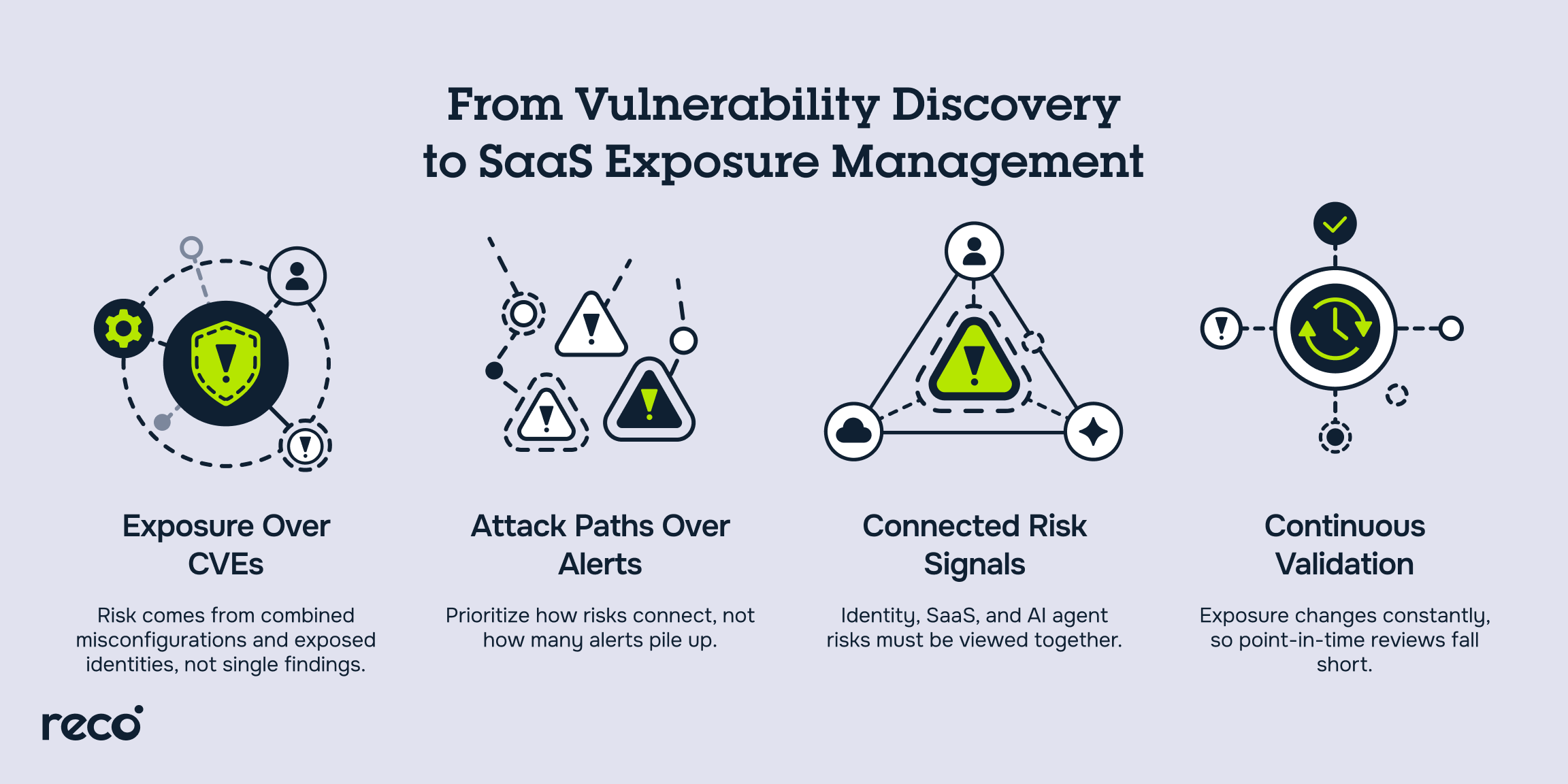
Claude Mythos highlighted a growing reality: discovering vulnerabilities is becoming easier than managing them. As AI accelerates the identification of security weaknesses, organizations must shift their focus from tracking individual findings to understanding how those findings contribute to overall exposure across identities, applications, data, and AI agents.
- Shift From CVE Lists to Exposure-Based Security Models: Traditional vulnerability management centers on CVEs and individual findings. Security teams increasingly need visibility into how vulnerabilities, misconfigurations, excessive permissions, and exposed identities combine to create organizational risk. Exposure-based security models provide a broader view of how attackers can move through interconnected environments.
- Prioritizing Real Attack Paths Instead of Raw Alerts: Not every finding presents a meaningful threat. Security teams must understand how vulnerabilities connect to internet-facing assets, privileged identities, sensitive data, and critical business applications, since attackers move laterally through connected identities and applications rather than stopping at a single flaw. Focusing on attack paths rather than alert volume helps organizations prioritize the exposures most likely to lead to compromise.
- Connecting Identity, SaaS, and AI Agent Risk Signals: Modern attacks rarely originate from a single weakness. Risk often emerges from the combination of excessive permissions, unmanaged SaaS applications, third-party integrations, exposed data, and AI agents. Bringing these signals together provides a more accurate picture of organizational exposure than evaluating each finding independently.
- Continuous Validation Instead of Point-in-Time Assessments: Traditional security assessments provide snapshots of risk at a specific moment. Yet SaaS environments, identities, integrations, and AI agents change continuously. Organizations need ongoing validation of security controls and exposure conditions to identify new risks as they emerge rather than waiting for periodic reviews.
How to Close SaaS Exposure Before AI Finds It First
As AI-powered discovery becomes more effective, organizations must focus on reducing exposure before vulnerabilities, misconfigurations, and identity risks become exploitable. The following practices can help security teams strengthen SaaS security posture and reduce attack opportunities.
How Reco Reduces the SaaS Exposure That Mythos-Class AI Is Built to Find
As AI-powered vulnerability discovery continues to accelerate, organizations need more than visibility into individual findings. Reco's approach to Agentic Ecosystem Security treats exposure, not the individual finding, as the unit of risk, giving security teams continuous insight into how identities, applications, data, and AI agents combine into attack opportunities across the SaaS environment.
- Agentic Posture Management Across the Full Agent Fleet: Reco continuously tracks permissions, ownership, and activity across every autonomous agent through agentic posture management. Security teams can see which agents exist, what each one can reach, and when its behavior drifts from policy, before that drift becomes an incident.
- Unified Discovery Across 235+ Apps and Every Agent: Reco discovers every connected application, AI agent, service account, and third-party integration across the environment through continuous application discovery. Security teams get a live inventory of every app, agent, and OAuth connection, including the ones employees connected without IT's knowledge.
- Browser Guard and MCP Discovery for Shadow Access: Reco's browser guard and MCP discovery extend coverage to shadow apps that bypass IAM and to agents operating outside identity provider visibility, closing the exposure that central authentication never sees.
- Data Exposure Management Before It Becomes an Attack Path: Many security incidents originate from excessive access to sensitive information rather than software vulnerabilities alone. Reco's data exposure management capabilities help identify exposed data, risky sharing configurations, and permission issues before they contribute to broader security incidents.
- Knowledge Graph Prioritization of Real Attack Paths: Rather than evaluating findings in isolation, Reco correlates identity, application, and exposure signals to identify attack paths that create meaningful organizational risk. This context helps security teams focus on the exposures most likely to lead to compromise instead of spending time on disconnected alerts.
Conclusion
Claude Mythos proved that AI can find vulnerabilities faster than organizations can manage them, and that gap is the real problem. The constraint was never discovery. It was knowing which findings matter, where exposure actually exists, and how individual weaknesses combine into paths an attacker can walk. AI-scale discovery widens that gap with every new finding it surfaces.
This is why the security question is shifting from how many vulnerabilities exist to how much exposure they create. Vulnerability lists, severity scores, and point-in-time assessments describe risk one finding at a time, while attackers move through the connections between identities, SaaS applications, integrations, AI agents, and data. Closing that distance requires continuous visibility into how those elements interact and which combinations create a real path to compromise.
Organizations that treat exposure as the unit of measurement, rather than the individual vulnerability, will prioritize what matters, shrink their attack surface, and stay ahead of AI-driven discovery before adversaries turn the same capability against them.
FAQs
What is Claude Mythos and why does it matter for enterprise SaaS security?
Claude Mythos Preview is an Anthropic frontier model that autonomously discovered thousands of previously unknown vulnerabilities across major operating systems, browsers, and open-source software projects. It matters for SaaS security because it demonstrated that AI can find weaknesses faster than organizations can manage them.
Key implications for enterprise teams include:
- Discovery is no longer the bottleneck. Validation, prioritization, and remediation are.
- The findings that matter most are the ones that connect into real attack paths.
- SaaS environments contain exactly the kind of identity and configuration exposure that AI is designed to uncover.
- Exposure management becomes increasingly important as AI-driven discovery scales.
How does AI-scale vulnerability discovery differ from traditional CVE scanning?
Traditional CVE scanning checks systems against a known list of disclosed vulnerabilities. AI-scale discovery identifies flaws that have never appeared on a CVE list, at a volume and speed that manual processes were never designed to handle.
Key differences include:
- CVE scanning is retrospective, while AI discovery can surface previously unknown weaknesses.
- Scanners produce ranked severity scores, while AI-scale findings require risk-based prioritization and validation.
- Manual triage typically handles hundreds of findings, while AI discovery can generate thousands.
- Discovery can occur continuously rather than waiting for public disclosure.
What types of SaaS exposures are most likely to be targeted by AI-assisted attackers?
AI-assisted attackers look for the same high-value, low-effort weaknesses that automated discovery can identify quickly. In SaaS environments, these exposures often center on identities, permissions, and integrations.
Common targets include:
- Overpermissioned accounts, orphaned identities, and privilege escalation paths.
- Excessive OAuth scopes and unmanaged service accounts tied to third-party integrations.
- Shadow AI tools and unsanctioned SaaS connections that expand the attack surface.
- Configuration drift that quietly weakens security controls.
How does Reco help security teams manage SaaS and identity exposure before it is exploited?
Reco provides continuous visibility into identities, applications, data exposure, and AI agents across the SaaS environment, then correlates those signals to identify the exposures that create meaningful attack paths.
Reco helps security teams by:
- Discovering every application, agent, and integration so that unmanaged assets do not create blind spots through application discovery
- Detecting identity threats and risky access patterns in real time with identity threat detection and response
- Surfacing exposed data before it contributes to broader security incidents through data exposure management
- Extending coverage quickly as new SaaS applications and AI-driven workflows are adopted, via the SaaS App Factory
What is the difference between vulnerability discovery and exposure management, and why does it matter?
Vulnerability discovery identifies individual weaknesses. Exposure management focuses on how those weaknesses combine with identities, permissions, configurations, and sensitive data to create attack paths that adversaries can actually exploit.
The distinction matters because:
- Discovery answers what is wrong, while exposure management answers what is reachable and worth fixing first.
- Severity scores rank findings in isolation, while exposure management connects them into attack paths.
- Point-in-time scans become outdated quickly, while exposure management is continuous.
- Exposure-based prioritization helps security teams focus on the risks most likely to lead to compromise.
Gal Nakash


%201.svg)
ABOUT THE AUTHOR
Gal is the Cofounder & CPO of Reco. Gal is a former Lieutenant Colonel in the Israeli Prime Minister's Office. He is a tech enthusiast, with a background of Security Researcher and Hacker. Gal has led teams in multiple cybersecurity areas with an expertise in the human element.


%201.svg)


.svg)