


AI Governance vs. AI Security: What Is the Difference and Why Enterprises Need Both

What Is AI Governance?
AI governance is the set of policies, roles, and oversight processes that guide how an organization develops, adopts, and uses AI. It defines which AI tools and agents are approved, what data they can access, who is accountable for their outcomes, and how the organization assesses risks, ethical standards, and legal obligations. A mature governance program, such as one aligned with the NIST AI Risk Management Framework, keeps an inventory of AI systems, assigns owners, documents decisions, and reviews systems as their uses and risks change.
What Is AI Security?
AI security is the set of technical controls and monitoring practices that protect AI systems, the data they handle, and the identities they use from misuse, manipulation, and compromise. It addresses threats catalogued in the OWASP Top 10 for LLM Applications, such as prompt injection, data and model poisoning, sensitive data exposure, agent compromise, and excessive agent permissions. An effective security program limits what agents can access and do, monitors their activity, and responds when suspicious behavior is detected.
AI Governance vs AI Security: Key Differences
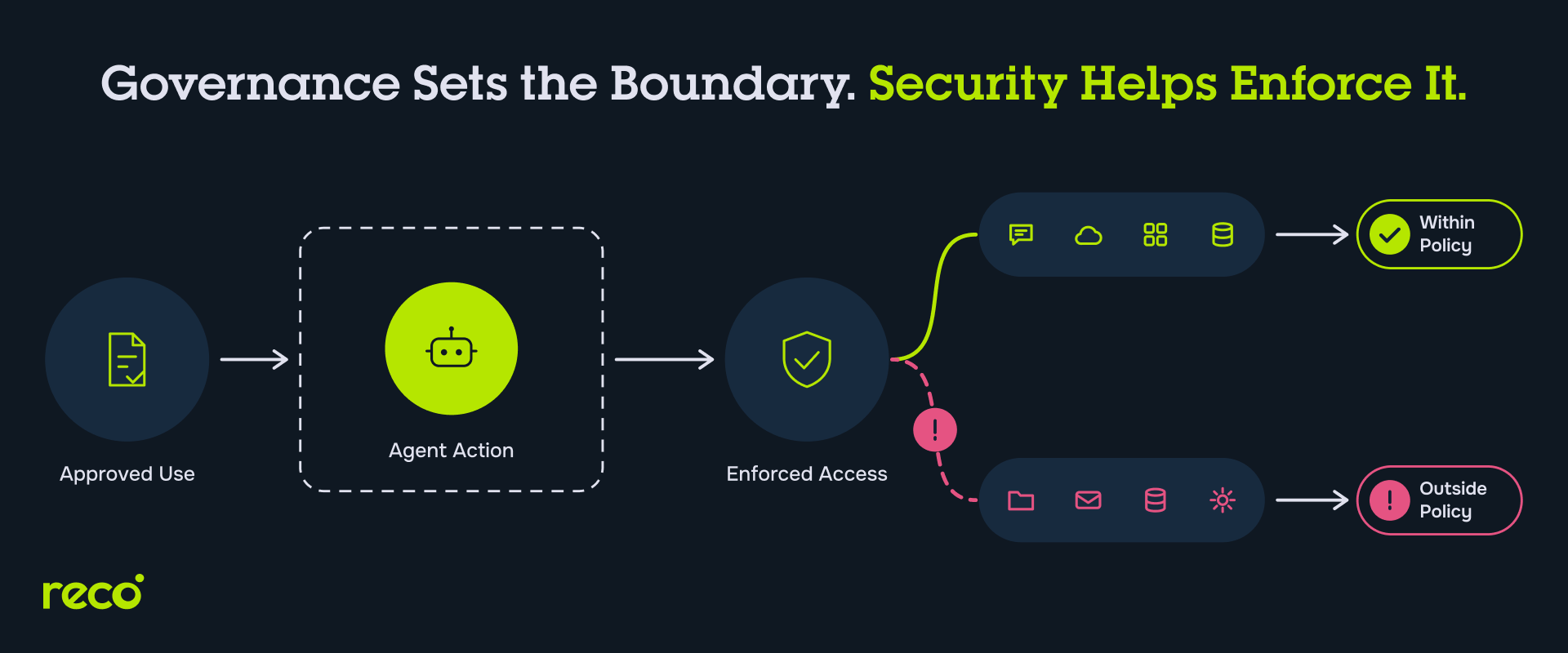
AI governance and AI security both help organizations use AI responsibly. Governance establishes which uses are acceptable and who is accountable for them, while security protects the systems and data involved and enforces those decisions through technical controls.
- Governance Sets Rules, Security Helps Enforce Them: Governance defines which agents are approved, which data they may access, and who authorizes new deployments. Security teams translate those decisions into permissions, access checks, monitoring, and incident response. For example, a policy prohibiting an agent from reading customer financial records needs an access control on the relevant data source to be effective.
- Governance Alone Cannot Detect Prompt Injection or Agent Compromise: An agent can be approved for a legitimate task and later encounter malicious instructions in an email, document, or web page. Governance establishes ownership and procedures for managing that risk. Technical safeguards and monitoring help prevent unauthorized actions and identify suspicious behavior, though they cannot catch every attack.
- Security Alone Cannot Determine Whether an AI Use Is Ethical or Lawful: An agent screening job applicants could operate with valid credentials while using inappropriate criteria. An agent could also process personal data without an applicable legal basis under the GDPR. Access controls and threat alerts cannot make those judgments on their own. The organization needs governance processes to assess the purpose, impact, and legal requirements of each use case.
- Gaps Between the Two Programs Create Significant Risk: An agent might be adopted without review, retain permissions after its role changes, or generate a security finding that never reaches its owner. A shared inventory, clear ownership, and a process for acting on findings help governance and security teams address those gaps.
Where AI Governance and AI Security Overlap
AI governance and AI security answer different questions, but they often rely on the same information. An agent inventory, access records, and activity logs help teams make approval decisions, investigate threats, and demonstrate how they manage AI systems.
Where AI Governance Falls Short Without Security
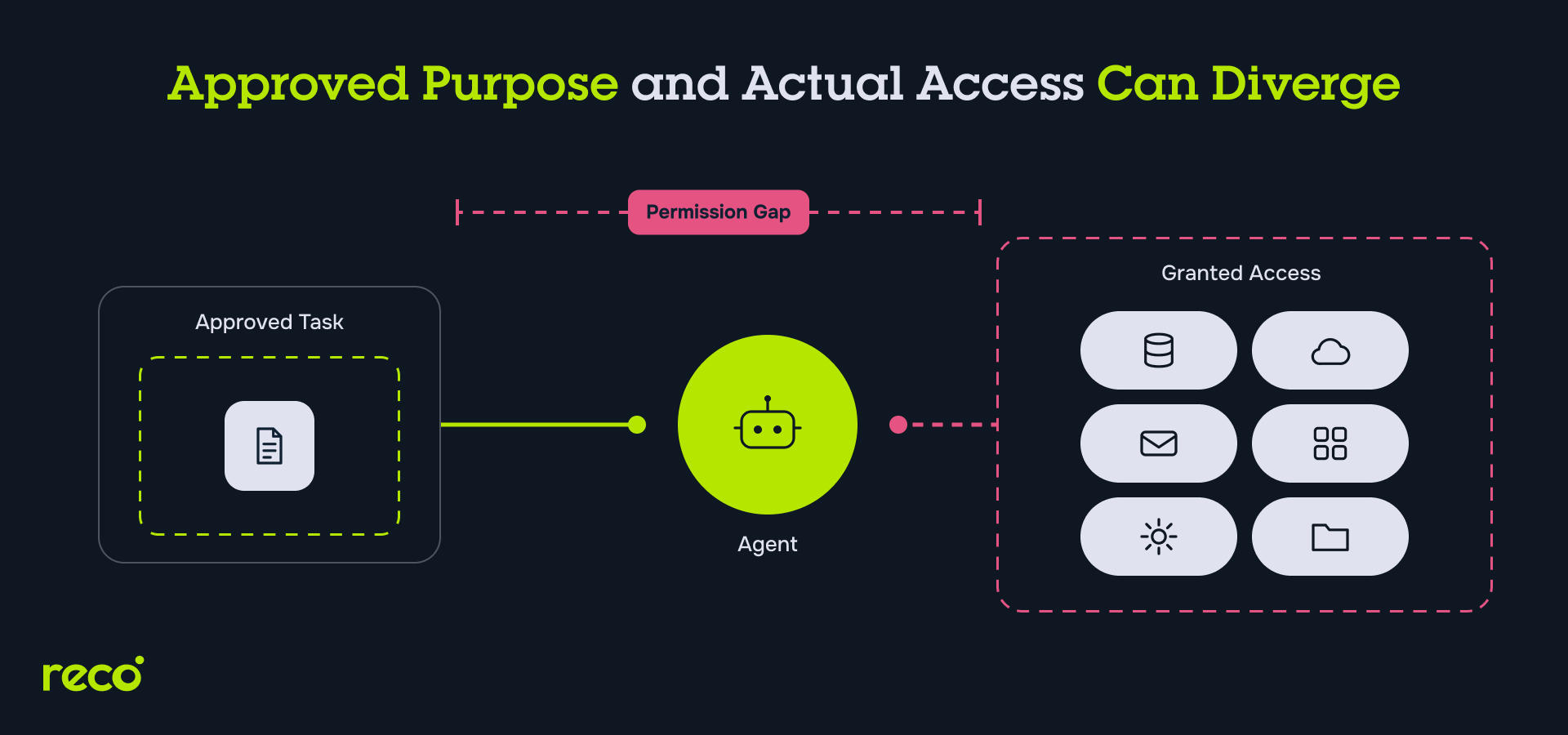
Governance defines how AI should be used, and technical controls and monitoring help teams check whether agents operate within those rules. Without them, an agent's permissions may differ from its approved purpose.
- Policies Need Technical Enforcement: A policy may require least privilege, but an agent can still receive broad permissions when it connects to a data source. An agent approved to summarize incoming email, for example, might receive the full Gmail scope https://mail.google.com/. That scope permits reading, sending, and permanently deleting messages. The narrower gmail.readonly scope, listed in Google's Gmail API scope documentation, supports reading without granting those additional actions. Security teams need to compare granted permissions with the agent's approved task and reduce access where necessary.
- Shadow Agents Can Bypass Review: Employees may create agents or connect external AI tools to company data through agent builders and OAuth consent flows. Whether they can do so without administrator approval depends on the organization's settings and the permissions requested. Discovery gives governance and security teams a way to identify these connections and decide whether to approve, restrict, or remove them.
- Ownership Needs to Be Traceable in Activity Records: Assigning an agent an owner is less useful if its actions appear only under a shared account or a user's delegated credentials. Investigators may struggle to tell which agent acted. Where possible, teams should use distinct agent identities or retain logs that link actions to the agent, its credentials, and its named owner.
- Agent Changes Need Timely Review: An agent can gain new tools or permissions, receive updated instructions, or switch models after its initial approval. Monitoring the configurations and activity that the organization can observe helps teams flag material changes and trigger another review, rather than waiting for the next scheduled assessment.
Where AI Security Misses Without Governance Context
Security teams can detect activity and enforce controls, but they need governance decisions to know which uses are approved and which actions fall outside an agent's intended role. Without that context, an alert may be difficult to interpret, and a control may be applied to the wrong activity.

Gal Nakash
Cofounder & CPO at Reco

Gal is the Cofounder & CPO of Reco. Gal is a former Lieutenant Colonel in the Israeli Prime Minister's Office. He is a tech enthusiast, with a background of Security Researcher and Hacker. Gal has led teams in multiple cybersecurity areas with an expertise in the human element.

Expert Insight: Keeping Agent Approvals Accurate After Deployment
Most agent risk I see builds after approval, when an agent's access, owner, or tools change, and nobody links that change back to the original decision. In my experience, these practices close the gap.
- Record Approved Scopes at Approval: Store the exact OAuth scopes approved, so later drift becomes a simple comparison.
- Give Every Agent Its Own Identity: Agents on a person's delegated token blur audit logs and outlive that person's offboarding.
- Link Agent Ownership to HR Events: When an owner leaves or changes roles, review every agent they own.
- Treat New Connections as New Deployments: Each new tool or system changes an agent's risk and deserves the same review.
- Put the Policy Owner in the Alert: Findings that name the policy and owner reach someone who can act.
Key Takeaway: Every agent alert should lead straight to who approved it, for what, and whether that still holds.
How Reco Unifies AI Governance and Security Across Your Agent Ecosystem
Reco brings agent discovery, access information, activity, and security findings into a shared view. Governance and security teams can use that context to review agents, investigate risks, and track changes across connected systems.
- Discovers Every Agent, Tool, and Integration: Reco's application discovery uses signals including SSO logs, OAuth integrations, and behavioral analysis to identify AI tools, agents, and third-party integrations. Teams can review discovered tools against their approved inventory and investigate unfamiliar connections.
- Reco Graph Maps Every Agent, Permission, and Connection: Reco Graph connects information about identities, permissions, integrations, and activity. This helps teams investigate access paths that could expose sensitive data, including agents with broad permissions and connections to other systems.
- Enforces Least-Privilege Across Human and Agent Identities: Reco's identity and access governance identifies risky permissions across connected systems and supports access reviews and remediation workflows. Its Identity Context Agent adds business context to each access decision, helping teams reduce permissions that exceed an agent's approved task.
- Maps Findings to NIST, SOC 2, and ISO 27001: Reco's posture management and compliance maps findings to these and other frameworks and monitors configuration changes. Its AI governance capabilities can also help categorize AI systems by EU AI Act risk level, giving compliance teams information to assess against applicable obligations.
- One View of Agent Risk for Security and Compliance Teams: Reco's identity threat detection and response connects alerts with identity and activity context and can feed findings into existing response workflows. Together with inventory, permission, and posture data, this helps teams investigate agent risks and document their response.
Conclusion
A useful way to test whether governance and security work together is to pick a single agent in your environment and answer 5 questions. Who approved it, and for what purpose? What can it access today? What did it do last week? Which policy applies to it? Who receives the alert if it misbehaves?
If each answer sits with a different team, in a different tool, or nowhere at all, the gap is already there. Closing it rarely starts with a new framework or another control. It starts with making sure both teams can answer those questions from the same record. Securing the agentic enterprise means having both answers for every agent: what it should do, and confirmation that it is doing exactly that.
FAQs
What is the main difference between AI governance and AI security?
AI governance decides how AI should be used, while AI security protects AI systems and helps ensure those decisions hold in practice. One sets the rules for agents, and the other enforces them and detects when something goes wrong.
- Governance defines approved uses, data boundaries, owners, and legal obligations.
- Security applies permissions, detects suspicious agent activity, and responds to threats such as prompt injection.
- Governance cannot detect a compromised agent, and security cannot judge whether a use is ethical or lawful.
- Gaps tend to appear where the two disconnect, such as permissions that grow after approval.
Which team owns AI governance and which owns AI security in an enterprise?
Ownership varies by organization, but governance usually sits with risk, compliance, and legal teams, while security sits with the CISO's organization. Agents make a clean split difficult, because the same permissions and activity records matter to both.
- Governance is often led by risk, compliance, legal, or a cross-functional AI governance committee.
- Security is typically owned by the CISO, security operations, and security engineering.
- IT and identity teams often run the access reviews and permission governance that connect both sides.
- Each agent should still have a named business owner accountable for its purpose and outcomes.
How can Reco surface shadow agents outside both governance and security controls?
Reco's application discovery identifies agents connected without review by combining several signals, then compares what it finds against the organization's approved inventory. This brings shadow agents into view for both teams, rather than leaving them outside governance approvals and security monitoring.
- Signals include SSO logs, email metadata, OAuth integration monitoring, and behavioral analysis.
- Coverage spans Copilot, ChatGPT, Claude, Agentforce, Make, n8n, and custom integrations.
- Browser extensions and agents connected through personal OAuth credentials are flagged.
- New agents are detected within minutes of connection.
Tal Shapira


%201.svg)
ABOUT THE AUTHOR
Tal is the Cofounder & CTO of Reco. Tal has a Ph.D. from the school of Electrical Engineering at Tel Aviv University, where his research focused on deep learning, computer networks, and cybersecurity. Tal is a graduate of the Talpiot Excellence Program, and a former head of a cybersecurity R&D group within the Israeli Prime Minister's Office. In addition to serving as the CTO, Tal is a member of the AI Controls Security Working Group with the Cloud Security Alliance.


%201.svg)


.svg)