


Best AI-SPM Platforms for Securing Agents & AI Apps: Top 8 Picks for 2026

A security team can list every SaaS app in their environment. Ask them to list every AI agent with access to that same environment, and the picture is far less complete. Copilots get enabled inside tools that already passed review. Employees connect personal AI accounts to company data without asking anyone. Agents are given permissions and left running.
AI Security Posture Management (AI-SPM) exists because none of this was covered by the tools already in place. It gives security teams a way to find every AI agent and application actually in use, see what each one can touch, catch risky configurations, and keep watching as new ones show up. Frameworks like the NIST AI Risk Management Framework are starting to formalize what "good" AI governance looks like.
Why Traditional Security Can't Keep Up with Enterprise AI
Security programs were built around technology that enters the business through procurement. AI agents and embedded copilots skip that step entirely.
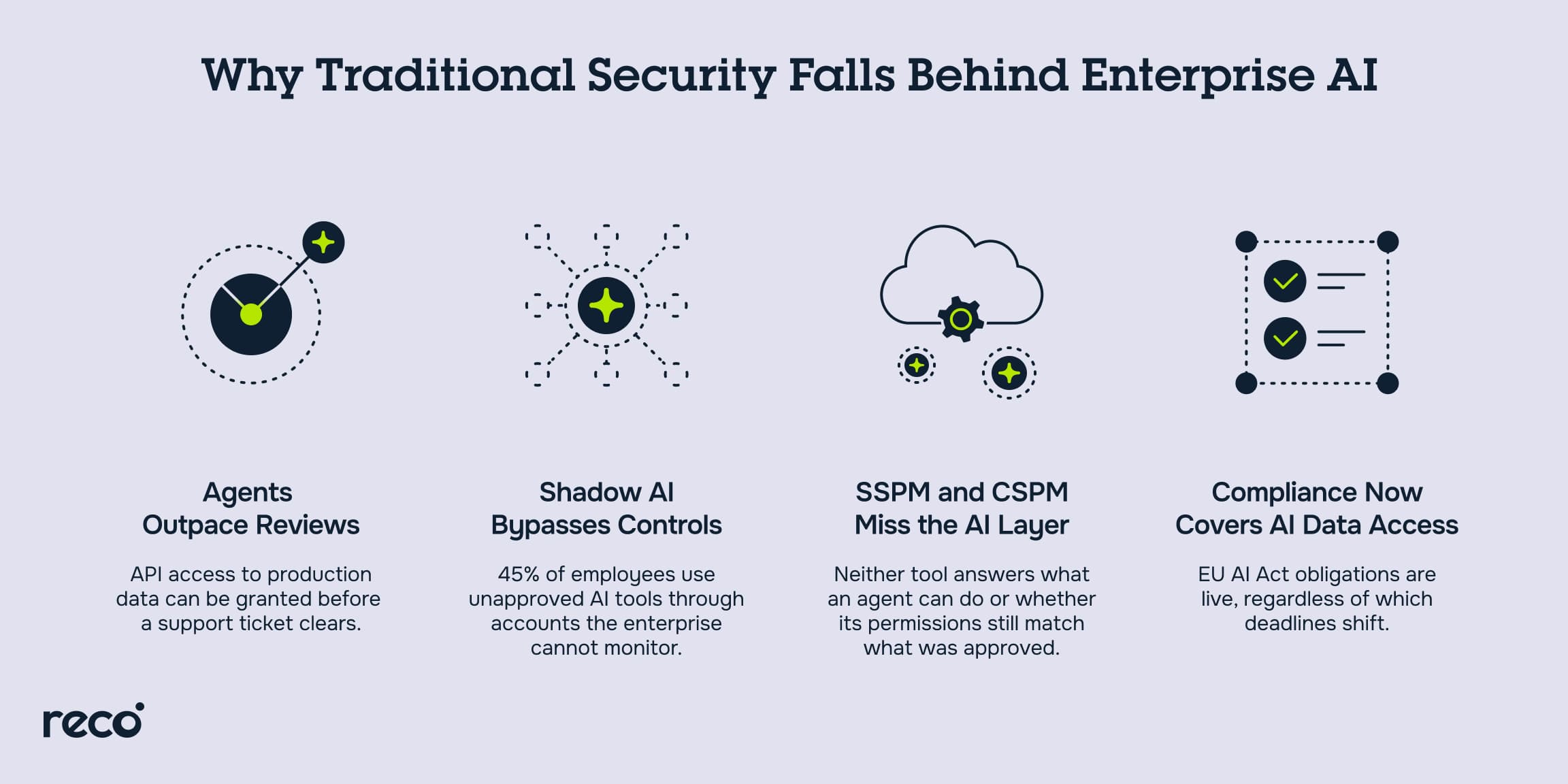
- AI Agents Deployed Faster Than Any Security Review Can Keep Up: A developer can grant an AI agent API access to production data in the time it takes to approve a support ticket. Quarterly audit cycles and manual access reviews were never built to operate at that speed, so agents often run with live permissions for weeks before any review catches up to them.
- Shadow AI Connecting to Business Data Before Policies Exist for It: Employee use of unapproved AI tools, tracked in Verizon's 2026 Data Breach Investigations Report, reached 45% of the workforce, with most of that activity happening through non-corporate accounts the enterprise cannot monitor. The same report found that source code is the data type most frequently uploaded to generative AI tools in policy violations, by a wide margin, ahead of images and structured data.
- Existing SSPM and CSPM Controls Were Not Built for the AI Layer: SaaS security posture management tools monitor configuration drift and user permissions within known applications; cloud security posture management tools monitor infrastructure. Neither answers AI-specific questions, like what an agent can do autonomously or whether its permission scope still matches what was approved.
- Compliance Obligations Now Extend to How AI Systems Access and Process Data: Under the EU AI Act's general-purpose model rules, obligations for providers took effect in August 2025, and its transparency requirements apply from August 2026. High-risk system obligations were pushed to December 2027 for Annex III systems and August 2028 for Annex I systems, but shifting deadlines don't remove the underlying work of mapping which AI systems touch regulated data.
Top AI-SPM Tools in 2026: TL;DR
Beyond what each platform focuses on, how it connects to your stack, automates response, and holds up at enterprise scale often decides whether it fits. Here's a quick look at those three dimensions across all eight tools before the full breakdown below.
8 Best AI-SPM Tools for Enterprise Security Teams
The eight platforms below cover the full range of what "AI-SPM" means in practice, from full agentic lifecycle security to narrower model and inference-layer protection. Each one below includes what it does well, where it falls short, and who it's actually built for.
1. Reco
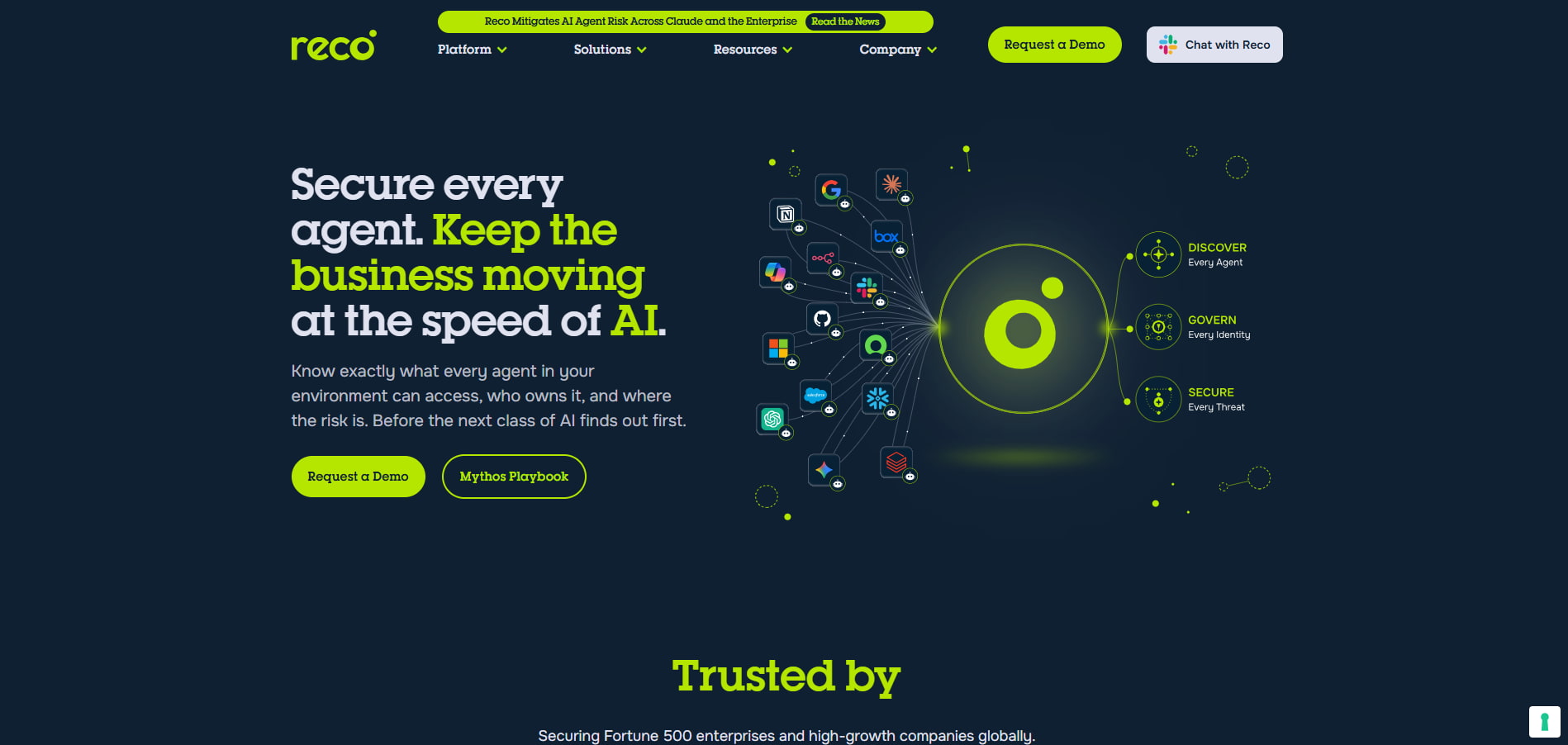
Reco is an AI Agent Security Platform built to cover the full AI-SPM lifecycle, from SaaS apps and embedded AI to autonomous agents, all from one agentless deployment. It maps agents, identities, and data flows together through the Reco Graph, so security teams see what an agent can reach in one place.
The platform catches what SSPM tools miss: shadow AI, over-permissioned agents, and gaps between discovery and identity governance. It covers 260+ apps and agents with 1,000+ pre-built detection controls, and Reco Factory adds new integrations in days, not quarters.
Pros:
- Unified coverage: Discovery, identity governance, and threat detection in one platform.
- Continuous identity monitoring: Catches orphaned accounts and incomplete access removal in real time.
- Fast integration cycle: New apps and agents onboarded in days.
Cons:
- No model-layer security: Needs a tool like HiddenLayer alongside it for ML pipeline risk.
- Newer vendor: Founded 2020, smaller analyst footprint than legacy SSPM players.
- Scales with SaaS footprint: Less relative value for small, simple environments.
2. Aim Security
Aim Security governed GenAI adoption across the enterprise, from employee use of tools like ChatGPT to embedded AI features in third-party apps and custom-built AI applications. Its AI-Firewall added runtime protection against prompt injection, data leakage, and adversarial attacks, layered under its core AI-SPM discovery and governance capabilities.
Cato Networks acquired Aim Security in September 2025, and its technology is now part of Cato AI Security, spanning AI Security for End Users, AI Security for Applications, and Agentic AI Security, rather than being sold as a standalone product. Enterprises evaluating it today are effectively evaluating a capability inside Cato's broader SASE platform, not an independent point solution.
Pros:
- Runtime protection built in: AI-Firewall defends against live attacks, not just posture gaps.
- Regulated-industry pedigree: Built with finance, healthcare, and defense compliance needs in mind.
- Now backed by Cato's platform scale: Integration brings the same policy engine and data lake that already secure Cato's network and cloud traffic.
Cons:
- No longer standalone: Can't be bought or evaluated independently of Cato Networks.
- Spread across three sub-products: AI Security now spans End Users, Applications, and Agentic AI rather than one unified module, so evaluating full coverage takes more digging.
- Original branding fading: No longer resolves as an independent product site.
3. Protect AI
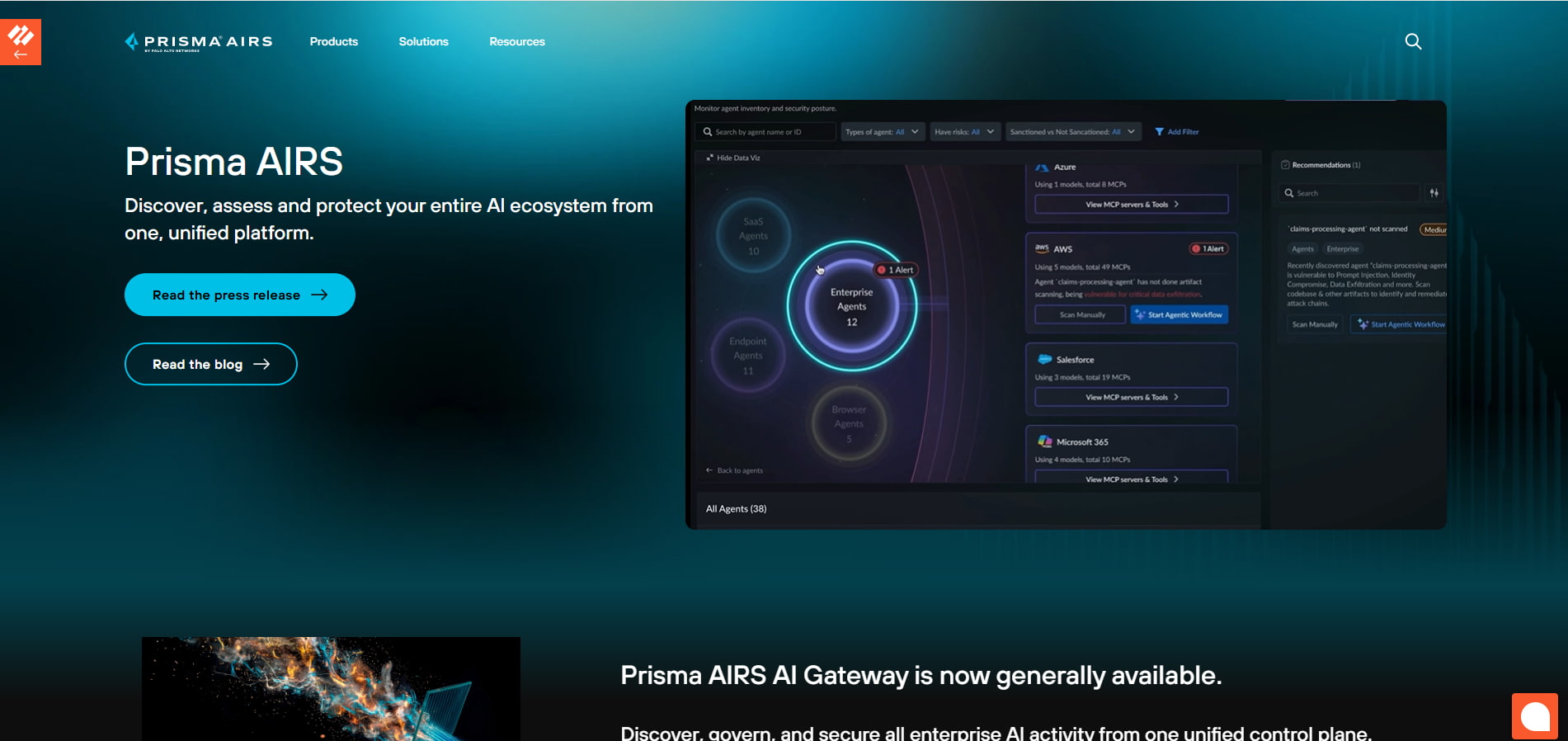
Protect AI built its platform around ML model and supply chain security: scanning model files for malicious code, auditing training datasets for exposed secrets, and hardening the ML pipeline from Hugging Face downloads through production. Palo Alto Networks acquired the company in 2025, and its technology is now folded into Prisma AIRS rather than sold as a standalone product.
For enterprises already running Palo Alto's security stack, this means model and supply chain scanning comes bundled into a platform they likely already use, spanning model scanning, automated red teaming, runtime protection, and AI agent security under one roof.
Pros:
- Deep ML pipeline coverage: Scans model files, training data, and notebooks for supply chain risk.
- Backed by Palo Alto's scale: Now part of a platform with broad enterprise reach and resources.
- Consolidated AI security stack: Model scanning sits alongside runtime and agent protection in Prisma AIRS.
Cons:
- No longer standalone: Can't be purchased or evaluated independently of Palo Alto Networks.
- Best fit tied to vendor lock-in: Value is highest for organizations already committed to Palo Alto's ecosystem.
- Narrower original scope: Built for model/ML pipeline risk, not full SaaS or agent ecosystem visibility like Reco.
4. CalypsoAI
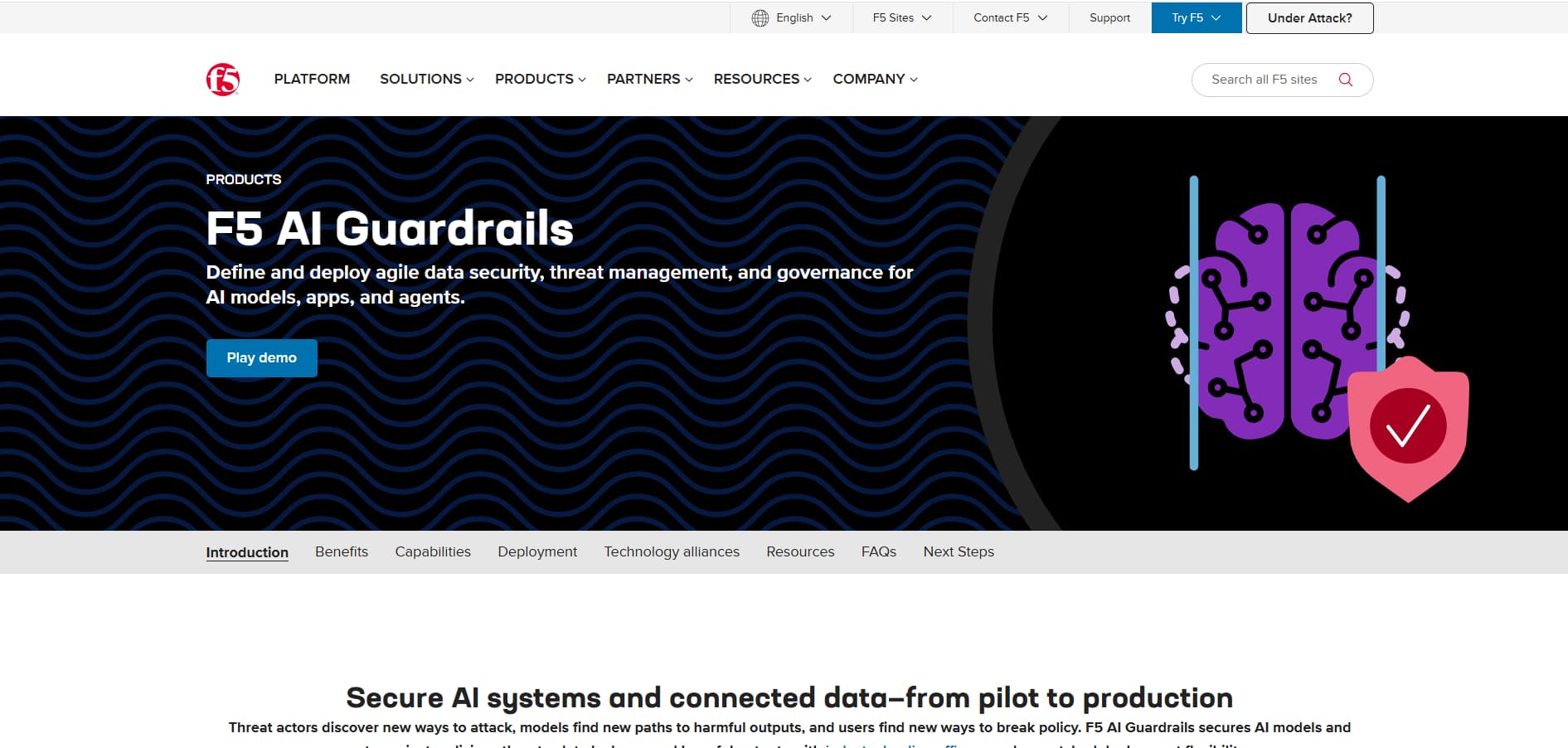
CalypsoAI secured AI models at the inference layer, offering real-time threat defense, agentic red-teaming, and policy enforcement across any model or environment. F5 Networks acquired the company in September 2025.
Its technology is now F5 AI Guardrails and F5 AI Red Team, both folded into F5's Application Delivery and Security Platform. Guardrails handles runtime protection in production, while Red Team runs continuous adversarial testing to catch weaknesses before attackers do.
Pros:
- Inference-layer specialization: Real-time defense at the moment models interact with live data.
- Backed by F5's infrastructure: AI security sits inside app delivery infrastructure many enterprises already run.
- Continuous red-teaming: Ongoing adversarial testing, not a one-time audit.
Cons:
- No longer standalone: Original branding is being phased out.
- Narrower scope: Built for inference defense, not full agent discovery or SaaS posture management.
- Still integrating: Rebrand into F5's platform is ongoing, not fully settled.
5. AppOmni (AgentGuard)
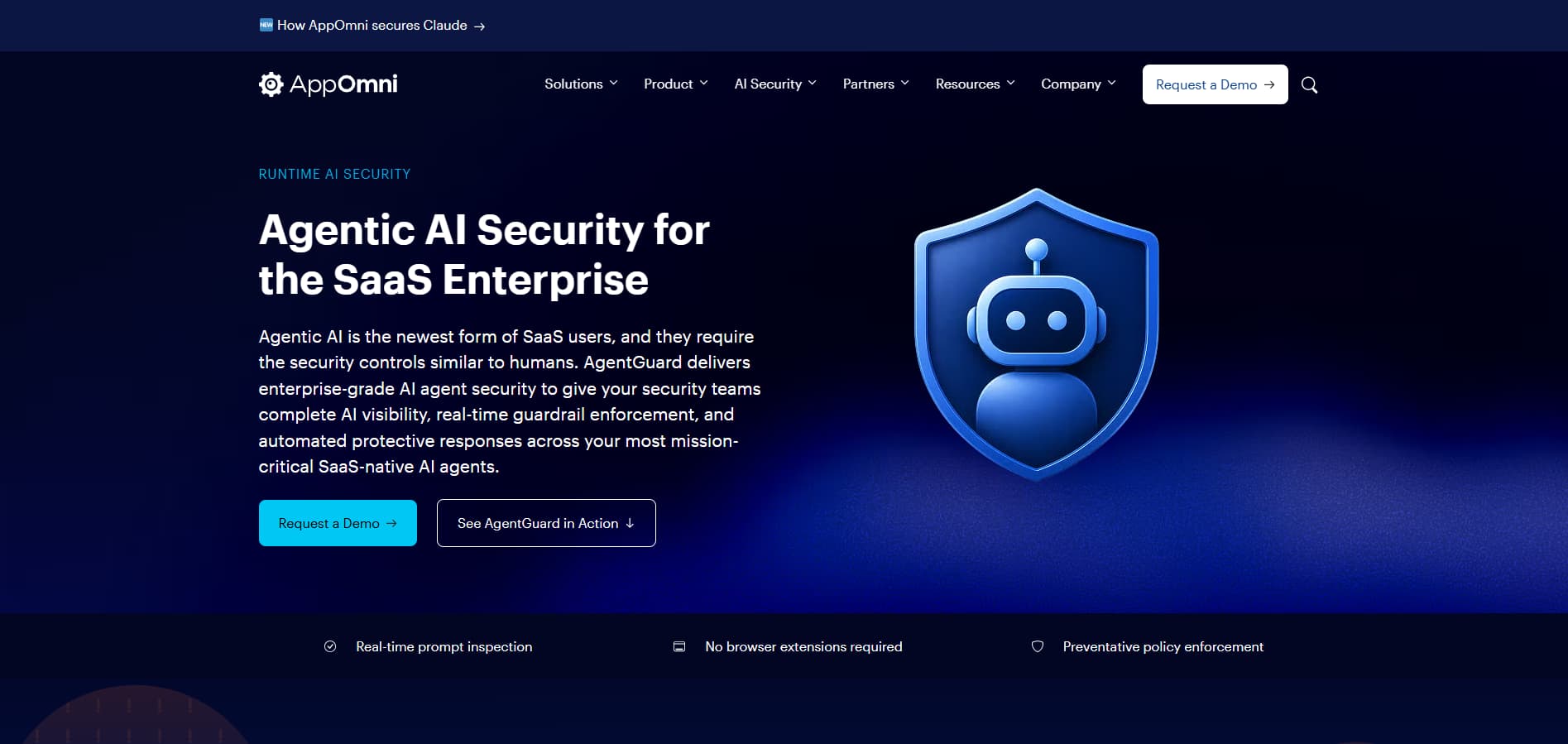
AppOmni built AgentGuard to secure AI agents embedded inside SaaS platforms, launching with ServiceNow's Now Assist in November 2025 before expanding to Salesforce Agentforce and Microsoft Copilot Studio. It monitors and blocks risky prompt interactions in real time, screening for prompt injection, jailbreak attempts, and policy violations before an agent acts.
The product extends AppOmni's existing SaaS Security Platform through one policy engine covering all three platforms, so agent-level protection sits alongside the posture management and threat detection AppOmni already runs across those same SaaS environments.
Pros:
- Real-time enforcement: Scans every prompt before an agent takes action, not after the fact.
- Deep platform expertise: Built on AppOmni's existing configuration and admin knowledge across Salesforce, ServiceNow, and Microsoft 365.
- Extends an established platform: Agent security sits inside a mature SaaS Security Platform, not a bolt-on tool.
Cons:
- Platform-specific focus: Strongest coverage is within SaaS-native agents on Salesforce Agentforce, ServiceNow Now Assist, and Microsoft 365 Copilot Studio; depth for standalone or custom-built agents outside these platforms may vary.
- Narrower than full AI-SPM: Built for embedded agent protection, not broad AI agent discovery across every source.
- Newer capability: AgentGuard launched for ServiceNow in November 2025 and expanded to Salesforce Agentforce and Microsoft Copilot Studio in May 2026, giving it a shorter track record, especially outside ServiceNow, than AppOmni's core SSPM product.
6. Mindgard
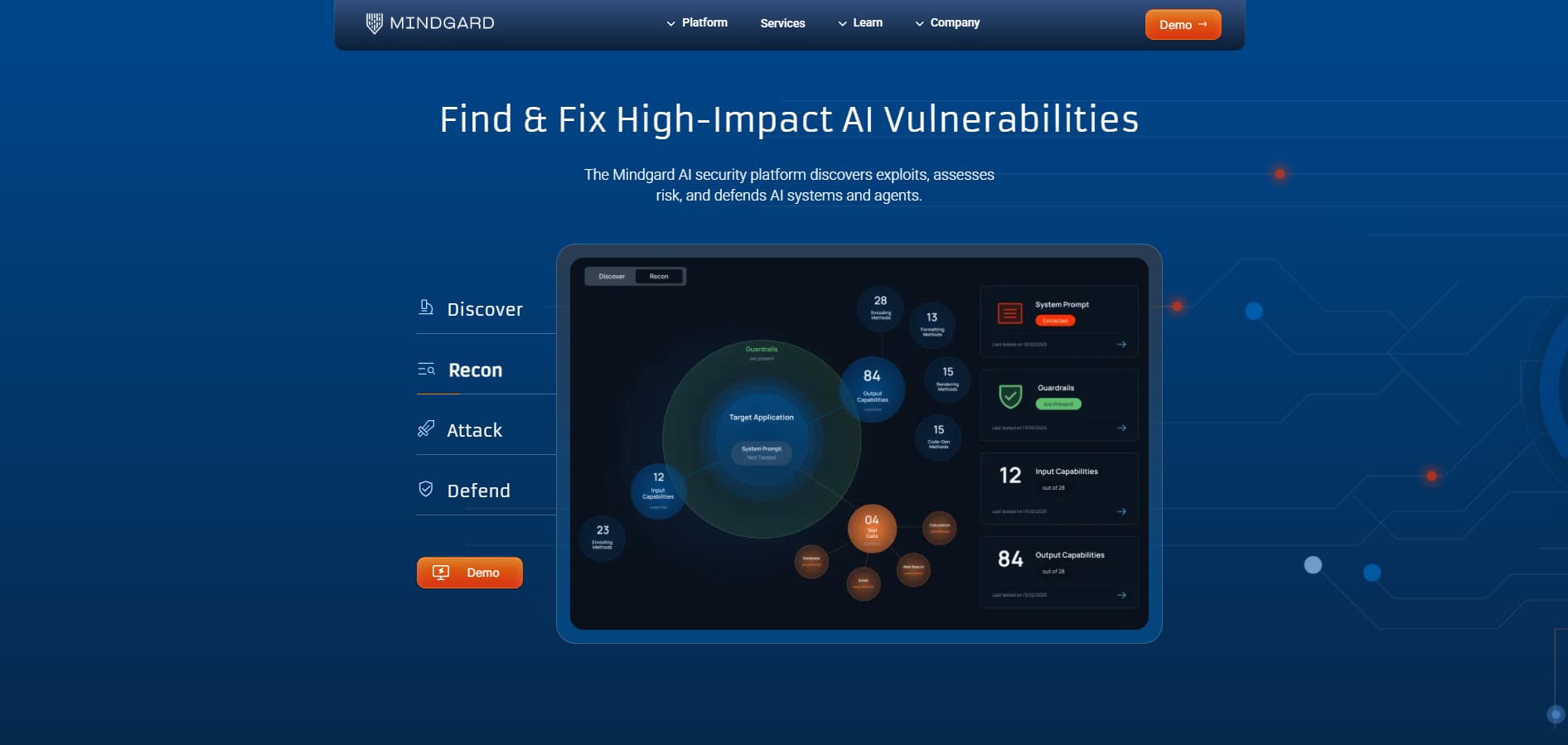
Mindgard runs automated, continuous red teaming for AI models, agents, and multimodal systems, spun out of over a decade of AI security research at Lancaster University. It works agentlessly via an API or CLI, requiring only an inference endpoint; no access to model internals is needed, and its attack library maps to MITRE ATLAS and OWASP.
The platform starts with reconnaissance to map an organization's AI attack surface, then runs continuous adversarial testing across prompt injection, jailbreaks, model extraction, and agent misuse, layering in runtime defense once vulnerabilities are found.
Pros:
- Fast setup: Testing begins in minutes via API, no deep integration work required.
- Framework-mapped reporting: Attack library aligned to MITRE ATLAS and OWASP for clean compliance reporting.
- Strong reconnaissance layer: Surfaces shadow AI and asset inventory most teams underestimate.
Cons:
- Narrower than full AI-SPM: Focused on red teaming and testing, not SaaS posture or identity governance.
- Agentic coverage still maturing: MCP/A2A server discovery and agentic red teaming are now named platform capabilities, but they're newer additions layered onto Mindgard's original model-testing foundation, so track record here is shorter than its core LLM red-teaming strength.
- Smaller scale: $11.9M raised total, modest next to platform-backed competitors like Prisma AIRS or F5 AI Guardrails.
7. Cranium
Cranium is an AI governance and security platform built around what it calls the Trust Loop: discover, observe, govern, secure, and prove every model, agent, and AI vendor continuously. It auto-discovers AI use cases across code, cloud, and endpoints, then maps findings to frameworks like the EU AI Act, NIST AI RMF, and ISO 42001 to generate audit-ready compliance evidence.
The platform was born out of KPMG Studio and positions itself around third-party AI risk as much as internally built systems, giving security and compliance teams a single system of record they can hand to auditors or regulators.
Pros:
- Strong compliance evidence generation: Built-in mapping to major AI regulatory frameworks, not bolted on.
- Covers third-party AI risk: Extends beyond internal systems to vendor and supply chain AI exposure.
- Continuous re-verification: Re-discovers and re-tests systems automatically as models and agents change.
Cons:
- Governance-first, not runtime-first: Less focused on real-time attack defense than red-teaming or inference-layer specialists.
- Newer vendor: Founded 2023, smaller funding base ($32M) than platform-backed competitors.
- Best fit for compliance-heavy orgs: Less relevant for teams whose primary need is technical threat detection over audit readiness.
8. HiddenLayer
HiddenLayer secures AI at the model layer: supply chain scanning, runtime defense, and adversarial attack simulation across the full ML lifecycle, from training to production. It's model-agnostic and agentless, operating on model artifacts and inference behavior without needing access to weights, training data, or prompts.
Its AISec Platform covers four areas: AI discovery, supply chain security, runtime defense, and attack simulation, backed by a research team that's disclosed 48+ CVEs in ML frameworks like PyTorch and TensorFlow.
Pros:
- Deep model-layer expertise: Purpose-built for threats traditional cybersecurity tools miss, like backdoored model weights.
- No access required: Agentless architecture works without touching weights, training data, or prompts.
- Strong research credibility: 48+ disclosed CVEs and 30+ granted patents in adversarial detection.
Cons:
- Narrower than full AI-SPM: Focused on ML model security, not SaaS posture or broader agent ecosystem visibility.
- Less identity/access governance: Doesn't cover the identity and permission layer the way Reco or Cranium do.
- Enterprise-scale orientation: ROI is strongest for organizations running production ML at scale, less suited to lighter AI footprints.
AI-SPM Tools Comparison Overview
Choosing between these platforms often comes down to how each one is packaged today, not just what it does. Ownership changes, product rebrands, and platform integrations reshape what "buying" a tool actually means, so here's where each one stands right now.
What Makes a Great AI-SPM Platform?
Not every AI-SPM tool covers the same ground, and the gaps matter more than the overlaps. These seven capabilities separate a platform that actually closes the AI security gap from one that just adds another dashboard.
- AI Agent Discovery and Inventory Across Every Source: A platform must find agents wherever they appear, whether in SaaS integrations, embedded copilots, custom-built tools, or shadow deployments, not just the ones IT already knows about.
- Agentic Posture Monitoring and Permission Governance: Discovery alone isn't enough. The platform needs to track what each agent can access and flag when permissions drift beyond what was approved.
- Shadow AI and Unsanctioned Tool Detection: Employees adopt AI tools faster than any approval process can track. Continuous detection catches unauthorized usage before it becomes a data exposure incident.
- Embedded AI Feature Visibility Inside Sanctioned Apps: Copilots ship inside tools that already passed security review. A platform needs visibility into these embedded features, not just standalone AI apps.
- Non-Human Identity and OAuth Grant Governance: Agents operate as identities in their own right. The platform must manage their credentials and access grants with the same rigor applied to human users.
- Compliance Alignment (EU AI Act, ISO 42001, NIST AI RMF): Regulatory mapping should be built in, not bolted on, covering frameworks like the EU AI Act's transparency and high-risk obligations, ISO 42001, and NIST's AI Risk Management Framework.
- Threat Detection and Response at Agent Speed: Agents can act in seconds. Detection and response need to operate at that same speed, not on a quarterly review cycle.
How to Choose an AI-SPM Platform Built for Enterprise AI
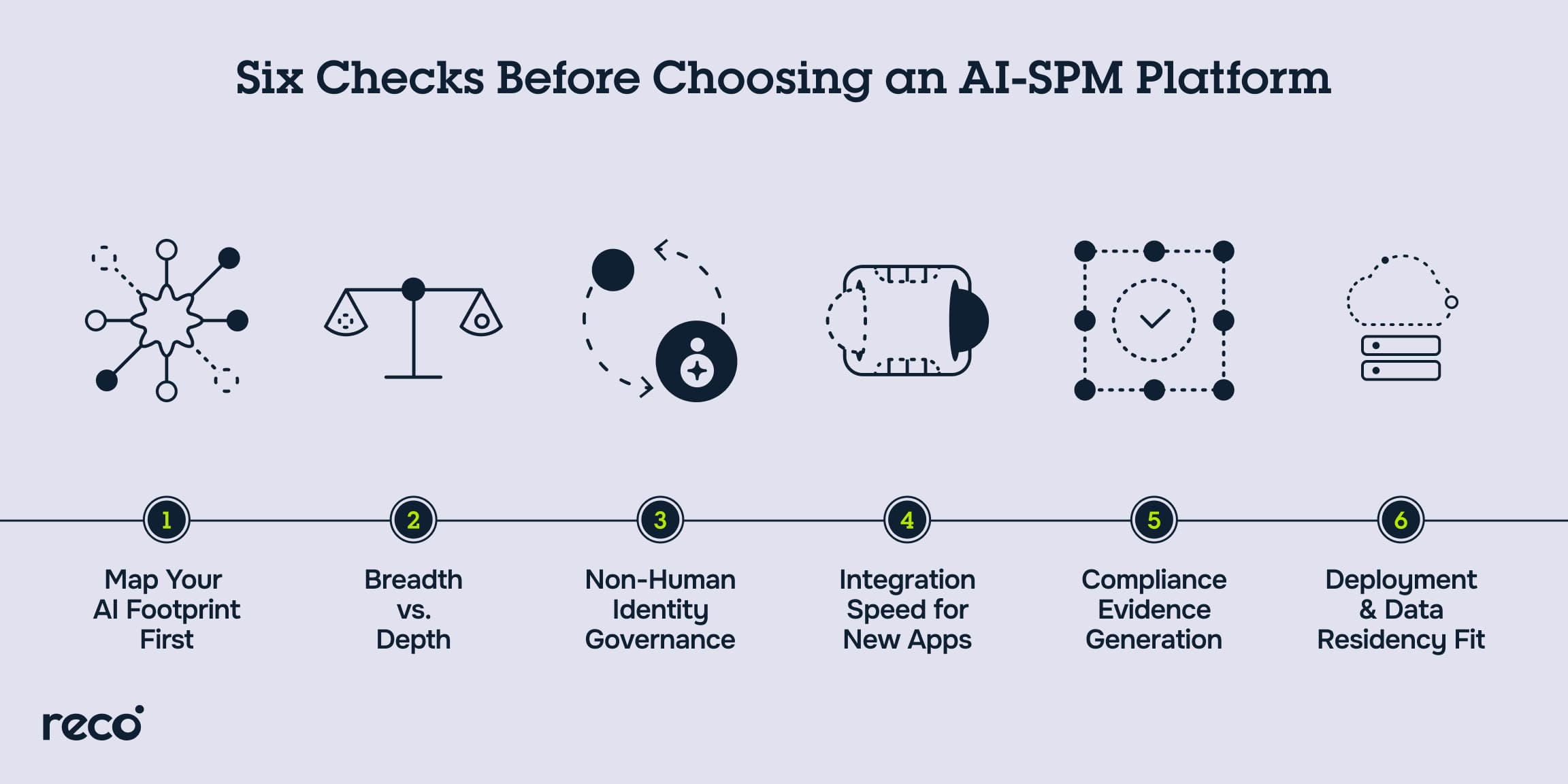
Choosing between AI-SPM vendors comes down to matching what the platform actually covers to where the organization's exposure sits. These six checks help narrow that decision before signing a contract.
- Map Your AI Agent and Application Footprint First: Before evaluating vendors, inventory what's actually running, sanctioned apps, embedded copilots, and any shadow AI already in use. A tool's fit depends entirely on what it needs to cover.
- Assess Whether the Tool Covers Breadth or Depth (or Both): Some platforms span the full SaaS and agent ecosystem, others go deep on one layer, like model security or red teaming. Match the tool to whether the gap is coverage or depth.
- Confirm Non-Human Identity and Access Governance Capabilities: Agents are identities with credentials and permissions. Verify the platform tracks OAuth grants and access scope for agents with the same rigor as human users.
- Evaluate Integration Speed for New AI Apps and Agent Platforms: New tools and agents appear faster than quarterly review cycles can track. A platform that takes months to onboard a new integration leaves a growing blind spot.
- Verify Compliance Evidence Generation for AI-Specific Frameworks: Confirm the platform maps findings to frameworks like the EU AI Act, ISO 42001, and NIST AI RMF, and can produce audit-ready evidence, not just dashboards.
- Consider Deployment Model and Data Residency Requirements: Agentless SaaS platforms, cloud-integrated modules, and on-prem options carry different data residency and access implications. Match the deployment model to regulatory and infrastructure constraints.
How Reco Graph Turns AI Agent Sprawl Into a Governable Risk Map
Most teams treat agent discovery as the finish line. It's the starting point. Once security knows an agent exists, the real question is what it can reach, whether that access still matches what was approved, and whether an audit trail exists if something goes wrong. Reco Graph exists to answer those questions continuously rather than at the next scheduled review.
- Connects Identity to Access, Not Just to Inventory: Identity and access governance maps every agent to the specific permissions it holds, so a security team can detect privilege creep the moment it occurs rather than discovering it during an incident.
- Traces Data Exposure Back to the Agent That Created It: Data exposure management links each agent to the datasets it touches, turning "we have 40 agents" into "we know exactly what each one can expose."
- Keeps Configuration Drift Visible as the Environment Changes: Posture management and compliance checks continuously compare agent and app configurations against policy, catching drift as it happens rather than at the next audit cycle.
- Extends the Graph as Fast as the Environment Grows: Reco Factory onboards new apps and agents in days, so newly deployed tools enter the risk map immediately instead of sitting invisible for months.
Conclusion
Three vendors on this list didn't survive 2025 as independent companies. That's not a fluke, but the market telling you where the real value sits, inside platforms that already touch identity, network traffic, or infrastructure, not as standalone dashboards. The consolidation will likely continue, so weigh a vendor's roadmap and ownership stability alongside its feature set.
None of these eight tools replace judgment. The right platform tells a security team what's running, what it can touch, and what changed since last week. What they do with that visibility is what actually separates a governed AI environment from one that's merely being watched.
FAQs
How does AI-SPM differ from traditional SSPM, and why can't existing posture tools cover AI agents?
SSPM tools were built to monitor configuration drift and user permissions within known SaaS applications. They weren't designed to answer AI-specific questions, like what an agent can do autonomously or whether its access still matches what was approved when it was deployed.
- SSPM tracks static app configurations; AI-SPM tracks dynamic agent behavior and permissions
- SSPM assumes a known, stable app inventory; AI-SPM must continuously discover new and shadow AI tools
- SSPM rarely covers non-human identities with the depth AI agents require
See how posture management and compliance extend this coverage to the AI layer.
What compliance frameworks apply specifically to AI applications and agentic AI systems in enterprise environments?
The EU AI Act, ISO 42001, and NIST AI RMF cover most of this ground today, but the EU AI Act's timeline is worth watching closely: transparency obligations apply from August 2026, while high-risk system obligations, originally due that same month, were pushed back during 2026 negotiations to December 2027 for standalone AI systems and August 2028 for AI embedded in regulated products. That deferral doesn't remove the underlying work. Enterprises still need to know which AI systems touch regulated data now, so the mapping is ready whenever each deadline actually lands.
How do AI-SPM tools handle non-human identities such as service accounts, OAuth tokens, and API credentials used by AI agents?
AI agents operate as identities in their own right, each with credentials, permissions, and access scope that can drift over time. AI-SPM platforms apply the same identity governance rigor to these non-human identities that organizations already apply to employees.
- Maps every agent to the specific permissions and OAuth grants it holds
- Flags orphaned accounts and incomplete access removal after an agent is decommissioned
- Detects when an agent's access scope drifts beyond what was originally approved
Reco's identity and access governance is built specifically around this non-human identity layer.
What is the difference between securing an embedded AI feature inside a sanctioned SaaS app and securing a standalone AI agent?
An embedded AI feature, like a copilot inside an already-approved SaaS tool, inherits that app's security review but adds new capabilities the original review never assessed. A standalone AI agent has no prior review at all. It needs full discovery, permissioning, and monitoring from the moment it's deployed, and both types need ongoing attention since either can expand its access over time.
How quickly should a security team expect an AI-SPM tool to surface its first actionable findings after deployment?
This varies by platform and environment size, so there's no single benchmark that holds across every vendor. What's consistent among agentless platforms is that they skip the lengthy setup legacy audits require, since there's no agent to install or infrastructure to configure before discovery can begin.
- Look for a platform that surfaces agent inventory, permission gaps, and shadow AI detection in its first pass, not just a partial app list
- Ask vendors for a specific time-to-first-finding benchmark during evaluation, since this varies enough to matter
- Integration speed for new apps and agents matters as much as the initial findings, since a slow onboarding cycle recreates the same blind spot over time.


%201.svg)


.svg)