

SaaS Data Governance: How Security Teams Control Data Access at Scale

What Is SaaS Data Governance?
SaaS data governance is the framework that defines how data within SaaS applications is owned, classified, and governed across an organization. It establishes clear accountability for SaaS data and sets consistent rules for how that data should be handled, regardless of which SaaS platform it resides in. The goal of SaaS data governance is to create an automated, identity-centric model that provides continuous visibility and control over data access and usage as organizations rapidly adopt cloud-native tools.
Why SaaS Data Governance Matters for Modern Organizations
As organizations rely on hundreds of SaaS applications to run core business functions, data increasingly lives outside traditional infrastructure boundaries. SaaS data governance becomes essential for maintaining control and consistency as SaaS usage scales across teams, tools, and workflows.
- SaaS Sprawl and Visibility Gaps: Uncontrolled SaaS adoption makes it difficult to maintain a clear picture of where data resides and how it moves between applications. Without governance, security, and IT teams lack a reliable way to understand which SaaS apps store sensitive data and how those apps are connected.
- Excessive and Unmanaged User Permissions: As users join, change roles, or leave the organization, permissions within SaaS applications often accumulate without review. SaaS data governance provides structure for aligning access levels with current responsibilities so data access does not expand unchecked over time.
- Third-Party and OAuth App Exposure: SaaS platforms frequently rely on integrations and OAuth-based connections to extend functionality. Governance helps define expectations around how third-party apps interact with SaaS data and ensures those connections are understood and tracked as part of the overall SaaS environment.
- Audit, Compliance, and Regulatory Pressure: Regulatory frameworks increasingly require organizations to demonstrate how data is accessed and controlled across cloud services. SaaS data governance establishes the foundation needed to answer audit questions and support compliance efforts without relying on manual or ad hoc processes.
SaaS Data Governance Risks Without Proper Controls
When SaaS data governance is missing or inconsistently applied, organizations lose the ability to understand and manage how data is accessed across their SaaS environment. Over time, this creates concrete exposure points that security teams struggle to detect and contain.
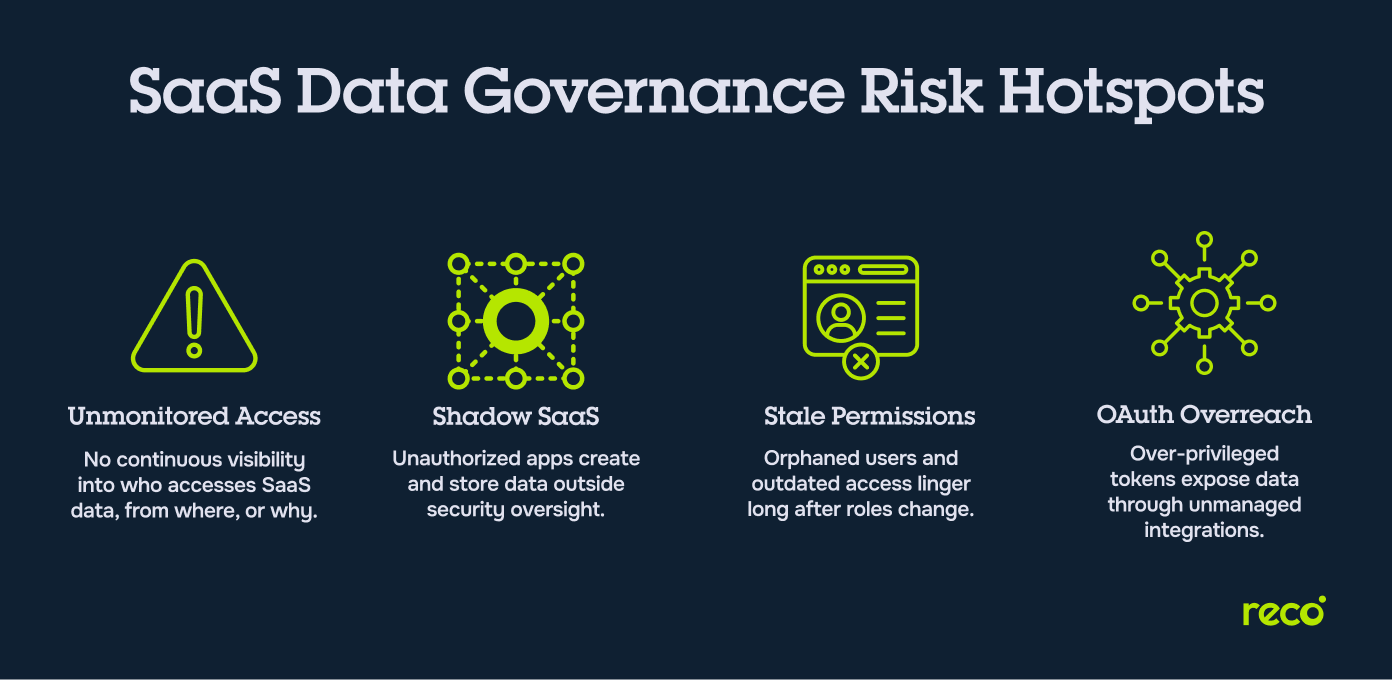
- Unmonitored SaaS Data Access: Without governance controls in place, data access within SaaS applications often occurs without ongoing oversight. Security teams lack continuous awareness of who is accessing SaaS data, from where, and under what conditions, making it difficult to identify inappropriate or unexpected access patterns.
- Shadow SaaS and Unauthorized Applications: Employees frequently adopt SaaS tools outside approved channels to solve immediate business needs. These unauthorized applications operate outside formal governance, allowing data to be created, shared, or stored in locations that security and IT teams do not actively monitor.
- Orphaned Users and Stale Permissions: As users change roles or leave the organization, access rights within SaaS applications are not always updated or removed. Over time, this results in dormant accounts and outdated permissions that continue to grant access to sensitive data long after it is needed.
- OAuth Token Abuse and Over-Privileged Integrations: SaaS platforms rely heavily on OAuth-based integrations to connect external applications and automate workflows. When these integrations are not governed, tokens can retain broad or unnecessary access to data, increasing the risk of data exposure through compromised or misused third-party connections.
Identity-Centric SaaS Data Governance in Modern Enterprises
As SaaS environments scale, data governance increasingly depends on how identities are defined, tracked, and governed across applications. An identity-centric approach treats access to SaaS data as a function of identities rather than isolated user accounts or app settings.
Human and Non-Human Identities Across SaaS Apps
Modern SaaS environments are accessed not only by human users but also by non-human identities such as service accounts, integrations, automation bots, and API-based workflows. These non-human identities often interact directly with SaaS data and can persist independently of employee lifecycles. Effective SaaS data governance requires visibility into both identity types and a clear understanding of how each is authorized to access data across applications.
Identity Lifecycle Management and Access Drift
Identity lifecycle management governs how access is granted, modified, and removed as roles and responsibilities change. In SaaS environments, identity lifecycle events often occur faster than access updates, leading to gradual access drift. Over time, identities accumulate permissions that no longer reflect their current function. An identity-centric governance model focuses on maintaining alignment between identities and data access expectations as organizations evolve.
Privileged and High-Risk Identity Exposure
Some identities inherently carry elevated access to sensitive SaaS data due to administrative roles, broad scopes, or integration-level permissions. These high-risk identities represent concentrated exposure points within the SaaS environment. SaaS data governance requires consistent identification and oversight of privileged identities so their access remains intentional, justified, and limited to what is operationally necessary.

Dr. Tal Shapira
Cofounder & CTO at Reco

Tal is the Cofounder & CTO of Reco. Tal has a Ph.D. from Tel Aviv University with a focus on deep learning, computer networks, and cybersecurity and he is the former head of the cybersecurity R&D group within the Israeli Prime Minister's Office. Tal is a member of the AI Controls Security Working Group with CSA.

Expert Insight: Governing SaaS Data Starts With Identity Context
In real SaaS environments, data governance breaks down when teams focus on applications instead of identities. The fastest way to regain control is to anchor governance decisions to identity context rather than static roles or app-level permissions.
From hands-on experience, these practices make the biggest difference:
- Track Effective Access, Not Assigned Roles: Permissions often look reasonable on paper, but expand through group membership, integrations, and automation. Always evaluate what identities can actually access.
- Treat Non-Human Identities as First-Class Citizens: Service accounts, OAuth apps, and automations often outlive employees. Govern them with the same rigor as human users.
- Review Access After Change Events, Not on a Schedule: Role changes, new integrations, and feature enablement introduce risk faster than quarterly reviews can catch.
The Key Takeaway is Simple: SaaS data governance becomes scalable only when identity context drives access decisions.
SaaS Data Governance Implementation Lifecycle
Implementing SaaS data governance is not a one-time project but a continuous lifecycle that evolves as SaaS usage grows and changes. This lifecycle provides a structured way for organizations to establish governance foundations and maintain alignment as applications, users, and data flows shift over time.
- SaaS Discovery and Application Inventory: The lifecycle begins with identifying all SaaS applications in use across the organization. A complete and continuously updated inventory establishes a baseline understanding of where data exists and which platforms are part of the SaaS environment.
- User, Role, and Identity Mapping: Once applications are known, governance requires mapping users and identities to those platforms. This step clarifies how individuals and non-human identities interact with SaaS data and how roles translate into access relationships across applications.
- Access Policy Definition and Enforcement: Governance policies define how access should be granted based on roles, responsibilities, and data sensitivity. These policies create consistency in how access decisions are made and applied across SaaS applications as part of normal operations.
- Continuous Monitoring and Risk Review: As SaaS environments evolve, governance depends on ongoing review rather than static controls. Continuous monitoring ensures governance rules remain aligned with current usage patterns, organizational changes, and emerging risks.
Key Components of SaaS Data Governance
These components are the building blocks that make SaaS data governance concrete and repeatable. Together, they define who is responsible for SaaS data, how access is managed, and how governance decisions stay measurable over time.
Security and Compliance in SaaS Data Governance
Security and compliance requirements do not stop at the network boundary. In SaaS environments, data governance provides the structure that helps teams apply consistent expectations for how SaaS data is handled and how proof is produced during reviews.
- Governance turns security expectations into enforceable rules by defining who can approve data access decisions, what handling standards apply to SaaS data, and how exceptions are managed.
- Governance creates audit-ready evidence by clarifying what activity must be recorded and who is accountable for validating access and data handling outcomes.
- Governance supports compliance workflows by making it easier to demonstrate that access decisions follow defined policies and responsibilities are clearly assigned.
- Governance strengthens third-party assurance by setting expectations for how SaaS providers and integrations process organizational data.
This governance-driven approach aligns closely with how SaaS controls are evaluated in formal assurance frameworks such as AICPA SOC 2 reporting, where consistent access management, accountability, and evidence are central evaluation criteria.
SaaS Data Governance Challenges in AI-Enabled SaaS Environments
As AI capabilities become embedded directly into SaaS platforms, data governance must account for new access patterns and operational behaviors that differ from traditional user-driven interactions. These changes introduce governance challenges that are often less visible and more difficult to manage using existing models.
- AI Features Expanding Data Access Paths: AI-driven features such as assistants, recommendations, and analytics often require broad and continuous access to underlying datasets. This expands the number of internal data access paths within SaaS applications, increasing complexity for governance teams trying to maintain clear data boundaries.
- Automated Workflows and Integration Sprawl: AI-enabled automation relies heavily on background services, APIs, and cross-application integrations to function at scale. These automated data flows often operate without direct human intervention, making it more challenging to track how data moves between SaaS applications and where governance rules apply.
- Governance Gaps Introduced by Embedded AI: Many governance frameworks were designed around human access and static workflows. Embedded AI features can introduce new data usage behaviors that fall outside those assumptions, creating gaps in accountability, oversight, and policy alignment if not explicitly addressed.
SaaS Data Governance Best Practices
Effective SaaS data governance relies on repeatable operational habits that keep data handling consistent as SaaS environments evolve. Industry best practices highlight the importance of continuous visibility, access oversight, and accountability across SaaS platforms.
How Reco Reduces SaaS Data Risk at Scale
Reco helps security teams apply SaaS data governance in practice by continuously mapping how data is accessed, shared, and exposed across SaaS environments. Its platform focuses on visibility, identity context, and real-time risk detection to support governance at scale.
- Full SaaS Application Discovery: Reco continuously identifies SaaS applications in use across the organization, including sanctioned tools and shadow SaaS. This discovery layer creates a reliable foundation for governance by ensuring teams know where SaaS data exists and which applications interact with it, supported by Reco’s SaaS application discovery capabilities.
- Deep User, Identity, and Permission Visibility: Reco provides detailed insight into how human and non-human identities access SaaS data, including effective permissions rather than assigned roles alone. This visibility helps teams understand real access paths and supports governance decisions through centralized identity and access governance.
- Continuous Risky Access Detection: Instead of relying on periodic reviews, Reco continuously analyzes SaaS activity to surface risky access patterns as they emerge. This includes identifying unusual data access, privilege misuse, and anomalous behavior using contextual identity threat detection and response.
- OAuth App and Integration Control: Reco monitors OAuth apps and integrations to understand what data third-party connections can access and how that access is being used. This enables governance teams to identify over-privileged integrations and unmanaged connections as part of broader data exposure management.
- Audit-Ready Reporting and Compliance Support: Reco aggregates access, activity, and risk context into structured reports that support internal reviews and external audits. These reporting capabilities help organizations demonstrate consistent governance practices across SaaS environments through Reco’s SaaS posture management and compliance platform.
Conclusion
SaaS data governance is no longer a theoretical discipline or a compliance checkbox. As organizations scale their SaaS environments, data access becomes increasingly dynamic, distributed, and identity-driven. Without a structured governance model, visibility erodes and risk compounds quietly over time. By grounding governance in identity context, continuous oversight, and clear accountability, security teams can regain control without slowing the business. Effective SaaS data governance creates the conditions for secure growth, where data access decisions are intentional, auditable, and aligned with how modern organizations actually operate.
How does Reco discover and monitor all SaaS applications in an organization?
Reco discovers SaaS applications by observing real identity activity across the environment rather than relying on declared inventories or manual inputs. This allows it to detect both approved tools and shadow SaaS as usage evolves.
- Identifies SaaS apps accessed through user authentication and integrations
- Detects applications introduced via OAuth connections and automation
- Maintains continuous visibility as new tools are adopted
For further reading, see how Reco approaches SaaS application discovery.
What is the difference between SaaS data governance and SaaS security?
SaaS data governance defines how data should be owned, accessed, and handled across SaaS applications, while SaaS security focuses on enforcing controls and responding to threats.
- Data governance establishes policies, accountability, and access expectations
- SaaS security applies technical controls and detects security events
- Governance provides the structure that security operates within
How does Reco identify risky user permissions and third-party app access?
Reco analyzes effective access rather than static role assignments, allowing it to surface risky permissions that emerge through role changes, integrations, and automation.
- Identifies excessive access based on real usage paths
- Detects over-privileged OAuth apps and unmanaged integrations
- Surfaces anomalous access patterns that are tied to identities
Learn more about how Reco detects risky access through identity threat detection and response.
Who is responsible for SaaS data governance in a growing organization?
SaaS data governance is typically a shared responsibility across security, IT, and business teams. Security teams often define governance frameworks, while application and data owners validate access decisions.
- Security teams set governance standards and oversight
- IT teams support identity and access processes
- Business owners confirm appropriate data access
How does SaaS data governance help reduce shadow SaaS risk?
SaaS data governance reduces shadow SaaS risk by increasing visibility into how applications are accessed and how data flows across the SaaS environment.
- Makes unsanctioned SaaS usage easier to detect
- Clarifies data exposure from unauthorized tools
- Enables informed decisions about remediation or approval
Gal Nakash


%201.svg)
ABOUT THE AUTHOR
Gal is the Cofounder & CPO of Reco. Gal is a former Lieutenant Colonel in the Israeli Prime Minister's Office. He is a tech enthusiast, with a background of Security Researcher and Hacker. Gal has led teams in multiple cybersecurity areas with an expertise in the human element.