


SaaS Access Management: How to Govern Identities Across Cloud Applications

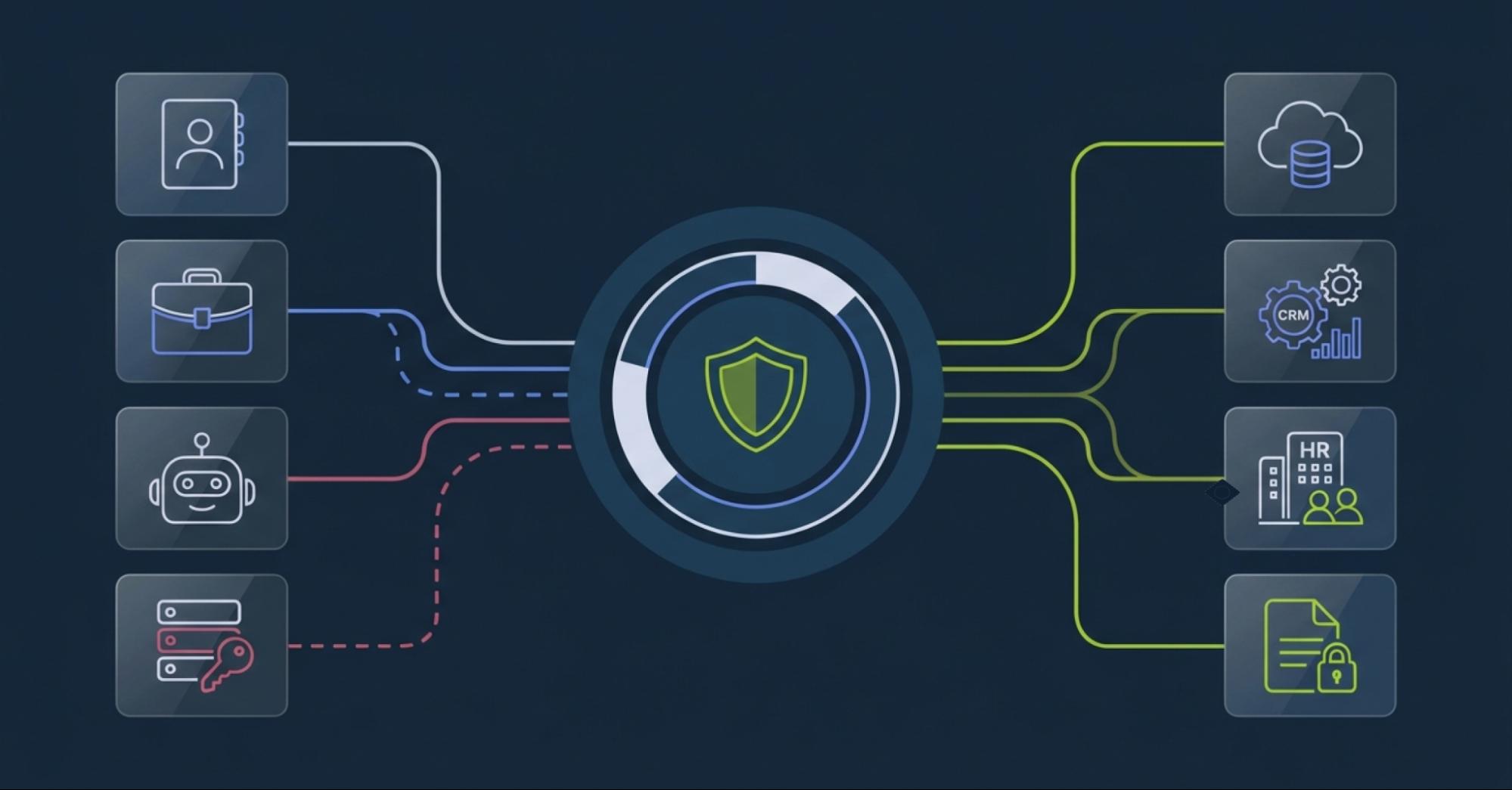
The perimeter is gone. Every employee, contractor, service account, AI agent, and OAuth integration is now a door into the SaaS environment. Some of those doors are governed. Most are not. SaaS access management is the discipline that determines which is which, and what happens when the answer is wrong.
What Is SaaS Access Management?
SaaS access management is the discipline of governing which identities can access SaaS applications, what permissions they hold, and how that access is authenticated, authorized, and monitored. It includes authentication, authorization, lifecycle management (provisioning and deprovisioning), and policy enforcement across employees, contractors, service accounts, AI agents, and third-party integrations interacting with SaaS environments. Unlike traditional IAM, it must also cover decentralized app ownership, OAuth integrations, and identities that bypass the corporate identity provider.
Why SaaS Access Management Matters
Modern organizations rely on hundreds of SaaS applications across distributed teams and devices. Without centralized access governance, excessive permissions, unmanaged accounts, and shadow SaaS usage can quickly expand the attack surface.
- Reduces Unauthorized SaaS Access: SaaS access management enforces authentication controls, least privilege policies, and access reviews to prevent unauthorized access to sensitive applications and data. Controls like multi-factor authentication are foundational to blocking compromised credentials before they reach SaaS environments.
- Improves Visibility Across SaaS Applications: Security teams gain centralized insight into users, service accounts, AI agents, OAuth grants, and third-party integrations operating across the SaaS environment.
- Supports Compliance and Audit Readiness: Centralized access governance supports compliance with frameworks such as GDPR, HIPAA, SOC 2, and ISO 27001 through audit logs, provisioning records, and policy-enforcement tracking.
- Limits Insider and Third-Party Risks: SaaS access management surfaces excessive permissions, dormant accounts, external collaborators, and vendor access that could expose sensitive systems or data.
Types of SaaS Access Management Models
Organizations use different access control models to manage permissions across SaaS environments. Each model approaches authorization differently based on business needs and security requirements.
- Role-Based Access Control (RBAC): RBAC assigns permissions based on a user’s role within the organization, simplifying administration and supporting least privilege enforcement.
- Attribute-Based Access Control (ABAC): ABAC evaluates attributes such as department, device type, location, or data sensitivity to make context-aware access decisions.
- Policy-Based Access Control (PBAC): PBAC enforces access through centralized policies that evaluate organizational rules, compliance requirements, and operational conditions at decision time.
- Risk-Based Access Controls: Risk-based models evaluate contextual signals such as login behavior, geographic anomalies, unmanaged devices, or unusual access patterns before granting access, aligning with the NIST Digital Identity Guidelines for risk-based authentication.
Core Components of SaaS Access Management
SaaS access management relies on identity and security controls that authenticate users, enforce permissions, automate lifecycle changes, and reduce unauthorized access across cloud applications.
SaaS Access Management Process
SaaS access management requires visibility, policy enforcement, and lifecycle governance across identities and applications. Most organizations follow a structured process to reduce unauthorized access and maintain operational control at scale.
- Discover All SaaS Applications and User Identities: Security teams must identify sanctioned and unsanctioned SaaS applications, as well as the employees, contractors, service accounts, AI agents, and integrations that interact with them.
- Classify User Roles and Access Levels: Map roles and permission requirements to determine which identities should access specific applications, data, and administrative functions.
- Apply Access Policies and Controls: Access controls are enforced through RBAC, ABAC, MFA, conditional access, and least privilege policies that reduce unnecessary permissions and identity risk.
- Automate and Enforce Access Policies at Scale: Automated provisioning, deprovisioning, approval workflows, and policy enforcement help manage access consistently across large SaaS environments with less manual overhead.
- Monitor, Review, and Continuously Update Access: Monitoring, audit reviews, behavioral analysis, and periodic access certifications help detect anomalies, remove dormant accounts, and adapt policies as risks evolve.
Common SaaS Access Management Risks
As SaaS environments expand, organizations face growing risks across employees, contractors, third-party integrations, and non-human accounts. Without proper governance, these exposures can lead to unauthorized access, compliance gaps, and data exposure.
AI Agents and Non-Human Identities: The Fastest-Growing Access Risk
Modern SaaS environments extend beyond human users. AI agents, service accounts, integrations, and automation tools now operate with persistent access, API tokens, and delegated permissions, creating new identity governance challenges for security teams.
Risks From AI Agents and Service Accounts
AI agents and service accounts often operate with persistent access tokens, elevated permissions, and limited oversight. Unlike human users, these identities may bypass standard authentication workflows and periodic access reviews, increasing the risk of excessive permissions and unauthorized data access. A compromised service account can become a lateral movement path across interconnected SaaS applications, often without triggering traditional user-based security controls.
Managing OAuth Grants and SaaS Integrations
OAuth-based integrations allow SaaS applications and AI agents to access data without requiring direct password sharing. While this improves automation and usability, it also creates hidden access paths that security teams may struggle to monitor.
For example, an AI meeting assistant connected via OAuth may simultaneously access calendars, email, cloud storage, and messaging platforms. A second pattern is even harder to catch: a CI/CD automation account that was originally provisioned to push builds gradually accumulates admin-level permissions across GitHub, Jira, and a cloud storage provider as engineers continuously expand its scope to resolve pipeline issues. When the original integration is abandoned, the service account often remains, holding organization-wide privileges that no current employee owns or reviews.
Without centralized visibility into OAuth grants and their scopes, security teams cannot easily determine which applications, agents, or integrations currently hold access to sensitive business data.
Cross-Identity Risk: When Agents Have More Access Than Their Human Owners
AI agents and service accounts can sometimes inherit broader permissions than the users who authorized them through OAuth scopes, API tokens, or delegated administrative permissions. This creates cross-identity risks, in which non-human identities become indirect paths for privilege escalation within SaaS environments.
Preventing Excessive AI Agent Permissions
Organizations can reduce AI identity risk by enforcing least privilege on OAuth scopes, auditing service account behavior, and reviewing dormant integrations across SaaS applications. Security teams should treat AI agents and automation accounts as first-class identities rather than unmanaged background systems. When they don't, a single compromised OAuth token tied to a forgotten automation account can hand an attacker administrative access across source code, ticketing, and production data in one move, often with no human login event to trigger an alert.

Dr. Tal Shapira
Cofounder & CTO at Reco

Tal is the Cofounder & CTO of Reco. Tal has a Ph.D. from Tel Aviv University with a focus on deep learning, computer networks, and cybersecurity and he is the former head of the cybersecurity R&D group within the Israeli Prime Minister's Office. Tal is a member of the AI Controls Security Working Group with CSA.

Expert Insight: Monitor OAuth Scope Growth Before It Becomes a Hidden Privilege Escalation Path
One of the most overlooked SaaS access risks is OAuth-connected applications and AI agents quietly accumulating permissions over time. Many organizations focus heavily on employee access reviews while delegated OAuth scopes for automation tools, browser extensions, and AI assistants remain largely unmonitored in the background.
Most organizations run quarterly access reviews for human accounts. OAuth grants to AI assistants and browser extensions accumulate daily. That gap is where exposure grows. Here are a few operational practices that consistently reduce hidden SaaS exposure risks:
- Continuously review OAuth scopes tied to AI agents and third-party integrations
- Flag integrations requesting admin-level or organization-wide permissions
- Audit dormant OAuth grants during offboarding and quarterly access reviews
- Monitor service accounts separately from human identities
- Correlate OAuth permissions with sensitive SaaS datasets and business-critical applications
Key Takeaway: Security teams that govern OAuth permissions as aggressively as employee access rights often uncover hidden exposure paths long before they become incident response problems.
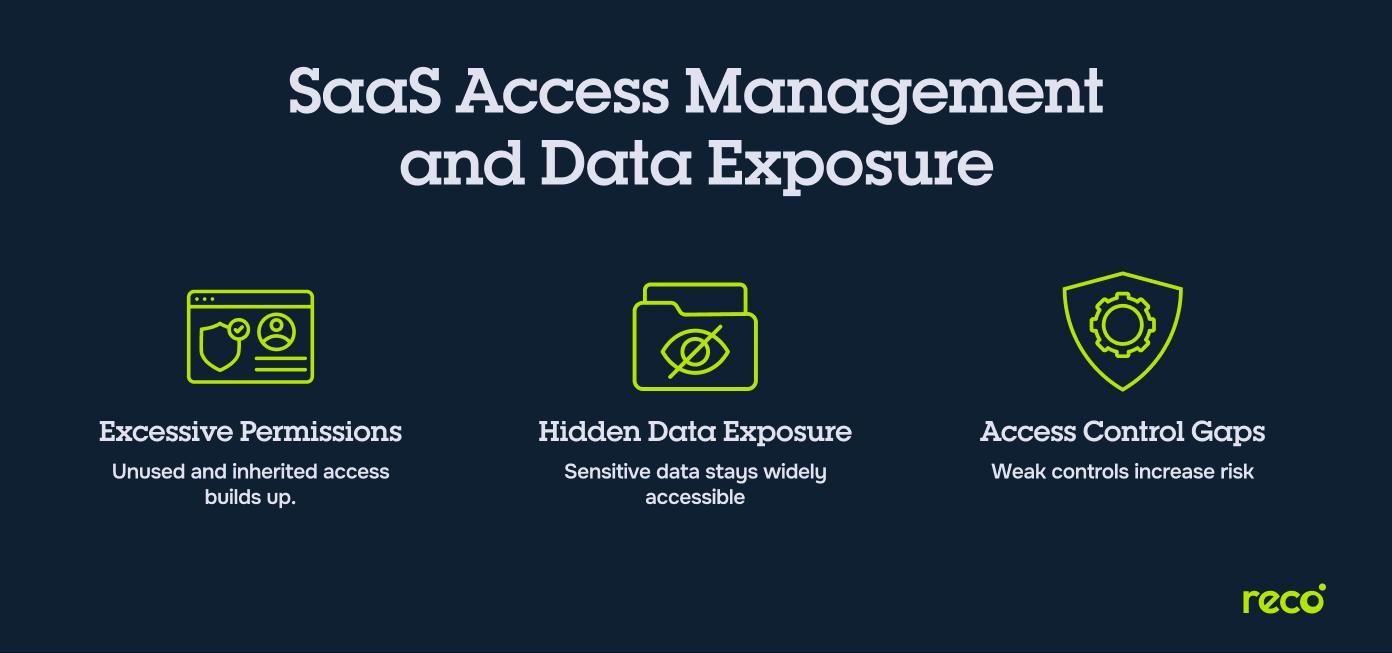
SaaS Access Management and Data Exposure
Excessive permissions, unmanaged identities, and uncontrolled SaaS integrations often expose sensitive business data long before a direct breach occurs. Effective SaaS access management reduces these risks by limiting unnecessary access paths and improving visibility into critical systems and data.
How SaaS Access Permissions Create Data Exposure Risk
SaaS applications frequently accumulate excessive permissions through role changes, dormant accounts, inherited access, and OAuth-based integrations. Users, service accounts, and AI agents may retain access to sensitive files, collaboration platforms, customer records, and administrative functions long after the original business needs change.
In interconnected SaaS environments, a compromised account with broad access can trigger a cascade across email systems, cloud storage, messaging platforms, CRMs, and internal documentation repositories in a single incident.
Identifying Sensitive Data Accessible Through Overpermissioned Accounts
Security teams must continuously identify which identities can access sensitive business data across SaaS applications, including employees, contractors, external collaborators, service accounts, AI agents, and third-party integrations. Overpermissioned accounts often emerge through privilege creep, inconsistent offboarding, abandoned integrations, or manual permission assignments. Without centralized visibility into SaaS identities and permissions, organizations may struggle to detect unnecessary access to regulated, financial, operational, or customer-related data.
Reducing the SaaS Data Attack Surface Through Access Controls
Organizations reduce SaaS data exposure by enforcing least privilege access, limiting OAuth scopes, applying MFA and conditional access policies, and continuously reviewing permissions across cloud applications. Automated provisioning and deprovisioning workflows help eliminate dormant accounts and stale permissions before they become security liabilities. Continuous behavioral monitoring surfaces risky access paths, unauthorized SaaS usage, and unusual identity activity before they expand the organization's SaaS attack surface.
SaaS Access Management Metrics and KPIs
Tracking SaaS access management metrics helps security teams measure identity risk, operational efficiency, and access governance effectiveness across cloud environments. These KPIs also support compliance reporting and security reviews.
SaaS Access Management and Compliance Requirements
SaaS access management plays a central role in meeting regulatory and security requirements across cloud environments. Organizations must demonstrate that access to sensitive systems and data is controlled, monitored, and reviewed across employees, contractors, third-party users, and non-human identities.
- Access Controls for SOC 2 and ISO 27001: Frameworks such as SOC 2 and ISO 27001 require formal access control policies, least privilege enforcement, authentication safeguards, and periodic access reviews. SaaS access management helps standardize these controls across applications and identities.
- Supporting GDPR and HIPAA Requirements: Regulations such as GDPR and HIPAA require organizations to limit unauthorized access to personal, financial, and healthcare-related data. Access governance helps organizations monitor permissions, restrict sensitive data access, and maintain audit records for regulated environments.
- Audit Readiness Across SaaS Applications: Security and compliance teams must maintain visibility into user permissions, provisioning activity, OAuth grants, and administrative changes across SaaS applications. Access monitoring simplifies audit preparation and reduces compliance gaps.
- Tracking User Activity for Compliance Reviews: Activity logs and behavioral monitoring help organizations track authentication events, permission changes, access requests, and unusual identity activity across SaaS ecosystems.
Challenges in SaaS Access Management
As organizations expand their SaaS ecosystems, access governance becomes increasingly difficult across users, applications, integrations, and distributed environments. Security teams must balance usability, operational speed, and compliance while maintaining visibility into evolving identity risks.
- Managing Hundreds of SaaS Applications Simultaneously: Large organizations often operate hundreds of SaaS applications with different permission models, administrative controls, and integration requirements, making centralized governance operationally complex.
- Handling Remote and Hybrid Workforces: Employees, contractors, and third-party collaborators access SaaS applications from multiple devices, locations, and unmanaged networks, expanding the attack surface and complicating authentication and monitoring.
- Maintaining Consistent Access Policies Across Environments: SaaS applications frequently support different authentication methods, access models, and administrative capabilities, making it difficult to enforce uniform least-privilege policies, MFA requirements, and access review processes.
- Keeping Pace with AI Agents and SaaS Sprawl: AI agents, automation tools, OAuth integrations, and unsanctioned SaaS applications continue to expand rapidly across organizations, often outside traditional IAM visibility and governance controls.
SaaS Access Management Best Practices
Effective SaaS access management requires governance across human users, non-human identities, SaaS integrations, and cloud applications. Organizations reduce identity risk by combining access controls, visibility, and lifecycle management within a unified security strategy.
How Reco Improves SaaS Access Visibility and Identity Risk Detection
The challenges described above, including shadow SaaS, overpermissioned accounts, dormant service accounts, and AI agents operating outside IAM visibility, are exactly what Reco is built to surface. As an AI Agent Security Platform, Reco covers the entire SaaS lifecycle, cradle to grave, across 225+ connected applications, giving security teams continuous visibility into the identities, permissions, and integrations that traditional IAM tools miss.
- Live Inventory of Every App, Agent, and Identity: Security teams get continuous visibility into every connected SaaS application, AI agent, and OAuth integration, including tools that never authenticate through the corporate identity provider, without manual scans or stale CMDB exports. Reco's application discovery surfaces SaaS-to-SaaS integrations, AI agents, and shadow tools as they appear.
- Overpermissioned Accounts Identified and Remediated in One Place: Excessive permissions, missing MFA, and risky administrative privileges across users, service accounts, and AI agents are flagged and resolved from a single platform, without spreadsheet-driven access reviews or back-and-forth with application owners. Reco's identity and access governance provides one-click remediation for risky access across SaaS applications.
- Hidden Permission Paths Become Visible in a Single Map: Orphaned accounts, inherited access, and OAuth scope chains that manual reviews routinely miss are surfaced through Reco's Knowledge Graph, which visualizes relationships between users, applications, permissions, integrations, and data flows, exposing cross-application permission paths that expand the attack surface.
- Continuous Access Lifecycle Monitoring, Not Quarterly Reviews: Incomplete offboarding, dormant accounts, stale permissions, and unusual identity activity are caught in real time rather than during periodic audits. Reco's Identity Context Agent analyzes identity behavior across the SaaS lifecycle, with AI-powered validation confirming that access has actually been revoked.
- New Apps Under Governance in 3-5 Days, Not Quarters: The AI agents, OAuth integrations, and SaaS applications users adopt outside IT are brought under governance on a timeline competitors measure in quarters. Reco's SaaS App Factory delivers new app integrations in 3-5 days, closing the visibility gap that lets non-human identities become indirect privilege escalation paths and expand data exposure.
Conclusion
The perimeter moved. It's not the network anymore, it’s the identity. Every employee, contractor, service account, AI agent, and OAuth integration is now a door into the SaaS estate. Some of those doors are governed. Many are not. Organizations that treat access as a continuous lifecycle, from discovery through provisioning, monitoring, and removal, keep pace with SaaS sprawl without expanding their attack surface. The ones that treat it as a quarterly review get blindsided.
The harder problem is what comes next. AI agents and non-human identities are already operating outside traditional IAM visibility, often with broader permissions than the humans who authorized them. Security teams that extend least privilege, behavioral monitoring, and continuous validation to these identities will reduce data exposure long before a breach forces the conversation. The rest will learn those lessons under worse conditions.
FAQs
How can companies reduce SaaS access sprawl as their application stack grows?
Organizations reduce SaaS access sprawl by centralizing visibility across applications, automating lifecycle management, and continuously reviewing permissions tied to users, service accounts, and integrations.
Key practices include:
- Enforcing least privilege access policies
- Automating onboarding and offboarding workflows
- Monitoring shadow SaaS usage and dormant accounts
- Continuously reviewing OAuth grants and third-party integrations
- Centralizing SaaS application discovery and access governance
What is the biggest security risk in SaaS access management?
One of the biggest risks is excessive or unmanaged access across SaaS applications. Over time, users, AI agents, service accounts, and third-party integrations often accumulate permissions beyond what they actually need.
Common exposure paths include:
- Overprivileged user accounts
- Dormant or orphaned accounts
- Missing MFA enforcement
- OAuth-connected applications with broad permissions
- Shadow SaaS operating outside the identity provider
How do SaaS integrations and OAuth grants create hidden access risks?
OAuth integrations allow applications and AI agents to access SaaS data without direct password sharing. While this improves usability and automation, it also creates hidden access paths that security teams may struggle to monitor.
OAuth-related risks often include:
- Excessive application permissions
- Organization-wide delegated access
- Dormant third-party integrations
- AI agents retaining long-lived access tokens
- Limited visibility into connected applications and scopes
These hidden access relationships can expand sensitive data exposure over time. Teams focused on limiting that exposure can learn more about Reco's data exposure management capabilities.
Can Reco detect unauthorized SaaS applications that bypass the identity provider?
Yes. Reco continuously discovers SaaS applications, browser-based tools, SaaS-to-SaaS integrations, and AI agents operating across the environment, including applications that never authenticate through the corporate identity provider.
This helps security teams:
- Detect shadow SaaS usage
- Identify unmanaged integrations and OAuth grants
- Surface unknown third-party applications
- Monitor risky application behavior
- Maintain a live inventory of connected SaaS services
Teams looking to uncover unmanaged applications and connected identities can explore Reco's application discovery capabilities.
How does Reco help security teams monitor non-human identities and AI agents?
Reco helps security teams monitor AI agents, service accounts, OAuth-connected applications, and other non-human identities operating across SaaS environments.
Its capabilities include:
- Continuous monitoring of AI agents and integrations
- OAuth scope analysis and permission mapping
- Detection of excessive permissions and stale access
- Identity behavior monitoring across SaaS applications
- Cross-identity risk detection tied to non-human accounts
For teams that need deeper monitoring of identity-based threats, Reco's identity threat detection and response capabilities extend this coverage with behavioral analysis and contextual risk prioritization. Teams looking to understand their current SaaS identity exposure can request a demo or explore Reco's identity and access governance capabilities.
Gal Nakash


%201.svg)
ABOUT THE AUTHOR
Gal is the Cofounder & CPO of Reco. Gal is a former Lieutenant Colonel in the Israeli Prime Minister's Office. He is a tech enthusiast, with a background of Security Researcher and Hacker. Gal has led teams in multiple cybersecurity areas with an expertise in the human element.


%201.svg)


.svg)