


AI Compliance Framework: Governing AI Risk in Modern SaaS Environments


What Is an AI Compliance Framework?
An AI compliance framework is a structured system of governance, policies, controls, and oversight mechanisms that ensures AI systems operate within legal, regulatory, and ethical boundaries. It helps organizations mitigate risks such as misuse, bias, privacy breaches, and accountability gaps, while enabling the responsible adoption of AI.
A strong framework advances transparency, risk management, data governance, security, and continuous monitoring across the entire AI lifecycle, from design and deployment through ongoing use and review.
Main Components of an AI Compliance Framework
While implementation differs by organization and risk profile, most AI compliance programs are built around a common set of control areas that support governance, accountability, and ongoing risk management.
Why AI Compliance Frameworks Matter for Enterprise Risk and Governance
As AI adoption expands across business functions, organizations face rising expectations from regulators, customers, and internal stakeholders. AI compliance frameworks help enterprises manage that pressure with consistent oversight and defensible processes.
- Growing Regulatory Pressure Across AI Use Cases: Governments are introducing new rules for high-impact AI systems, privacy protections, transparency, and automated decision-making across multiple sectors.
- Increasing Use of AI Across SaaS Applications: Business platforms increasingly include copilots, assistants, recommendation engines, and generative AI features that may be enabled faster than internal review processes can assess them.
- Rising Shadow AI and Unapproved Tool Usage: Employees often adopt external AI tools independently, creating visibility gaps for security, legal, and compliance teams.
- Expanding Third-Party and Data Exposure Risks: AI services may process prompts, uploaded files, internal records, or customer data, increasing the need for stronger vendor governance and data-handling controls.
- Need for Continuous Audit Readiness: Organizations are increasingly expected to show how AI is governed, who can access it, and what evidence supports compliance decisions.
Key AI Compliance Frameworks and Regulations
Organizations often align their AI governance programs to recognized laws, standards, and risk management models. The most relevant frameworks today include the following:
- EU AI Act and Risk-Based Classification: The EU AI Act is the first comprehensive cross-sector AI law adopted by a major jurisdiction. It applies a risk-based model that places systems into categories such as minimal, limited, high-risk, and prohibited uses, with stricter obligations for higher-risk systems.
- NIST AI Risk Management Framework (AI RMF): Developed by the U.S. National Institute of Standards and Technology, the NIST AI RMF provides voluntary guidance for identifying, assessing, and managing AI risk. Its core functions are Govern, Map, Measure, and Manage.
- ISO/IEC Standards for AI Governance: International standards such as ISO/IEC 42001 help organizations establish AI management systems. These standards support governance, accountability, continual improvement, and documented control processes.
- GDPR and Data Protection Requirements for AI: The General Data Protection Regulation applies when AI systems process personal data. Relevant obligations can include lawful processing, data minimization, transparency, security measures, and data subject rights.
- US AI Governance and Policy Landscape: The United States currently regulates AI through a combination of existing laws, sector regulators, federal guidance, and state-level legislation rather than one unified national AI statute.
The Shift from Traditional AI Compliance Frameworks to SaaS and Shadow AI Governance
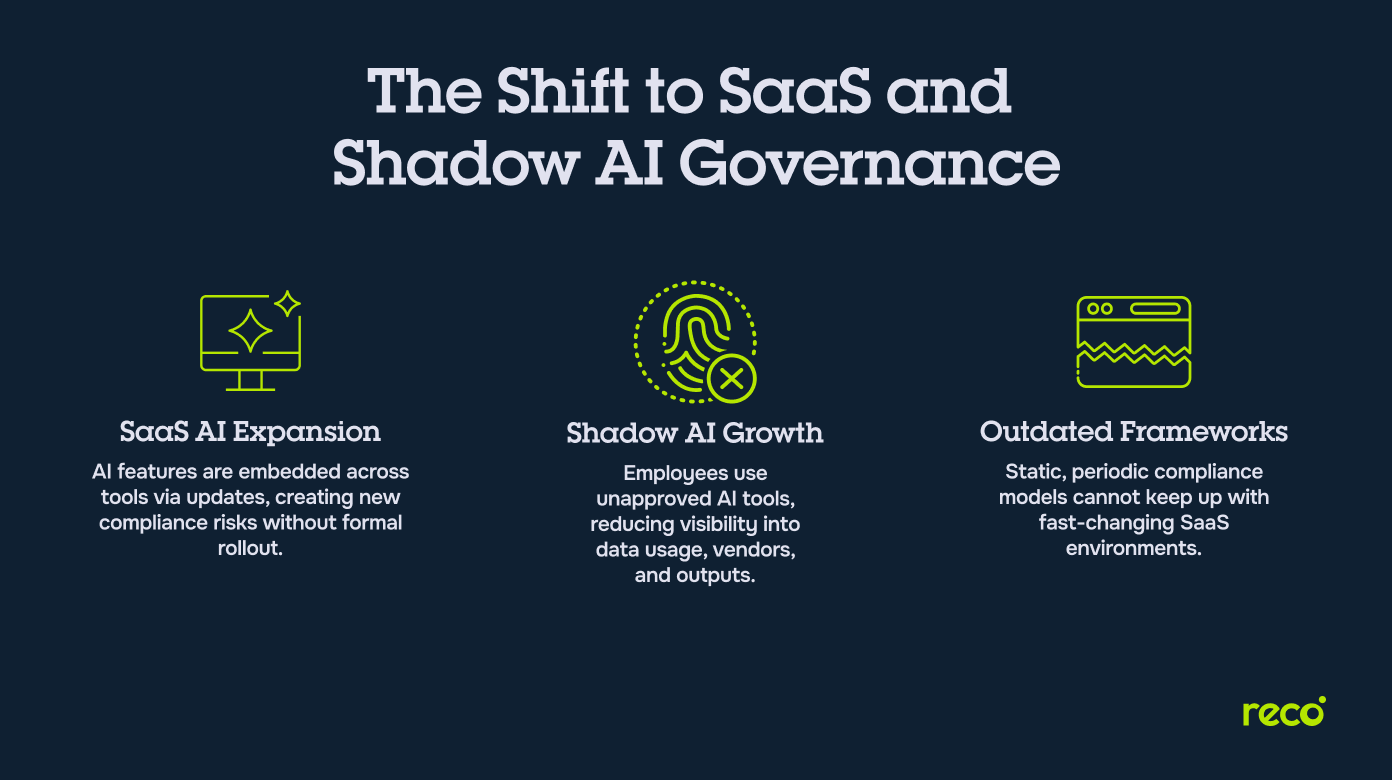
AI governance has changed quickly. Many organizations now use AI through SaaS platforms, embedded features, and employee-adopted tools rather than only internally managed systems. As a result, traditional compliance models often need stronger visibility and faster oversight.
Rise of AI Embedded in SaaS Applications
AI now appears across major SaaS platforms through copilots, automated content generation, intelligent search, forecasting, workflow recommendations, and natural language assistants. In many cases, these capabilities are introduced through existing subscriptions or vendor product updates, which can create new compliance obligations without a separate deployment project.
Shadow AI as a Growing Compliance Blind Spot
Shadow AI refers to the use of unapproved AI tools, browser extensions, or external services outside formal procurement and security processes. Employees may adopt these tools for coding support, summarization, research, or productivity tasks. Without visibility, organizations may not know what data is being shared, which vendors are involved, or how generated outputs are being used.
Limitations of Traditional Frameworks in Dynamic SaaS Environments
Traditional compliance models often rely on periodic assessments, manual inventories, and static vendor reviews. These methods can fall behind when AI features change frequently, integrations are added quickly, and permissions shift across teams. Effective governance in SaaS environments increasingly depends on continuous discovery, ongoing monitoring, and faster policy enforcement.
How to Build an AI Compliance Framework for SaaS Environments
Creating an effective framework starts with understanding where AI is used, which risks matter most, and how oversight will be maintained as environments change. The following steps provide a practical roadmap for SaaS organizations:
Common Challenges in AI Compliance Framework Implementation
Even well-designed programs can face execution challenges, especially in SaaS environments where AI capabilities evolve quickly. The following issues commonly create delays, visibility gaps, or inconsistent control coverage.
- Shadow AI Discovery Gaps: Employees may use external AI tools, browser extensions, or unsanctioned productivity apps without formal approval. This can limit visibility into data sharing, vendor access, and business dependence on those tools.
- Limited Visibility into Embedded AI Features: Numerous major SaaS platforms offer AI assistants, copilots, automation, and smart recommendations via routine product updates. Organizations may track the core application yet have limited visibility into which AI capabilities are enabled or how they handle internal data.
- Incomplete SaaS-to-AI Connection Mapping: Modern environments may include APIs, plugins, browser add-ons, and third-party integrations that connect SaaS platforms to external AI services. Without a clear mapping of these relationships, assessing data flows, permissions, and downstream exposure becomes more difficult.
- Policy Drift Across Rapidly Changing Applications: Internal policies may be written for earlier product configurations while vendor capabilities continue to change. New AI functions, access settings, or workflow automations can create gaps between documented requirements and the system's actual behavior.
- Fragmented Ownership Across Security, GRC, and IT: AI governance responsibilities are commonly distributed across multiple teams. Security may focus on access and data risk, GRC on regulatory obligations, and IT on application administration, which can create coordination challenges.

Dr. Tal Shapira
Cofounder & CTO at Reco

Tal is the Cofounder & CTO of Reco. Tal has a Ph.D. from Tel Aviv University with a focus on deep learning, computer networks, and cybersecurity and he is the former head of the cybersecurity R&D group within the Israeli Prime Minister's Office. Tal is a member of the AI Controls Security Working Group with CSA.

Expert Insight: Why Most AI Compliance Programs Fail Before They Start
In my experience, many AI compliance programs fail because teams start with policy language before they understand actual AI usage. In SaaS environments, visibility should come first. Once you know where AI is operating, governance becomes far easier to apply and defend.
Practical Steps That Work
- Map Real AI Usage First: Identify embedded AI features, external AI tools, copilots, and connected applications already in use.
- Rank by Data Sensitivity: Prioritize systems that touch customer records, source code, financial data, or internal documents.
- Assign One Owner Per Risk Area: Split accountability clearly across Security, GRC, IT, and business teams.
- Collect Evidence Continuously: Save approvals, access reviews, vendor assessments, and policy exceptions as they happen.
- Review Quarterly: AI features and vendor capabilities change quickly.
Takeaway: Start with visibility, then build controls around real usage instead of assumptions.
Best Practices for Operationalizing AI Compliance Frameworks
Once a framework is defined, the next challenge is applying it consistently across live SaaS environments. The practices below help organizations maintain visibility, accountability, and ongoing compliance as usage evolves:
How Reco Improves AI Compliance with Shadow AI Visibility and Policy Automation
AI compliance in SaaS environments depends on what organizations can actually see, assess, and govern, not only what is written in policy documents. Reco closes that gap by making AI governance and AI agent security core pillars of its platform, built into the same operational model used to manage SaaS risk, access, and compliance. The result is a single layer of continuous visibility and automated control across SaaS apps, embedded AI features, generative AI tools, and autonomous AI agents.
- Shadow AI and OAuth Discovery Across Connected Applications: Shadow AI typically appears through unsanctioned tools, OAuth-connected services, browser extensions, or employee-led workflows outside formal review. Reco's application discovery capabilities surface these connections in a live inventory of apps in use across the environment. Identity and access governance then layers in the permission context, including what each app can access, which accounts may need stronger controls like MFA, and where ownership review is required. Together, they support least-privilege access and more defensible vendor oversight.
- Visibility into Embedded AI and Copilot Features: Many SaaS providers now release copilots, assistants, and AI-driven automation through product updates or existing subscriptions. Reco helps organizations understand how approved applications are evolving by surfacing new integrations, changing capabilities, and user adoption patterns. Through its AI governance and security approach, teams can better align emerging AI features with internal governance standards and control expectations.
- AI Agent and Autonomous Workload Oversight: Agentic AI systems increasingly operate across SaaS environments with delegated permissions, service accounts, and persistent access to sensitive data. Reco's AI agent security capabilities help organizations discover sanctioned and shadow AI agents, monitor their behavior, and apply governance controls so non-human identities follow the same standards as users. This is particularly relevant as enterprises adopt copilots and autonomous workflows that can move data, trigger actions, and access multiple systems on their own.
- Sensitive Data Exposure and Continuous Policy Enforcement: AI risk is closely tied to the data systems that can be reached. Reco's data exposure management capabilities identify sensitive records, risky sharing settings, and broad access paths across SaaS environments. Paired with identity threat detection and response, teams can continuously monitor for risky activity and contain it before it becomes a larger compliance event.
Conclusion
An AI compliance framework has become a practical requirement for organizations using AI across SaaS platforms, copilots, and employee-led tools. Success depends less on lengthy policy documents and more on knowing where AI is in use, what data it can access, and how controls are enforced as environments change.
For security, GRC, and IT teams, the priority is clear: maintain visibility, apply risk-based governance, and keep reliable audit evidence. Organizations that operationalize these fundamentals can turn AI compliance from a reactive obligation into a scalable business capability.
What are the key regulations governing AI compliance today?
AI compliance requirements come from three overlapping sources: AI-specific laws, privacy regulations, and governance standards. They apply to an organization depending on the industry, geography, and use case:
- EU AI Act: Risk-based rules for AI systems operating in the EU market.
- GDPR: Applies when AI systems process personal data.
- NIST AI RMF: Voluntary framework for managing AI risk.
- ISO/IEC 42001: Standard for AI management systems and governance.
- Sector regulations: Healthcare, finance, and public sector organizations may face additional obligations.
Organizations with global operations often map internal controls across multiple frameworks rather than relying on one standard. Explore Reco’s AI governance security solution.
What evidence is required for AI compliance audits?
Auditors typically look for evidence that AI governance controls exist, are operating, and are reviewed regularly. Strong evidence is usually continuous, organized, and easy to verify.
- AI system inventories and approved use case registers
- Risk assessments and classification records
- Vendor due diligence and contractual reviews
- Access control reviews and permission logs
- Policy acknowledgments and employee training records
- Monitoring alerts, incident records, and remediation actions
- Change management records for new AI features or integrations
Well-maintained evidence reduces manual audit preparation and improves defensibility during reviews. Learn about Reco’s automated SaaS compliance monitoring.
How can Reco improve AI compliance across SaaS environments?
Reco helps organizations operationalize AI compliance by improving visibility, access governance, and continuous control monitoring across fast-changing SaaS environments.
- Uncover connected apps and emerging AI tools through application discovery, reducing shadow AI blind spots.
- Review third-party permissions and user privileges through identity and access governance, supporting least-privilege access.
- Prioritize exposed records, risky sharing settings, and sensitive data paths through data exposure management.
- Strengthen ongoing policy checks and audit readiness through SaaS posture management and compliance.
Together, these capabilities help turn AI compliance into an operational process rather than a periodic review exercise.
Gal Nakash


%201.svg)
ABOUT THE AUTHOR
Gal is the Cofounder & CPO of Reco. Gal is a former Lieutenant Colonel in the Israeli Prime Minister's Office. He is a tech enthusiast, with a background of Security Researcher and Hacker. Gal has led teams in multiple cybersecurity areas with an expertise in the human element.


%201.svg)


.svg)