

Looking for Obsidian Security Alternatives? 5 Best Tools Reviewed in 2026


A security team at a 2,400-person fintech company runs its quarterly access review and finds standing access to a customer database, granted to an AI agent spun up eight months ago to automate a support workflow. Nobody remembers who approved it or what data it has touched since. Inside supported apps like Salesforce, Obsidian Security would flag that behavior well. It excels at insider threat and account anomaly detection. But the agent itself was never inventoried, and neither was the shadow SaaS tool three teams over that nobody in security knew existed.
That's the pattern pushing teams toward Obsidian Security alternatives in 2026. Obsidian goes deep inside a defined app set, but AI agents and unconnected shadow apps sit outside it. The gap isn't behavioral depth; it's discovery breadth.
Obsidian Security Overview: Behavioral Analytics Within a Defined App Set
Obsidian built its reputation on precisely monitoring activity within connected applications. Its deepest strength remains UEBA, although it has expanded into agent governance and runtime enforcement. Understanding that distinction is the first step in deciding whether an alternative would be a better fit.
What Obsidian Does Well for Insider Threat and Account Behavior Detection
Obsidian's core strength is correlating real-time activity, app configurations, and breach intelligence inside a knowledge graph, then applying self-learning detection on top of it. This lets it catch account takeovers, session hijacking, and OAuth token abuse with low noise, particularly across M365, Salesforce, and similar core platforms. The deployment model is agentless and API-based, so most teams are up and running within minutes rather than weeks. Customer support is consistently cited as a strength too, with dedicated account teams that help enterprise customers get value from the platform quickly.
Where Its UEBA-First Architecture Creates Gaps for AI Agent and Shadow SaaS Coverage
The same architecture that makes Obsidian sharp inside its supported apps also limits what it can see outside them. Shadow SaaS discovery depends on activity already flowing through connected identity providers and apps, so a tool nobody signed up through SSO or an unfederated app can sit outside its visibility entirely. Obsidian has expanded into AI agent security, agent governance, and agent runtime security as named capabilities, including MCP server inventory and OWASP-aligned risk scoring for agents built on platforms like Microsoft Copilot, Claude, Salesforce Agentforce, and n8n. The question for teams evaluating alternatives isn't whether Obsidian covers agents, but whether its architecture delivers the cross-environment identity governance and remediation depth that enterprises with complex, multi-platform agent estates need. And once something is discovered, remediation often stops at flagging the anomaly rather than closing it, leaving teams doing the cleanup manually.
Why Behavioral Depth Without Discovery Breadth Leaves Growing Environments Exposed
Any app or identity Obsidian does not connect to remains a blind spot, regardless of how strong its detection is. That distinction matters as SaaS integrations and third-party tools multiply faster than teams can manually add them to a platform built around a known app catalog. Even with its expanded agent governance capabilities, Obsidian’s visibility is still strongest where it is deployed. For environments that extend beyond a fixed set of apps and platforms, coverage breadth matters just as much as detection quality.
What Moves Security Teams Beyond Obsidian Security
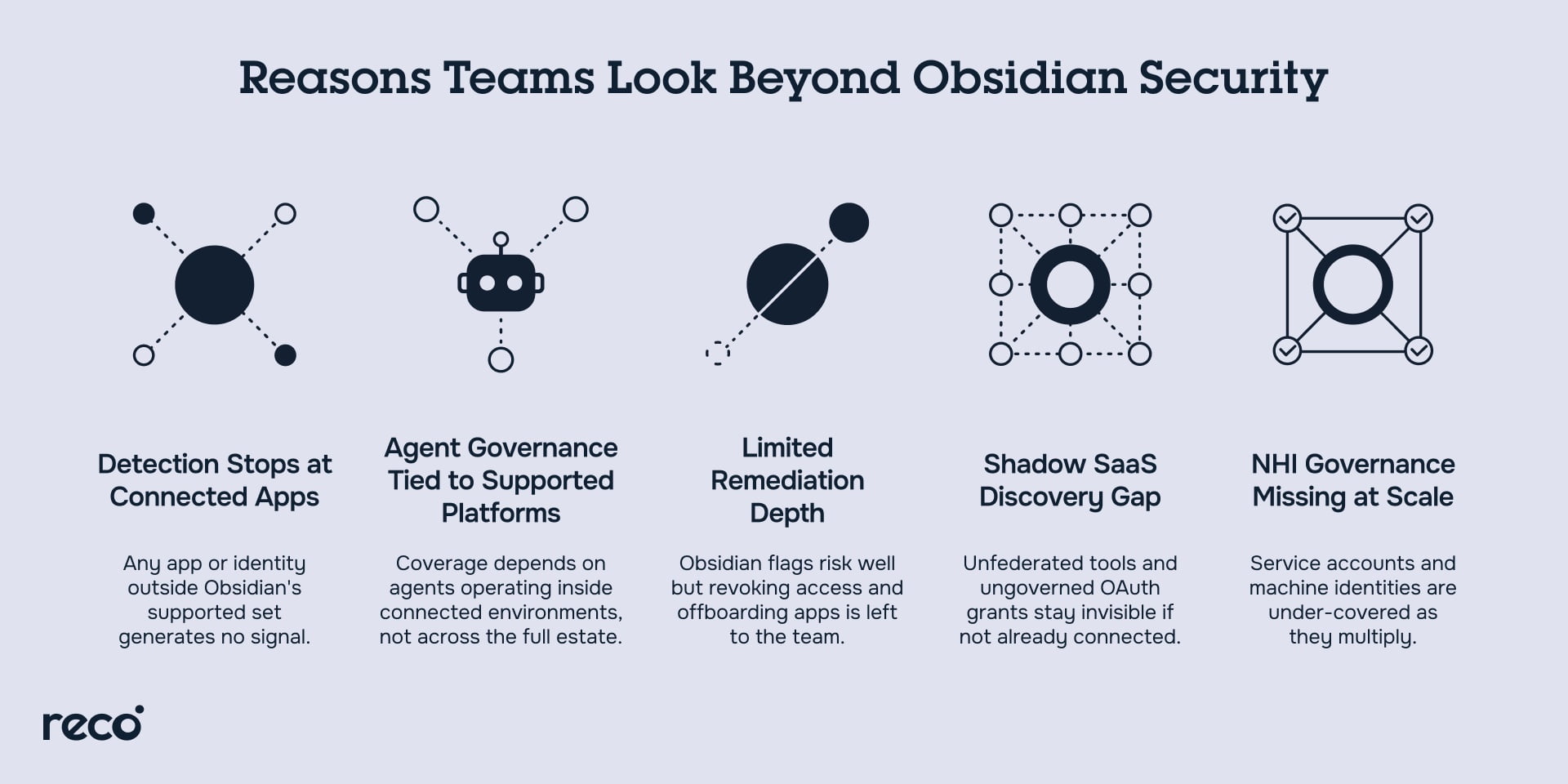
Five specific limitations tend to surface once teams try to extend Obsidian past its original scope. Each one maps to a capability the alternatives in this guide were built to cover.
- Behavioral Analytics That Stop at the Edge of Supported Applications: Detection only runs where Obsidian is connected, so any app or identity outside that set generates no signal.
- Agent Governance Still Bound to Supported Platforms and Apps: Obsidian's agent inventory, runtime enforcement, and MCP visibility cover major platforms like Copilot, Claude, and Salesforce Agentforce - but like its core UEBA model, coverage still depends on the agent operating inside a connected, supported environment rather than extending natively across the full estate.
- Limited Remediation Capability Beyond Surfacing Behavioral Anomalies: Obsidian flags risk well, but closing it (revoking access, offboarding an app, removing a stale grant) is largely left to the team.
- Shadow SaaS Discovery That Depends on What Is Already Connected: Discovery runs off identity providers and connected apps, so unfederated tools and ungoverned OAuth grants can stay invisible indefinitely.
- Identity Governance That Does Not Extend to Non-Human Identities at Scale: Governance is built around human accounts, leaving service accounts and other machine identities under-covered as they multiply.
Top Obsidian Security Alternatives: TL;DR
5 Obsidian Security Alternatives Worth Evaluating in 2026
Each tool below takes a different angle on the gap Obsidian leaves open, from full agent ecosystem coverage to data-centric classification. Here's what each does well, who it fits, and who it doesn't.
1. Reco

Reco is an AI Agent Security Platform built for what most security tools miss: agents, non-human identities, and third-party sprawl across the entire environment. It runs on the Reco Graph, mapping identity, permissions, connectivity, and activity into a living exposure map. Reco Factory adds new integrations in days, not quarters, and the Identity Context Agent continuously catches orphaned accounts and incomplete access removal. With one of the largest catalogs in the category (280+ agent and app integrations), Reco covers the full lifecycle, cradle to grave, closing the exact gap behavioral tools hit when they run out of ground to watch.
Reco Is for You If:
- Your environment includes agents across multiple frameworks that need to be inventoried as governed identities.
- Shadow third-party tools make manual spreadsheet triage unsustainable.
- You need remediation that goes beyond detection and verifies that access was actually removed, not merely requested.
Reco Is Not for You If:
- Your environment is small, static, and limited to a handful of core tools with no agent usage planned.
- You only need compliance checklist coverage, not identity-level remediation.
- The budget requires a single-purpose tool, not a platform spanning discovery, governance, and threat detection.
What Customers Say: A G2 reviewer highlighted Reco's clean, intuitive interface for surfacing posture risk and prioritizing what needs attention first. (G2)
2. AppOmni
AppOmni is an SSPM and AISPM platform built on patented, agentless API scanning. It continuously checks configurations, permissions, and third-party connections across apps like Salesforce, M365, and ServiceNow against best-practice baselines. AppOmni has also extended coverage to AI-powered SaaS platforms and shadow AI.
AppOmni Is for You If:
- You want deep, granular configuration and permission auditing across a defined set of core SaaS apps.
- Agentless, API-based scanning fits your deployment preferences.
- Compliance reporting against frameworks like NIST CSF and SOC 2 is a core requirement.
AppOmni Is Not for You If:
- Your biggest exposure is agent sprawl across many AI frameworks rather than posture drift in a known app set.
- You need OAuth-grant-level shadow SaaS discovery beyond core supported apps.
- Reporting flexibility matters; some reviewers cite dashboard customization as a weak point.
What Customers Say: A verified G2 reviewer said AppOmni alerts them to possible security risks so they can proactively remediate. (G2)
3. Netskope
Netskope is primarily an SSE and SASE platform, secure web gateway, CASB, and zero trust access, with SaaS Security Posture Management as one module inside it. That module checks SaaS settings against benchmarks like CIS and NIST, using graph-based detections to flag misconfigurations and risky OAuth connections.
Netskope Is for You If:
- You already run Netskope for SSE or CASB and want SaaS posture folded into that same console.
- You are consolidating network security and SaaS security spend under one platform.
- Compliance benchmarking across a defined app set covers your primary use case.
Netskope Is Not for You If:
- You are shopping specifically for a dedicated SaaS or AI agent security tool, not a network security platform with SSPM attached.
- AI agent inventory and non-human identity governance are a primary requirement.
- You want to avoid adopting a full SSE platform just to get SaaS posture coverage.
What Customers Say: A G2 reviewer praised the Netskope One Platform for its comprehensive visibility and data protection across cloud apps. (G2)
4. Varonis
Varonis is a data-centric security platform built around classification and exposure analysis, not app-level posture. It scans sensitive data across SaaS, multi-cloud, and on-prem environments, applying AI classification to find where sensitive data lives and how it is exposed, with an optional 24x7 managed detection service (MDDR).
Varonis Is for You If:
- Your primary risk is sensitive data exposure across a hybrid environment, not just SaaS app posture.
- You want a managed service layer rather than running detection and response entirely in-house.
- Deep data classification accuracy matters more than AI agent inventory.
Varonis Is Not for You If:
- Your primary gap is AI agent and SaaS-to-SaaS integration visibility, not data classification.
- Your timeline cannot absorb a multi-month implementation; reviewers cite around 4 months to value.
- You need a lighter, faster-to-deploy tool over a full data security platform.
What Customers Say: A G2 reviewer said the SaaS version's interface is a significant improvement, with strong support from the team. (G2)
5. Wing Security
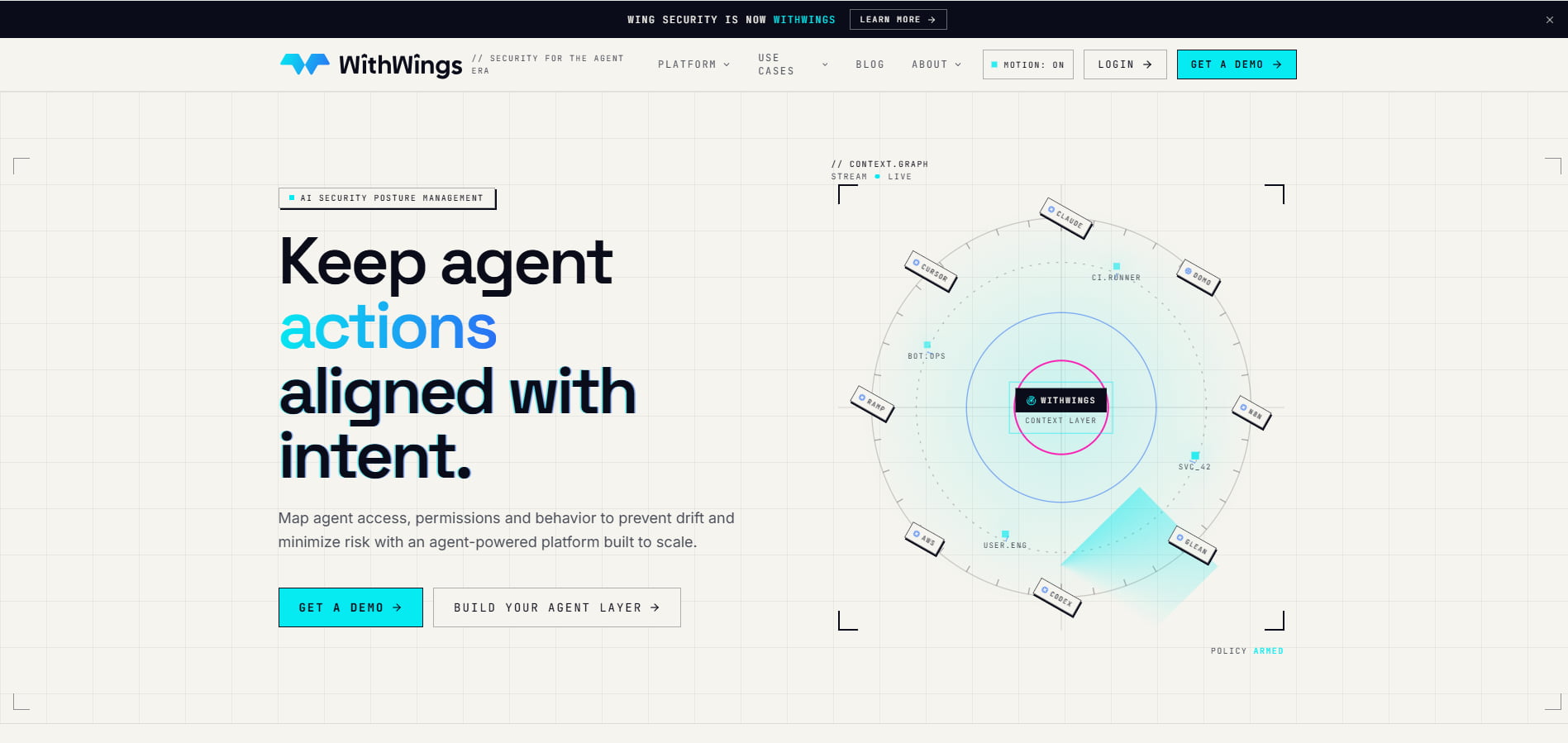
Wing Security (now With Wings at withwings.ai) is an AI security posture management platform that has evolved toward agent-based security. It deploys contextual security agents that learn your environment, map agent access, monitor behavior, and enforce policy. Discovery, observability, control, enforcement, and mitigation are delivered as separate deployable agents rather than a unified SSPM console.
Wing Security Is for You If:
- You want fast visibility into risk within minutes, without a lengthy setup process.
- Bulk, automated remediation matters more than deep configuration-level auditing.
- You are a smaller or mid-market team that needs SaaS visibility without a lengthy implementation.
Wing Security Is Not for You If:
- You need enterprise-grade depth across large, complex non-human identity estates.
- Detailed vendor and app risk metadata is a requirement; some reviewers note it runs thinner here.
- You need published, self-serve pricing rather than a quote-based sales process.
What Customers Say: A G2 reviewer said Wing makes it much easier to track their SaaS vendors and understand who is using what. (G2)
Notable Tools That Didn't Make the List and Why
These three came up repeatedly as close contenders during research, but each had a specific gap that kept them off the primary list.
- Grip Security: Strong identity-driven SaaS and AI discovery, correlating email, browser, and IdP signals to surface shadow apps and OAuth risk. Left off the list since its remediation still leans on connected telemetry completeness; teams that skip a data source lose coverage.
- Push Security: Browser-native detection that catches identity attacks (AiTM phishing, session hijacking) other tools miss entirely. Left off the list since its visibility is scoped to browser activity; apps and agents operating outside the browser sit outside its reach.
- UpGuard: Unifies vendor, attack surface, and workforce risk in one console, with AI-powered questionnaire automation and continuous, on-demand vendor monitoring. Left off the list since it's built around third-party and attack surface risk management rather than SaaS app posture or AI agent inventory.
Obsidian Security vs. Alternatives at a Glance
Here's how Obsidian and each alternative work under the hood, deployment, approach, and where each one fits best.
What Enterprise Teams Should Expect From an Obsidian Security Alternative
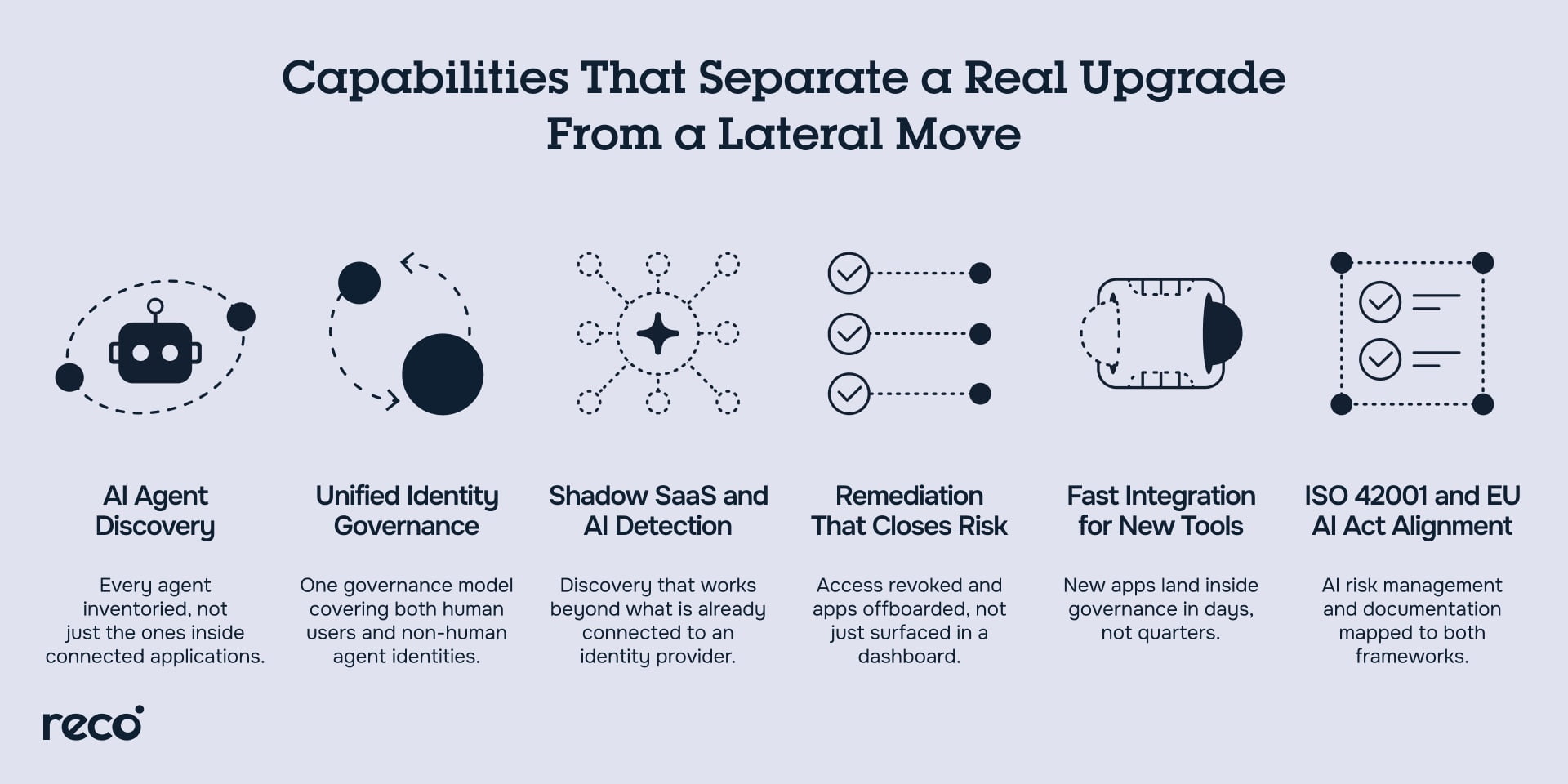
These six capabilities separate a real upgrade from a lateral move.
- AI Agent Discovery and Agentic Posture Management Across the Full Environment: Every agent inventoried, not just the ones inside connected apps.
- Identity Governance Covering Both Human Users and Non-Human Agent Identities: One governance model, not a human-only system with agents bolted on.
- Shadow SaaS and Shadow AI Detection Beyond the Sanctioned App Catalog: Discovery that doesn't depend on what's already connected to an identity provider.
- Remediation That Goes Beyond Flagging Risk to Actually Closing It: Access revoked and apps offboarded, not just surfaced in a dashboard.
- Integration Speed for New Apps and AI Tools in Days, Not Quarters: New tools land inside governance before they become a blind spot.
- Compliance Alignment Including ISO 42001 and EU AI Act Coverage: AI risk management, inventory, and documentation mapped to both frameworks, since ISO 42001 provides the governance foundation but doesn't itself satisfy the EU AI Act's binding legal requirements for high-risk systems.
Before You Switch: What to Confirm Before Replacing Obsidian Security
A few things are worth confirming before committing to a switch, so the new platform actually closes the gap rather than just moving it.
- Mapping Obsidian's Behavioral Coverage to Broader Discovery and Posture Capabilities: Confirm the replacement covers application discovery and posture management as thoroughly as Obsidian covers behavior inside its supported apps, not just a wider app list with shallower detection.
- Whether Your Primary Risk Is Insider Behavior or AI Agent and Shadow SaaS Sprawl: If the bigger exposure is unmanaged agents and unconnected tools rather than account anomalies, prioritize identity threat detection and response over pure behavioral analytics.
- How Remediation Works in the Replacement Platform vs. Manual Follow-Up: Check whether identity and access governance in the replacement platform actually closes risk, revoking access, offboarding apps, or just flags it for someone to act on later.
- Integration Timeline for Apps Outside Obsidian's Supported Catalog: Ask how long a new tool takes to land inside governance; Reco Factory adds coverage in days, not the weeks or quarters some platforms require.
Conclusion
Obsidian Security earned its reputation through precise, low-noise behavioral detection across a defined set of core applications. Its precision was never the problem. Its limited coverage is. Risk increasingly lies beyond the applications Obsidian monitors, in undiscovered agents, unconnected third-party tools, and ungoverned non-human identities. This blind spot is growing faster than platforms built around a known application catalog can keep up with.
Reco was built for this new reality, mapping every agent, tool, and identity across the entire environment. Whichever alternative you choose, make sure it addresses where your risk lives today, not where it lived when Obsidian was built.
FAQs
What should security teams prioritize when evaluating Obsidian alternatives: behavioral depth or breadth across the full SaaS and agent estate?
Both matter, but breadth is the harder gap to close later. Behavioral depth improves how well a tool catches anomalies inside the apps it already watches. Breadth determines whether it sees the app, agent, or identity at all.
- If your environment is stable and limited to a known set of core apps, behavioral depth alone may be sufficient.
- If agents, third-party integrations, or unconnected tools are multiplying, breadth becomes the deciding factor, since undetected risk can't be analyzed no matter how precise the detection engine is.
- Most enterprise environments in 2026 need both, but should weigh breadth first if forced to choose.
How does Reco's identity-first approach differ from Obsidian's behavioral analytics model for detecting cross-app identity risk?
Obsidian analyzes behavior inside the apps it connects to. Reco starts from identity and access governance, mapping every agent, tool, and permission an identity holds across the entire environment, then tracking how that access moves and changes over time.
- Obsidian's model is strong at catching anomalous behavior once an identity is inside a supported app.
- Reco's model tracks the identity across every connected agent and tool, not just the ones with behavioral monitoring enabled.
- This closes cross-app identity risk that behavioral tools miss when an identity's access spans systems outside their supported catalog.
How does Reco govern non-human identities like agents that behavioral analytics tools were never designed to track?
Agents are treated as governed identities from the moment they're detected through identity threat detection and response, not as a category bolted onto human-identity tooling after the fact.
- Every agent is mapped to its owner, its permissions, and what it can reach.
- Deviations from expected agent behavior are flagged the same way identity threats are, through continuous monitoring rather than periodic review.
- New agents are inventoried automatically as they appear, closing the gap where ungoverned agents operate invisibly.
