

Claude Mythos and SaaS Security: What You Need to Know


What Is Claude Mythos?
Claude Mythos is a frontier AI model developed by Anthropic, now in its fifth iteration as Claude Mythos 5, with advanced capabilities in cybersecurity and biology research.
As part of Project Glasswing, Anthropic and roughly 50 partners used Claude Mythos Preview to identify more than 10,000 high- and critical-severity vulnerabilities across some of the world's most important software systems. The results prompted Anthropic to limit general availability while expanding access through a vetted partner program that now includes approximately 150 organizations across more than 15 countries.
Access to Mythos 5 remains limited to approved partners, reflecting the sensitivity and potential impact of these capabilities.
For security teams, Mythos is important not because it introduces new attack techniques but because it demonstrates how AI can accelerate vulnerability research and security operations at an unprecedented scale.
Why Claude Mythos Changes the SaaS Threat Landscape
Claude Mythos highlights how quickly AI-driven attack capabilities are evolving. For SaaS security teams, the concern is not a specific model but how these capabilities can expose weaknesses that already exist across applications, identities, integrations, and access controls.
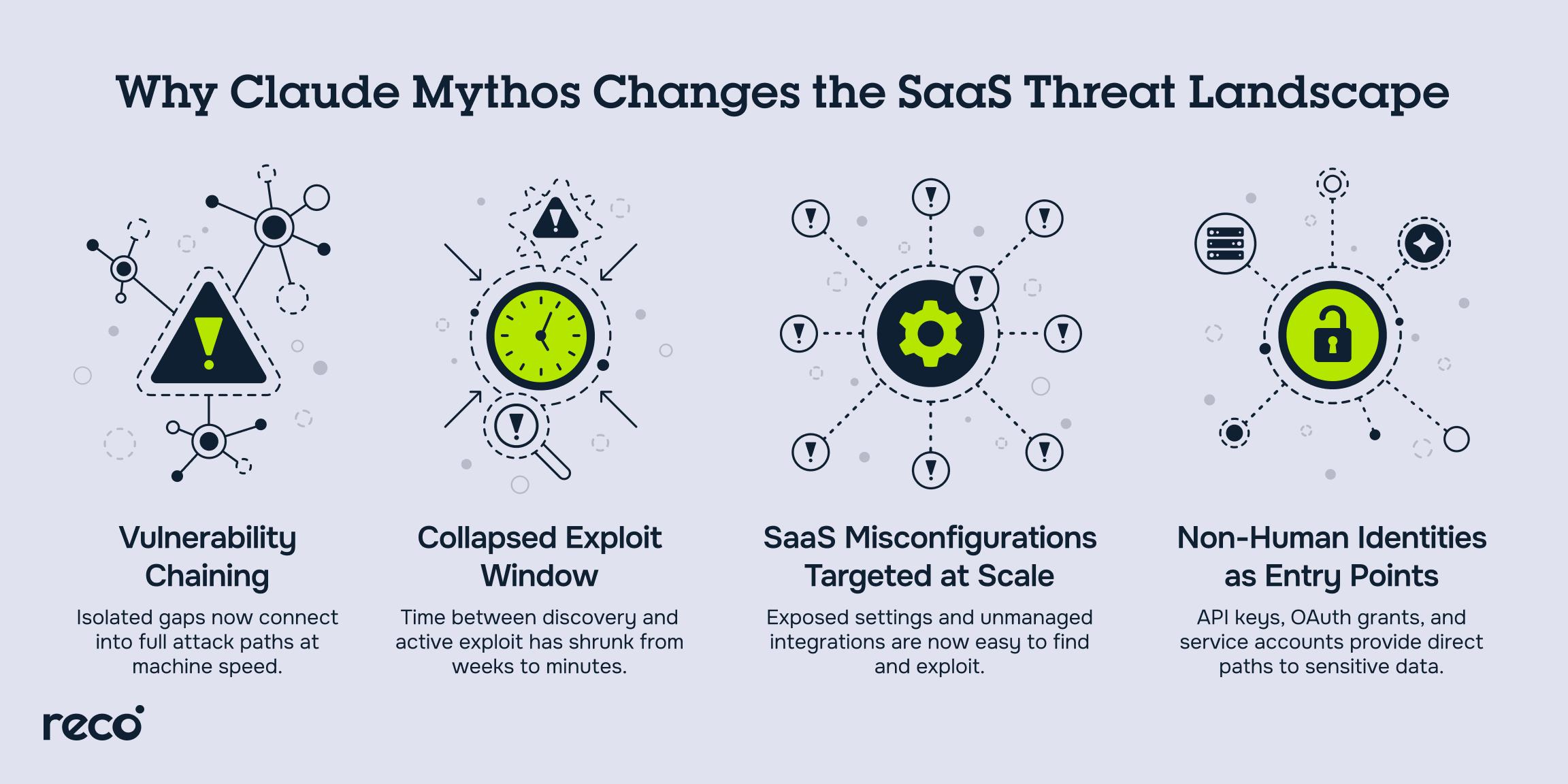
- Automated Vulnerability Chaining at Machine Speed: Weaknesses that once appeared isolated can now be analyzed and connected into complete attack paths much faster. Identity exposures, excessive permissions, insecure integrations, and configuration gaps can become part of the same attack chain.
- The Exploit Window Has Collapsed From Weeks to Minutes: Security teams have traditionally relied on time to investigate and remediate newly discovered risks. As AI accelerates vulnerability analysis and exploit development, that response window continues to shrink.
- SaaS Misconfigurations as the Primary Attack Surface: Misconfigured SaaS applications, excessive sharing settings, exposed resources, and unmanaged integrations often present a more accessible target than sophisticated infrastructure attacks. AI allows attackers to identify these issues at scale.
- Non-Human Identities and Over-Privileged Tokens as Entry Points: Service accounts, API keys, OAuth grants, and AI agents frequently have broad access across business-critical systems. Without proper governance, they can provide a direct path to sensitive data and high-value SaaS assets.
How Mythos-Class AI Targets Enterprise SaaS Environments
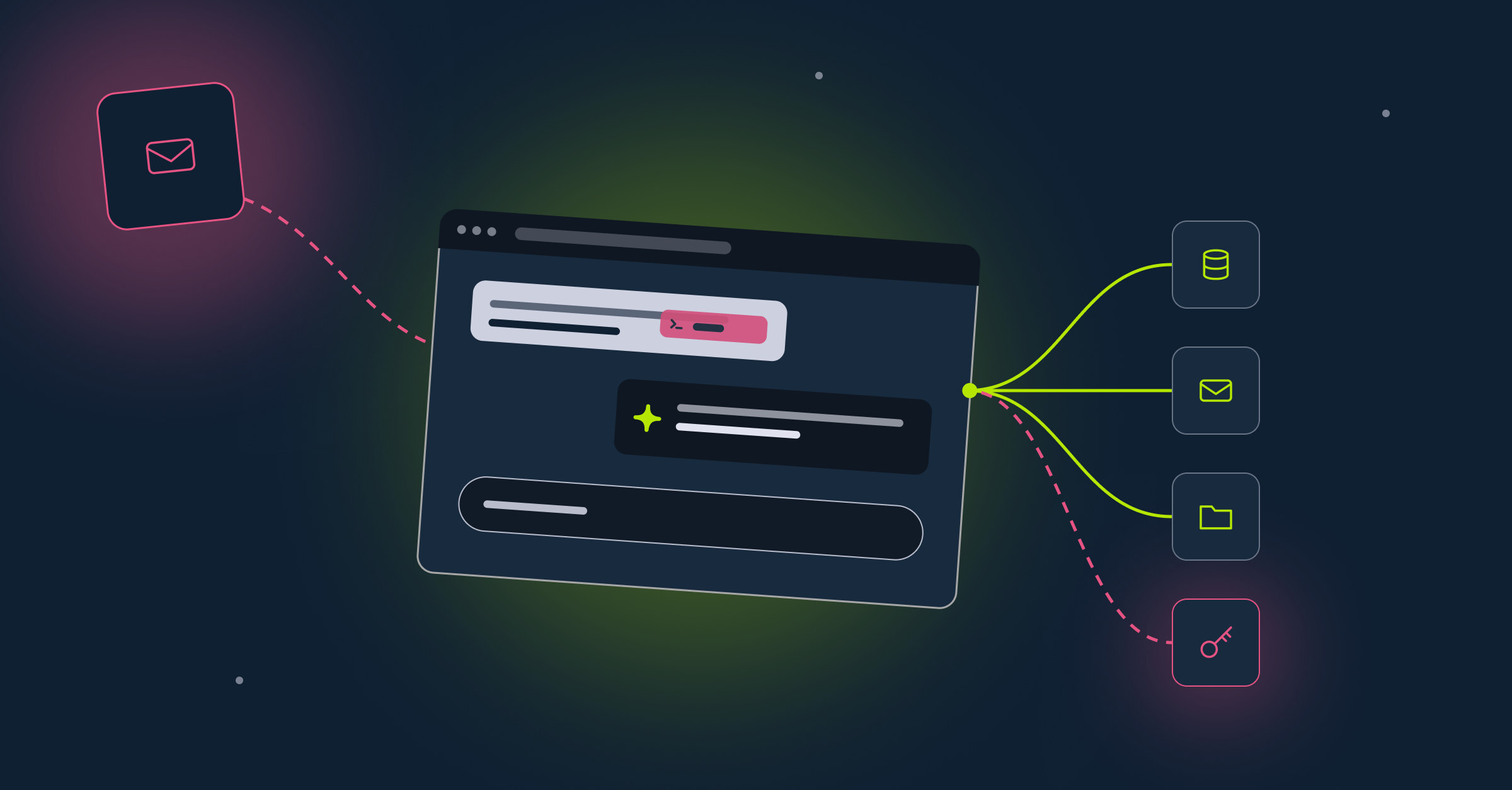
Most enterprise SaaS environments contain thousands of identities, applications, integrations, and permission relationships. Mythos-class AI can rapidly analyze these interconnected systems to identify weaknesses that attackers may use to gain access, escalate privileges, and move across critical business applications.
What Security Teams Need to Do Now
The emergence of Mythos-class AI does not require an entirely new security strategy. It requires organizations to execute core SaaS security practices faster, more consistently, and across a much larger attack surface.
- Audit Every App and Agent Across the SaaS Perimeter: Security teams cannot protect assets they cannot see. Establish a complete inventory of SaaS applications, AI agents, service accounts, third-party integrations, and connected identities to identify unmanaged access paths and hidden risks.
- Close Misconfiguration Gaps Before They Are Found and Chained: Configuration weaknesses that appear low risk in isolation can become part of a larger attack path when combined with other exposures. Continuously identify and remediate excessive permissions, insecure sharing settings, and configuration drift across critical SaaS applications.
- Govern Non-Human Identities With the Same Rigor as Human Ones: Service accounts, API keys, OAuth tokens, and AI agents often have access to sensitive systems and data. Apply the same visibility, ownership, access reviews, and least-privilege controls used for human users to every non-human identity.
- Accelerate Detection to Match the Speed of AI-Driven Attacks: As attack cycles become increasingly automated, delayed detection can significantly increase risk. Invest in continuous monitoring, behavioral analytics, and automated response workflows that reduce the time between identifying suspicious activity and taking action.

Gal Nakash
Cofounder & CPO at Reco

Gal is the Cofounder & CPO of Reco. Gal is a former Lieutenant Colonel in the Israeli Prime Minister's Office. He is a tech enthusiast, with a background of Security Researcher and Hacker. Gal has led teams in multiple cybersecurity areas with an expertise in the human element.

Expert Insight: Visibility Gaps Matter More Than Threat Sophistication
Security teams often focus on the sophistication of emerging threats while overlooking the visibility gaps that make those threats succeed. Mythos-class AI reinforces a key reality: attackers do not need a zero-day if they can find excessive permissions, unmanaged applications, orphaned accounts, or over-privileged tokens.
To reduce exposure:
- Continuously inventory SaaS applications, AI agents, and third-party integrations.
- Review non-human identities with the same frequency as user accounts.
- Prioritize misconfigurations that create access paths between critical applications.
- Monitor OAuth grants and service accounts for unnecessary privileges.
The most effective defense against AI-driven attacks is reducing exploitable paths before attackers find them. Visibility and governance often eliminate risk long before detection and response become necessary.
Best Practices for Hardening Your SaaS Stack Against Mythos-Class Threats
As AI-driven attack capabilities continue to evolve, organizations must focus on reducing exploitable exposure across their SaaS ecosystem. The following practices can help security teams strengthen visibility, reduce risk, and improve resilience against increasingly automated attacks.
- Enforce Least-Privilege Across Every App and Agent: Apply least-privilege principles to human users, service accounts, API keys, OAuth grants, and AI agents. Limiting access to only what is required reduces the potential impact of compromised identities, tokens, and third-party integrations.
- Continuously Monitor SaaS Posture and Flag Drift in Real Time: SaaS environments change constantly as users, applications, permissions, and integrations evolve. Continuous posture monitoring helps identify configuration drift, excessive permissions, and newly introduced risks before they can be exploited.
- Vet Every Third-Party App and Agent Before and After Deployment: Third-party applications and AI agents often receive access to sensitive systems and business data. Security reviews should occur before deployment and continue throughout the application's lifecycle to ensure permissions remain appropriate and risk levels do not change over time.
- Build a Readiness Framework That Covers Before, During, and After an Attack: Organizations should prepare for AI-driven threats before an incident occurs, establish clear detection and response processes during an attack, and conduct post-incident reviews to identify control gaps and strengthen future defenses. A structured readiness framework helps security teams respond more effectively as attack timelines continue to shrink.
How Reco Helps Security Teams Get Ahead of Mythos-Class AI Threats
Mythos-class AI increases the importance of visibility, governance, and continuous monitoring across the SaaS ecosystem. Reco's approach to Agentic Ecosystem Security extends the same governance organizations apply to human users across every non-human identity: service accounts, API keys, OAuth grants, and AI agents that automated attackers reach for first.
- Every Non-Human Identity, Mapped to What It Can Reach: Reco's identity and access governance treats service accounts, API keys, OAuth grants, and AI agents as first-class identities, not afterthoughts. The Knowledge Graph shows which non-human identity can reach which system, where access is excessive, and which accounts are orphaned, so the identities attackers target first stop being a blind spot.
- Agents and Shadow Access the Identity Provider Never Sees: Reco's browser guard and MCP discovery bring agents and shadow apps that bypass IAM under identity governance, governing the non-human access that operates entirely outside central authentication.
- Least Privilege Enforced Across the Agent Fleet: Reco surfaces every over-privileged token, OAuth grant, and agent permission, then flags when an agent holds more access than the person who created it. Bringing non-human identities to least privilege shrinks what a single compromised agent or token can reach.
- Identity Threat Detection Tuned to Non-Human Abuse: More than 1,000 pre-built detections through identity threat detection and response catch the permission abuse, token misuse, and lateral movement that Mythos-class AI surfaces, watching human and non-human identities alike for behavior that signals compromise.
Conclusion
Mythos-class AI does not see your company the way you do. Not a team, not a budget, not a roadmap. It sees an attack surface, and it reads that surface in minutes.
The organization that closed its exposure first looks like a dead end. Every token scoped to one job. Every agent boxed into a single task. Orphaned accounts already removed. The AI traces the environment, finds nothing that meaningfully connects, and moves on.
The organization that waited looks like an invitation. One over-privileged service account reaches three critical systems. One forgotten OAuth grant opens the door to Salesforce. One shadow agent has more access than the person who built it. The AI finds the first weakness in seconds, and every weakness after it becomes the next link in a chain it was built to assemble.
Same model. Same speed. Two outcomes. The difference was never how capable the AI became. It was whether the exposure still existed when the AI came looking.
FAQs
What makes Mythos-class AI fundamentally different from earlier AI security threats?
Earlier AI tools handled isolated tasks such as drafting phishing emails, summarizing code, and speeding up reconnaissance. Mythos-class AI reasons through a full attack lifecycle, connecting separate weaknesses into a working attack path with little human direction.
- It analyzes thousands of identities, permissions, and integrations at once.
- It chains low-severity exposures into high-impact attack paths.
- It compresses weeks of expert research into minutes.
The bar for a sophisticated attack has dropped, so the weaknesses already in your environment matter far more than they used to.
Why are SaaS misconfigurations particularly vulnerable to automated AI-driven attack chains?
Misconfigurations are common, easy to find, and rarely require a sophisticated exploit to abuse, making them an efficient target for automated analysis. One excessive sharing setting or over-privileged token can open a much larger chain across connected applications.
- They look low risk in isolation but compound when linked together.
- They go unnoticed as applications, users, and permissions change.
- They create access paths between critical applications that attackers can follow.
Because these gaps accumulate quietly, continuous SaaS posture management is increasingly important for reducing risk before attackers can exploit it.
How should security teams prioritize SaaS hardening when the exploit window is under 30 minutes?
When exploitation takes minutes, prevention beats reaction. The priority is cutting the number of exploitable paths before an attacker finds them, spending limited resources on the exposures that create the most access for the least effort.
- Close misconfigurations that link critical applications together.
- Revoke excessive permissions on tokens, OAuth grants, and service accounts.
- Maintain continuous visibility so new risks surface as they appear.
Detection speed still matters, but in a sub-30-minute window, the teams that win are the ones that already shrank their attack surface, leaving fewer paths to chain.
How does Reco help security teams discover and govern the non-human identities that Mythos-class AI targets?
Service accounts, API keys, OAuth grants, and AI agents often hold broad access with little oversight, making them a direct path to sensitive data and a natural target for automated attacks. Reco governs these non-human identities the same way it governs human users, so they stop being a blind spot.
- It maps every identity and its access across the SaaS environment.
- It flags over-privileged, orphaned, and unmanaged non-human identities.
- It surfaces when an agent has more access than the person who created it.
Non-human identities outnumber human ones and change constantly, so bringing them under the same identity and access governance controls is one of the most effective ways to close the gaps Mythos-class AI is built to find.
Can Reco detect when an AI agent or third-party app is behaving anomalously across a SaaS environment?
Yes. Reco pairs behavioral monitoring with context from across the SaaS ecosystem to spot activity that deviates from normal patterns, catching compromised or misbehaving agents before they cause damage. Instead of relying on static rules, it correlates activity across identities, applications, permissions, and integrations to surface behavior worth investigating.
- It baselines activity across users, agents, and applications.
- It flags anomalies such as unusual access, data movement, or privilege use.
- It delivers context-rich alerts that explain what happened and why it matters.
When an agent reaches for data it has never touched or acts outside its normal behavior, Reco's identity threat detection and response capabilities give security teams the context to investigate and respond fast.

Tal Shapira
%201.svg)
ABOUT THE AUTHOR
Tal is the Cofounder & CTO of Reco. Tal has a Ph.D. from the school of Electrical Engineering at Tel Aviv University, where his research focused on deep learning, computer networks, and cybersecurity. Tal is a graduate of the Talpiot Excellence Program, and a former head of a cybersecurity R&D group within the Israeli Prime Minister's Office. In addition to serving as the CTO, Tal is a member of the AI Controls Security Working Group with the Cloud Security Alliance.
Tal is the Cofounder & CTO of Reco. Tal has a Ph.D. from the school of Electrical Engineering at Tel Aviv University, where his research focused on deep learning, computer networks, and cybersecurity. Tal is a graduate of the Talpiot Excellence Program, and a former head of a cybersecurity R&D group within the Israeli Prime Minister's Office. In addition to serving as the CTO, Tal is a member of the AI Controls Security Working Group with the Cloud Security Alliance.


.png)


%201.svg)


.svg)