
Real AI Security Incidents: Lessons from the Field


Artificial intelligence is rapidly embedding itself into enterprise workflows, but real-world AI security incidents show how quickly this adoption can introduce risk. Sensitive data leakage through generative AI tools, prompt injection attacks, and unauthorized access across SaaS environments are already occurring at scale.
These incidents rarely stem from a single mistake. Instead, they reveal gaps in identity management, access control, and visibility, especially as AI systems interact with sensitive data and interconnected applications in ways security teams struggle to monitor and control.
What Real AI Security Incidents Reveal About Enterprise Risk
When examined closely, these incidents follow consistent patterns that extend beyond individual failures. Risk emerges at the intersection of AI systems, SaaS applications, and identity layers, driven by how these systems are deployed, connected, and accessed.
- AI Incidents Rarely Start in Isolation: Most incidents originate from a combination of user actions, SaaS integrations, and AI system behavior rather than a single failure point, making root cause analysis more complex.
- SaaS Ecosystems Amplify AI Risk Exposure: AI tools integrate with multiple SaaS applications, increasing the attack surface and enabling a single compromised integration to propagate risk across systems.
- Identity and Access are Central to AI Incidents: Over-permissioned users, service accounts, and AI agents often enable unintended access to sensitive data and critical workflows.
- Lack of Visibility Delays Detection: Security teams often lack visibility into AI usage, prompt activity, and cross-app data flows, allowing incidents to go undetected for longer.
- AI Adoption Outpaces Security Controls: Organizations deploy AI capabilities faster than they implement governance, monitoring, and access controls, creating gaps that attackers can exploit.
Real AI Security Incidents: Examples
Real-world incidents show that AI-related risks are not theoretical. They appear across multiple layers, including data handling, model behavior, and automated decision-making, often with direct business impact.
Lessons From Real AI Security Incidents
Real-world AI incidents consistently point to a small set of underlying weaknesses. These lessons highlight where enterprise security strategies must evolve to effectively manage AI-driven risk.
- Visibility Gaps are the Root Cause of Most Incidents: Security teams often lack full visibility into AI usage, prompt interactions, and cross-application data flows, allowing risky behavior and data exposure to go undetected. This is especially critical in SaaS environments where AI tools operate outside traditional monitoring boundaries.
- Identity Context is Critical for Faster Investigation: Understanding which user, service account, or AI agent initiated an action is essential for tracing incidents and reducing time to resolution. Without identity-level context, correlating actions across SaaS and AI systems becomes slow and unreliable.
- Over-Permissioning Significantly Expands Blast Radius: Excessive access rights across users, APIs, and AI agents enable incidents to escalate quickly, exposing more data and systems than necessary. Many real incidents show that AI tools inherit permissions far beyond what is required for their function.
- SaaS-to-AI Connections Require Continuous Governance: Integrations between AI tools and SaaS applications introduce dynamic risk that changes over time. OAuth scopes, API access, and third-party plugins must be continuously monitored to prevent misuse.
- Reactive Security Models Fail for AI Workflows: Traditional detection and response approaches are too slow for AI-driven interactions, where actions occur in real time and across multiple systems. By the time alerts are triggered, the impact has often already spread.
- Incident Response Must Include AI-Specific Playbooks: Security teams need dedicated procedures for handling AI-related incidents, including prompt analysis, access and activity review, and integration-level investigation. Standard playbooks do not account for how AI systems process and expose data.
Why Real AI Security Incidents Matter for Enterprise Security Teams
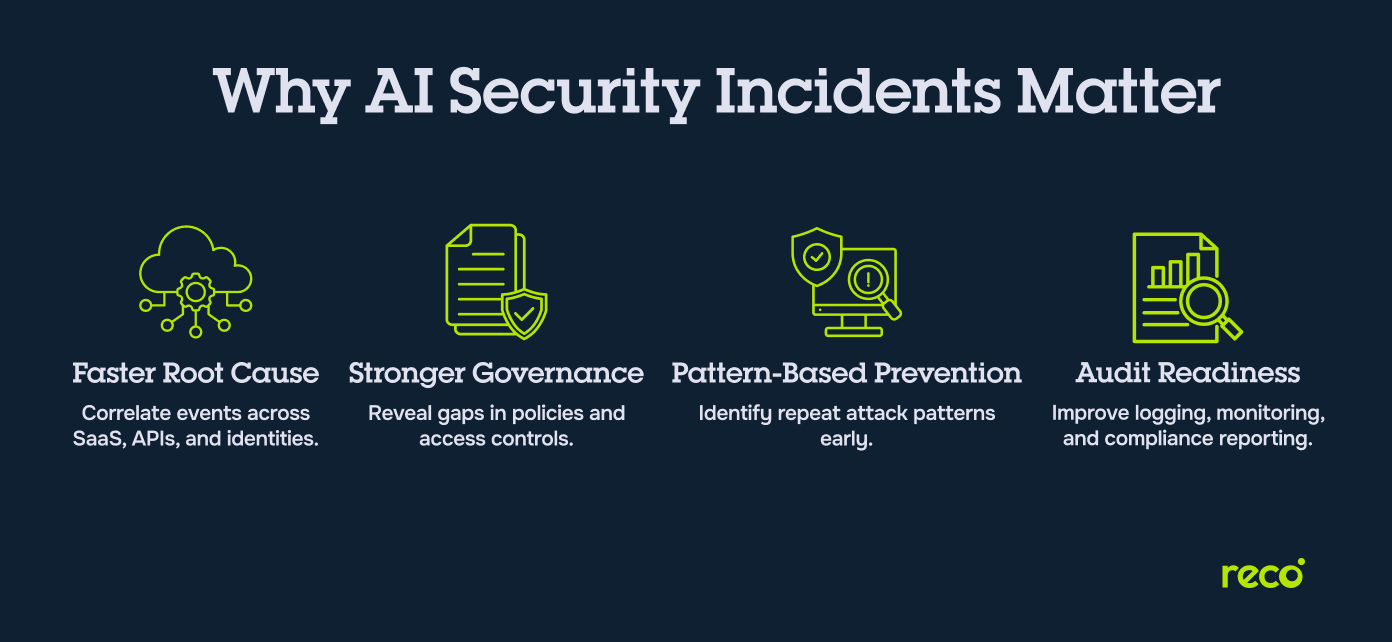
These incidents provide more than postmortem insights. They expose how modern attack paths form across AI systems, identities, and SaaS applications, giving security teams a clearer framework for improving detection, governance, and response.
Faster Root Cause Discovery Across SaaS and AI Systems
AI-related incidents rarely exist within a single system. They span prompts, APIs, SaaS integrations, and identity layers, making root-cause analysis significantly more complex than traditional incidents. Studying these patterns helps security teams correlate events across systems, reduce investigation time, and more accurately identify the initial entry point and scope of impact.
Improved AI Governance and Policy Decisions
Observed failures highlight where governance frameworks break down in practice. Gaps in acceptable use policies, data handling rules, and integration controls often emerge only after deployment. These insights enable security teams to refine policies around prompt usage, third-party AI tools, and access permissions based on actual usage patterns rather than assumptions.
Reduced Repeat Incidents Through Pattern Recognition
Recurring attack patterns such as prompt injection, over-permissioned access, and integration misuse create predictable risk conditions. Identifying these patterns allows teams to move from reactive response to proactive risk reduction, systematically addressing weaknesses before they lead to repeated incidents.
Stronger Audit, Compliance, and Reporting Readiness
AI introduces new layers of data access, processing, and decision-making that must be accounted for in audits and compliance frameworks. Reviewing past incidents helps organizations strengthen logging, monitoring, and reporting mechanisms, improving their ability to demonstrate control over AI-driven workflows during audits and internal risk assessments.
Common AI Security Incident Patterns Observed in the Field
AI security incidents tend to follow repeatable patterns that emerge across SaaS environments, identity layers, and AI workflows. Understanding these patterns helps security teams identify risk conditions early and prevent escalation:
How AI Security Incidents Escalate Across SaaS Environments
AI-related incidents rarely remain contained. Once an initial action occurs, risk can quickly propagate across SaaS applications, identities, and data stores through a predictable escalation path.
- Unsanctioned AI App Signup and Usage: A user adopts an AI tool using a corporate identity without security review, establishing an unmonitored entry point into the SaaS environment.
- OAuth Token Grants and Scope Expansion: The AI application requests and receives OAuth permissions, often with broad scopes that allow access to emails, files, and other sensitive resources.
- Lateral Movement Across SaaS Applications: With granted permissions, the AI tool or associated integrations can access multiple connected applications, enabling movement across systems without additional authentication.
- Access to Sensitive Files, Emails, and Data Stores: The AI system interacts with high-value data sources, retrieving or processing sensitive information that may be exposed through prompts, outputs, or integrations.
- Persistence Through Long-Lived Tokens or Integrations: Access remains active through stored tokens or persistent integrations, allowing continued data access even after the initial activity is no longer visible.

Gal Nakash
Cofounder & CPO at Reco

Gal is the Cofounder & CPO of Reco. Gal is a former Lieutenant Colonel in the Israeli Prime Minister's Office. He is a tech enthusiast, with a background of Security Researcher and Hacker. Gal has led teams in multiple cybersecurity areas with an expertise in the human element.

Expert Insight: Investigate AI Incidents by Following Identity and Access Paths
In my experience, the fastest way to understand AI-related incidents is to shift focus from the model to the identity and access layer. Most issues don’t originate in the AI system itself but in how it interacts with SaaS applications and data.
- Start with the Identity: Identify which user, service account, or AI agent initiated the activity and what permissions were in place.
- Trace OAuth Scopes and Tokens: Review granted permissions to understand how access expanded across systems.
- Map Connected Applications: Look at all integrations tied to the AI tool to uncover lateral movement paths.
- Prioritize Data Access: Focus on what sensitive data was accessed, not just what action was taken.
The Key Takeaway Is Simple: AI incidents become manageable once you treat them as identity-driven access events rather than isolated system failures.
Key Components of AI Incident Investigation
Effective AI incident investigation requires correlating activity across identities, SaaS applications, and AI systems. Each component plays a critical role in reconstructing what happened and identifying the root cause.
Best Practices for Learning From Real AI Security Incidents
Applying lessons from real AI incidents requires moving beyond awareness to continuous monitoring, governance, and response improvements across SaaS and AI environments.
- Continuously Discover AI Apps, Agents, and Copilots: Maintain real-time visibility into all AI tools in use, including sanctioned and unsanctioned applications, to eliminate blind spots and reduce shadow AI risk.
- Monitor OAuth Grants and Third-Party Integrations: Track granted permissions, scopes, and connected applications to identify excessive access and prevent unauthorized data exposure through AI integrations.
- Map AI Usage to Sensitive Data and Business Context: Understand which data sources AI tools interact with and how that data aligns with business-critical processes to prioritize risk and enforce appropriate controls.
- Build AI-Specific Incident Response Playbooks: Develop dedicated procedures for investigating AI-related incidents, including prompt analysis, integration review, and identity-based tracing across SaaS environments.
- Align AI Governance with SaaS Security Controls: Ensure AI usage policies, access controls, and monitoring strategies are integrated with existing SaaS security frameworks to maintain consistent enforcement and visibility.
How Reco Helps Reduce AI Incident Risk Across SaaS Environments
Reducing AI-related risk across SaaS environments requires continuous visibility, identity context, and control over how applications, data, and integrations interact. Reco addresses these challenges by aligning AI risk management with core SaaS security operations.
- Continuous Discovery of Shadow AI Tools, Agents, and Copilots: Reco continuously identifies both sanctioned and unsanctioned AI applications across the environment through its application discovery capabilities, eliminating blind spots and ensuring AI usage remains visible and governed. Reco's SaaS App Factory identifies new and unsanctioned AI tools as they connect to the environment, including agents and copilots added without IT approval.
- SaaS-to-AI Connection Mapping Across Apps, Identities, and Data: Reco provides a unified view of how AI tools connect to SaaS applications, users, and sensitive data by combining AI Governance, application discovery, and SaaS posture visibility. This enables stronger control over integrations and data flow across interconnected systems.
- Identity-Based Context for Faster AI Incident Investigation: Reco's Identity Knowledge Graph links user and non-human identities to AI activity, enabling teams to trace actions and accelerate investigations. This combines identity and access governance with continuous monitoring and threat detection for accurate attribution across SaaS and AI systems.
- Visibility into Permissions, Access Paths, and Risky Behavior Patterns: Reco surfaces excessive permissions, risky integrations, and abnormal activity across SaaS and AI workflows using data exposure management, helping reduce risk and limit potential impact.
Conclusion
Managing AI risk requires operational discipline across identity, data, and SaaS environments. As AI systems become embedded in everyday workflows, security teams need clear visibility into how access, data flows, and integrations interact in real time. This demands consistent governance, tighter control over permissions, and the ability to investigate activity across connected systems.
Every real AI incident breaks the same way: an identity, an integration, and a data source that nobody was watching together. Most security stacks see each piece in isolation, which is why investigations stretch into days, and exposure keeps growing while teams piece the story together. Teams that correlate AI activity with identity context and SaaS connections close incidents faster and expose less data. That is the capability Reco is built to provide.
Which SaaS signals reveal hidden AI risk first?
Hidden AI risk often appears through indirect signals rather than explicit alerts. These signals typically emerge from identity activity, integrations, and unusual data access patterns.
- New or unknown applications connected via OAuth
- Unusual prompt activity tied to sensitive data sources
- Sudden spikes in API calls or data access requests
- Access from AI tools to previously unused SaaS resources
These early indicators help security teams detect shadow AI usage before it leads to broader exposure.
How does Reco detect shadow AI before data leakage?
Detecting shadow AI early depends on visibility into application usage and identity activity across SaaS environments. Reco continuously identifies unsanctioned AI tools as they connect to corporate systems, using capabilities such as application discovery to surface unknown apps and data exposure management to flag risky access patterns.
- Continuous monitoring of new SaaS and AI app connections
- Detection of OAuth grants and third-party integrations
- Identification of unknown or unmanaged applications
- Correlation of user activity with newly introduced tools
What governance gaps cause repeat AI incidents?
Inconsistent controls across identities, integrations, and data access usually drive repeat incidents. These gaps allow the same risk conditions to persist over time.
- Lack of centralized visibility into AI usage
- Over-permissioned users, agents, and integrations
- Missing policies for third-party AI tools
- Limited monitoring of data access and movement
Addressing these gaps requires aligning AI governance with broader SaaS security controls and access policies.
How does Reco improve AI incident investigation across SaaS apps?
Effective investigation depends on correlating activity across identities, applications, and data. Reco improves this by linking user and non-human identities to AI activity, combining identity and access governance with identity threat detection and response to provide full context during analysis.
- Mapping identities to AI-driven actions
- Correlating events across multiple SaaS applications
- Analyzing OAuth tokens, permissions, and access paths
- Reconstructing timelines across connected systems
Which metrics best prove AI incident reduction over time?
Measuring improvement requires tracking both incident frequency and exposure reduction across AI and SaaS environments.
- Reduction in shadow AI applications detected over time
- Decrease in over-permissioned accounts and integrations
- Faster mean time to detect (MTTD) and respond (MTTR)
- Lower volume of sensitive data exposure events
These metrics help security teams validate the effectiveness of governance, monitoring, and access control strategies.

Tal Shapira
%201.svg)
ABOUT THE AUTHOR
Tal is the Cofounder & CTO of Reco. Tal has a Ph.D. from the school of Electrical Engineering at Tel Aviv University, where his research focused on deep learning, computer networks, and cybersecurity. Tal is a graduate of the Talpiot Excellence Program, and a former head of a cybersecurity R&D group within the Israeli Prime Minister's Office. In addition to serving as the CTO, Tal is a member of the AI Controls Security Working Group with the Cloud Security Alliance.
Tal is the Cofounder & CTO of Reco. Tal has a Ph.D. from the school of Electrical Engineering at Tel Aviv University, where his research focused on deep learning, computer networks, and cybersecurity. Tal is a graduate of the Talpiot Excellence Program, and a former head of a cybersecurity R&D group within the Israeli Prime Minister's Office. In addition to serving as the CTO, Tal is a member of the AI Controls Security Working Group with the Cloud Security Alliance.