


Reco vs AppOmni: Side-by-Side Comparison [2026]

Reco Overview
Reco is an AI Agent Security Platform built to secure the full lifecycle of SaaS and AI agent identities, from discovery through remediation. It maps every identity, permission, connection, and event into Reco Graph, a living risk map that helps security teams understand how agents, applications, and users relate across the environment. Beyond identifying misconfigurations, Reco uses AI-powered validation to confirm remediation actions, such as access removal, have been completed.
AppOmni Overview
AppOmni is a SaaS Security Posture Management (SSPM) and AI-SPM platform focused on continuous visibility into SaaS configurations, permissions, and AI-enabled environments. It built its reputation on deep, native coverage of Salesforce, Microsoft 365, and ServiceNow before expanding into broader SSPM and AI security. Its AI investigation layer, Marlin AI, launched in 2026 as an autonomous engine that correlates indicators, investigates incidents, and delivers guided remediation. AppOmni also holds FedRAMP authorization, positioning it for federal and regulated-industry deployments.
Reco vs AppOmni: Agent-First Security vs. Event-Driven SaaS Monitoring
The two platforms start from different premises about where SaaS risk originates. Reco builds outward from identity and agentic behavior, giving it depth across every connection an identity touches. AppOmni builds outward from application telemetry and configuration state, giving it depth within a defined set of monitored apps.
Reco: Identity-Depth Security Across the Full Agent and SaaS Lifecycle
Reco treats every AI agent as a non-human identity that needs an owner, a permission set, and a risk score, just like a human account. Its Identity Context Agent tracks agents against the humans who built them, flagging cases where an agent holds more access than its creator or an account sits orphaned after an employee offboards. This identity-first model extends into Reco Graph, giving security teams deep, relationship-level visibility into agentic risk across every app and identity it touches, not a static configuration snapshot of one app at a time.
AppOmni: Event Telemetry Within a Curated App Set
AppOmni's approach centers on observability within a defined set of business-critical applications. Marlin AI correlates indicators, investigates clusters of activity, and surfaces guided remediation steps. This event-driven model gives AppOmni useful visibility within apps like Salesforce, Microsoft 365, and ServiceNow, but that depth stops at the edge of its supported catalog, leaving activity in unconnected or newly adopted apps outside its view.
Why the Distinction Matters for Enterprise Security in 2026
As AI agents multiply across enterprise environments, security teams need to know not just what changed in an application, but who or what an agent is, what it can reach, and if its access still matches its purpose. Identity-first platforms like Reco answer that question natively across the whole environment, while event-driven posture tools answer a narrower one: whether a monitored app's configuration matches policy. The gap shows most with agents operating across multiple apps at once, where a single app's event log won't reveal that the agent's combined access has become disproportionate to its task, exactly the kind of cross-app risk Reco is built to catch and AppOmni's app-by-app model structurally cannot.
Reco vs AppOmni: Core Platform Differences
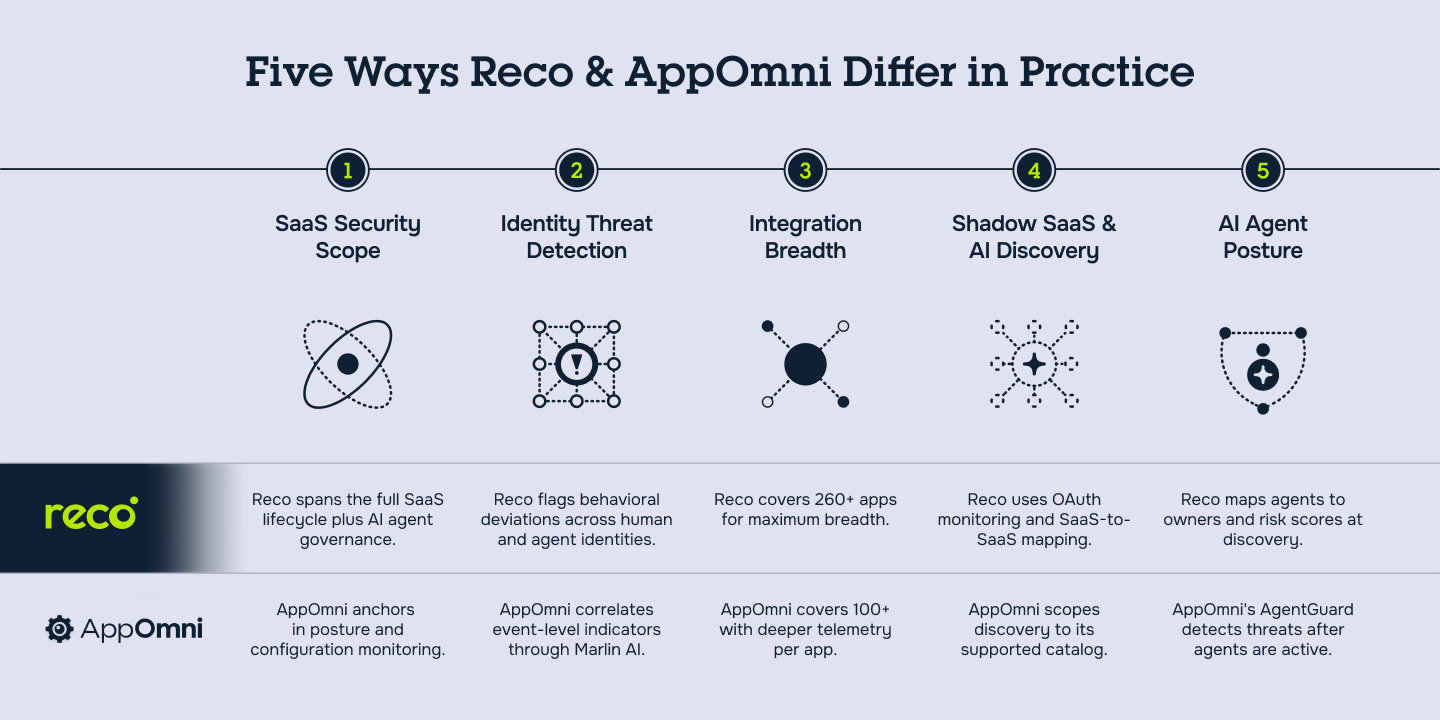
Beyond their starting philosophies, Reco and AppOmni diverge across five practical dimensions that shape day-to-day operations for security and IT teams.
1. SaaS Security Scope
AppOmni's scope is anchored in posture management and configuration monitoring within its supported application set. Reco's scope spans the full SaaS lifecycle, plus AI agent inventory and governance, so agent risk is tracked alongside the human identities and applications it touches.
2. Approach to Identity Threat Detection and Response
Reco tracks how an identity, human or agent, typically behaves, then flags deviations like privilege escalation. AppOmni's detection runs through Marlin AI, correlating event-level indicators across connected applications, drawing on 78 billion monthly SaaS events, to surface clustered activity for investigation.
3. Integration Breadth
Reco connects to 260+ app integrations, giving it both breadth across the SaaS and AI stack and depth within each connection through Reco Graph's identity and permission mapping. AppOmni integrates with over 100 SaaS applications, concentrating its telemetry within a smaller, curated set of platforms, which limits visibility once an organization's footprint extends beyond that supported list.
4. Support for Shadow SaaS, Shadow AI, and Agentic AI Governance
Reco's discovery layer uses OAuth monitoring, behavioral analysis, and SaaS-to-SaaS mapping to catch unsanctioned tools and agents as they appear. AppOmni's discovery similarly surfaces unsanctioned third and fourth-party connections, though scoped to its supported catalog.
5. AI Agent Inventory and Posture
AppOmni's AgentGuard focuses on threat prevention, detecting prompt injection and abnormal agent behavior within connected apps. Reco's approach starts earlier, mapping each agent to an owner, purpose, and risk score at discovery, enabling governance decisions before an agent's behavior becomes a live threat.
Reco vs AppOmni: Feature Comparison
The table below breaks down how each platform handles eight core SaaS and AI security capabilities. Both platforms cover most categories at a functional level, but the depth and design philosophy behind each differ in ways that matter for evaluation.
Architecture and Integration Model
Both platforms take an agentless, API-native approach to connecting with SaaS environments. Still, the underlying architecture reflects each vendor's core bet: Reco pairs broad coverage with identity-level depth across every connection, while AppOmni concentrates its telemetry depth within a curated set of applications.
Licensing and Deployment Model
Neither vendor publishes public pricing; both operate on custom enterprise quotes. The licensing structure and deployment approach behind each quote differ in ways worth understanding before talking to sales.
Reco: Identity-Depth Licensing Across a Broad, Fast-Growing Catalog
Reco's licensing scales with the breadth of an organization's SaaS and AI footprint, expanding alongside the stack as new apps and agents are onboarded through Reco Factory in 3-5 days rather than a lengthy procurement cycle, so identity-level depth extends to every new connection automatically.
AppOmni: Licensing Scoped to a Curated Application Set
AppOmni's licensing is scoped around its supported application set, typically a defined list of business-critical apps like Salesforce or ServiceNow, with Scout or Guard available as separate managed service tiers.
FedRAMP Availability: AppOmni's Regulated Market Positioning
AppOmni holds FedRAMP Moderate Authority to Operate, along with TX-RAMP and SOC 2 Type II. Reco does not currently list an equivalent regulated-market accreditation.
Total Cost of Ownership at Enterprise Scale
TCO depends on deployment scope rather than a published rate card. Reco's cost scales with connected apps and identities across a broad catalog; AppOmni's concentrates around depth of coverage and managed services within a smaller app set. Request a scoped quote from each vendor based on actual app count and desired service tier.
Reco vs AppOmni: Ease of Use and Time to Value
Time to value depends on how quickly a platform moves from deployment to actionable findings, and how much ongoing effort it takes to keep alerts relevant rather than noisy. The two platforms differ in deployment speed, alert experience, and how much support comes baked in versus sold separately.
Reco vs AppOmni: Use Cases and Ideal Customers
The right platform often comes down to where an organization's SaaS risk actually concentrates: agent sprawl and identity governance, a handful of business-critical apps, or regulatory requirements that narrow the field first.
Best Fit for AI Agent Security and Agentic AI Governance at Scale
Organizations deploying agents like Copilot, ChatGPT, or Salesforce Agentforce across multiple business units need visibility starting at the identity level. Reco's Identity Context Agent and Reco Graph are built for this, mapping agent risk alongside human identities.
Best Fit for Deep Per-App Security in Salesforce, ServiceNow, and M365
Organizations whose SaaS risk concentrates in a small number of business-critical platforms benefit from AppOmni's per-app telemetry model, delivering granular configuration and permission monitoring within its supported application set.
Best Fit for FedRAMP-Regulated and Compliance-Driven Organizations
Federal agencies and regulated industries where accreditation is a procurement requirement are better served by AppOmni, which holds FedRAMP Moderate Authority to Operate. Reco does not currently list an equivalent accreditation.
Best Fit for Enterprises Managing Broad SaaS Sprawl Across 50+ Applications
Enterprises running 50 or more SaaS applications, with new tools and shadow AI entering regularly, need coverage that scales as fast as the environment grows. Reco's broad app catalog and fast integration cycle fit this profile.
Reco vs AppOmni: Which Platform Should You Choose?
The right choice depends on where SaaS risk concentrates in your environment and what your compliance requirements demand. Use the criteria below to match your priorities to the platform built for them.
Choose Reco If
- Full AI Agent Visibility: You need identity-level visibility into AI agents, shadow AI, and agentic posture across your entire environment, not just the apps you've explicitly connected.
- Breadth and Depth Together: You want continuous discovery across 260+ apps without losing identity-level depth, with Reco Graph tying every identity, permission, and connection into a single, continuously updated risk map.
- Full Lifecycle Coverage: You need one platform covering the SaaS lifecycle from discovery through remediation, with AI-powered validation confirming that remediation actions actually completed, not separate tools stitched together.
- Active Sprawl Priorities: AI sprawl, agent sprawl, and configuration sprawl are active priorities your security program needs to address now, not later.
- Fast-Moving Environment: New apps, agents, and shadow AI enter your stack faster than a quarterly review can track, and you need new integrations covered in days, not quarters, to keep pace.
Choose AppOmni If
- Focused App Silo: Your SaaS footprint is concentrated in 1-3 critical apps rather than spread across a broad, growing catalog.
- FedRAMP Requirement: You operate in a FedRAMP-regulated environment that requires that specific accreditation as a procurement condition.
- Posture-First Priority: Your primary concern is misconfiguration and posture management within a curated set of critical apps.
Why Reco Is Built for the Future of SaaS and AI Security
As SaaS environments become inseparable from the AI agents operating inside them, security programs need a platform built around that reality from the ground up rather than extended to accommodate it. The five capabilities below are what set Reco apart for organizations facing that shift.
- AI Agent Security, Visibility and Governance Across the Full Agent Fleet: Reco treats every AI agent as a non-human identity with an owner, a purpose, and a risk score, closing the blind spot where agents accumulate access quietly across multiple apps with no single owner accountable for the combined risk.
- Reco Graph, Living Map of Every Identity, Permission, Connection, and Risk: Investigations start with relationship context instead of an isolated alert, so security teams see not just that an identity behaved unusually, but who it's connected to and what it can reach.
- Reco Factory, New App and Agent Support in Days, Not Quarters: New app and agent integrations are added in 3-5 days, matching the pace at which SaaS and AI tools actually enter enterprise environments, so coverage gaps don't sit open for a quarter at a time.
- Unified Lifecycle Coverage, Discover, Score, Govern, and Remediate in One Platform: Discovery, posture scoring, governance, and remediation draw from the same identity and risk context in one platform, covering the SaaS lifecycle cradle to grave instead of stitching together disconnected tools.
- Breadth and Depth at Scale, 260+ Apps With Identity-Level Context on Every One: Broad coverage across 260+ apps comes paired with the same relationship-level depth, identity, permissions, and behavior that narrower platforms only achieve within a handful of curated apps, so scale doesn't come at the cost of context or precision.
Conclusion
Reco and AppOmni take different approaches to SaaS and AI security. Reco is built around identity-centric governance, AI agent security, and deep relationship-level context across a rapidly growing SaaS ecosystem, giving security teams both breadth and depth in a single platform. AppOmni, by contrast, concentrates on event-level telemetry and posture management within a curated set of business-critical applications, supported by FedRAMP authorization for regulated environments.
For organizations facing AI agent sprawl, shadow AI, and a SaaS footprint that keeps expanding, Reco's identity-first model is built for where that risk actually shows up. Organizations with a narrow, stable app footprint and a hard FedRAMP requirement are the clearer exception where AppOmni's per-app telemetry model fits best.
FAQs
What is the difference between AppOmni's event-driven telemetry approach and Reco's identity and agent-centric model?
AppOmni analyzes application events, configuration changes, and permission activity within its supported SaaS applications. Reco starts with identity, using identity and access governance to treat every human user and AI agent as a governed identity with an owner, permissions, and a continuously evaluated risk profile that spans the entire SaaS environment.
Key differences:
- AppOmni emphasizes event correlation and posture within connected applications.
- Reco correlates identities, permissions, AI agents, and SaaS relationships through Reco Graph.
- Reco extends identity governance across both human and non-human identities.
How does AppOmni's per-app telemetry in Salesforce and ServiceNow compare to Reco's broader, identity-deep coverage?
AppOmni prioritizes visibility into a curated set of business-critical SaaS applications, with telemetry that stops at the edge of that catalog. Reco combines broad SaaS application discovery with identity-level depth on every connection, so organizations can continuously discover, govern, and secure applications, and the agents and identities behind them, as their SaaS footprint expands.
Key differences:
- AppOmni focuses on event-level depth within 100+ supported applications.
- Reco supports 260+ SaaS and AI applications with the same identity and relationship-level depth on each one, plus rapid onboarding through Reco Factory.
- Broad, identity-aware discovery helps reduce blind spots created by shadow SaaS and newly adopted AI tools that AppOmni's curated catalog wouldn't yet cover.
How does Reco Graph help security teams understand agent risk in ways that posture management tools alone cannot?
Traditional posture management identifies configuration issues inside individual applications. Reco Graph adds relationship context by mapping identities, permissions, AI agents, integrations, and applications into a continuously updated graph, feeding into identity threat detection and response so analysts can understand how access and risk propagate across the SaaS environment.
Key differences:
- Maps relationships instead of isolated findings.
- Reveals excessive privileges across applications.
- Provides context for faster investigation and remediation.


%201.svg)


.svg)