


Best MCP Security Tools in 2026: 5 Platforms Reviewed for Securing AI Agent Connections


A developer wires an MCP server into the pipeline so an agent can pull data and reach an external API. No ticket, no review, no sign-off. By the next sprint, it's just part of how the build runs. That pattern is now the norm, and researchers are finding the wreckage. A scan of thousands of MCP servers found hundreds wide open to any device on the same network, with dozens carrying flaws severe enough to let an attacker run their own code or wipe a host system outright. Identity platforms and existing security tools were never built to see this layer, and gateways only catch what passes through them.
The question isn't whether an environment has this problem. It's whether anything is watching for it.
The MCP Security Gap That Grows Every Time a New Agent Connects
Every MCP connection hands an agent tool access before anyone has confirmed what those tools actually do. That gap builds up in layers most security stacks were never designed to inspect.
- MCP Servers Give Agents Tool Access That Nobody Reviewed Before It Was Granted: Four in five AI tools operate with no IT oversight, and their credentials are rarely scoped to what the connection needs. An agent granted read access to email often inherits write access to the entire workspace.
- Tool Poisoning and Prompt Injection Arrive Through Connections Security Teams Cannot See: Agents treat tool descriptions and schemas as trustworthy context, so anyone who plants instructions there can steer what the agent does next, read by the model and never seen by the user.
- Existing Third-Party and Identity Controls Were Never Built to Govern Agent-to-Tool Relationships: An identity platform can confirm who made a request, but not which MCP server it passed through, what tools that server exposed, or whether the tool description the model read matches what security reviewed at deployment.
- MCP Gateways Alone Are Not Enough; They Only See What Passes Through Them: Plenty of MCP servers run locally over stdio, with no network traffic at all. A gateway built to inspect traffic has nothing to inspect when the connection never generates any.
Best MCP Security Tools in 2026, TL;DR
MCP servers create a growing security blind spot by connecting AI agents directly to enterprise tools, data, and identities. These five platforms address the risk through approaches ranging from discovery and remediation to network filtering and cloud posture mapping.
5 Best MCP Security Tools for Enterprise AI Agent Governance
Each platform below takes a different route to the same problem: connections that grant tool access nobody reviewed. Here's what actually works, and where each one falls short.
1. Reco
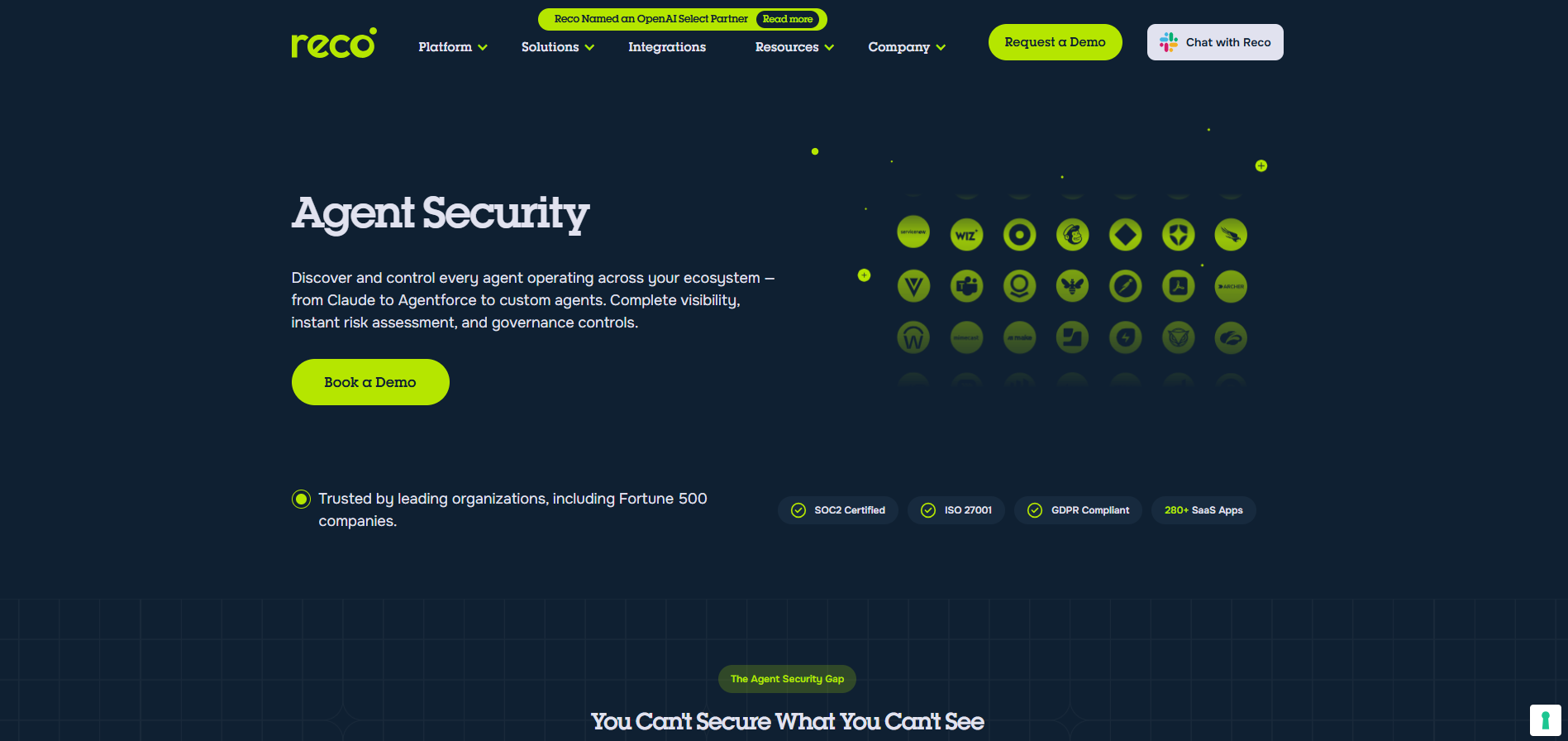
Reco is agent ecosystem security built on the Reco Graph, mapping every agent, MCP server, and identity across connected applications into one governable risk surface. It doesn't stop at visibility. It prioritizes risk by identity, permissions, and activity, then remediates directly, revoking stale access, disabling unauthorized agents, and scoping down permissions that got too broad. New coverage rolls out through Reco Factory in days, not quarters. Fortune 500 organizations use it to secure 280+ connected applications and 1,000+ detection controls.
Key Features:
- Reco Graph maps every agent, MCP server, and identity across connected applications into one governable risk surface
- Remediates risk directly, revoking stale access, disabling unauthorized agents, and scoping down permissions, rather than only flagging it
Reco Is for You If:
- You want one platform for agent discovery, identity governance, and remediation instead of three tools stitched together
- Non-human identity governance matters as much to you as knowing an agent exists, stale permissions and orphaned access included
- You need new agent and application coverage added in days rather than next quarter
Reco Is Not for You If:
- You want a narrow scanner instead of a unified platform. That's a smaller commitment, and a smaller outcome
- You're fine with monitoring after the fact. Reco is built to stop exposure before it becomes an incident
- You have no meaningful agent footprint yet, and no platform at this level is what an environment like that needs
2. Microsoft Defender (via Entra Internet Access)
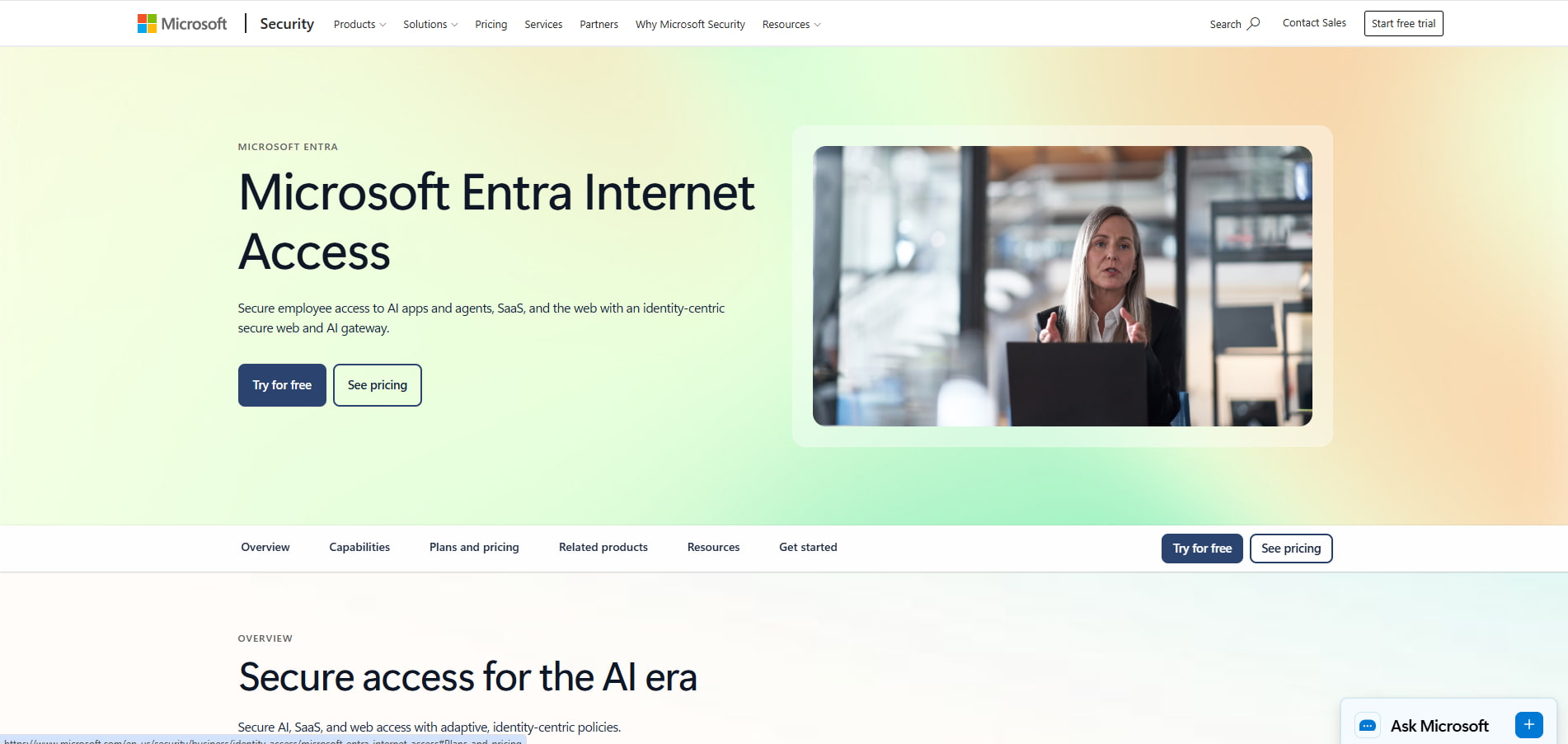
Microsoft's MCP coverage lives inside Entra Internet Access, part of Global Secure Access, not a standalone product called "MCP Firewall." Web content filtering policies block unsanctioned MCP servers at the network layer, and Shadow MCP visibility surfaces MCP traffic, correlated with Microsoft's threat intelligence.
Key Features:
- Web content filtering policies block unsanctioned MCP servers at the network layer within Entra Internet Access
- Shadow MCP visibility surfaces MCP traffic and correlates it with Microsoft's existing threat intelligence
Microsoft Defender Is for You If:
- You're already on Entra Suite and Global Secure Access, and want MCP visibility folded into that stack
- Network-level blocking is your primary control point, stopping unsanctioned traffic before it reaches an endpoint
- You want MCP filtering tied into threat intelligence Microsoft already applies across web traffic
Microsoft Defender Is Not for You If:
- You're not on Entra Suite, since the MCP capabilities are tied to that licensing
- You need visibility into local MCP servers over stdio, which generate no traffic to inspect
- You want agent-to-tool relationship mapping, not network-layer filtering, as your primary lens
3. Grip Security
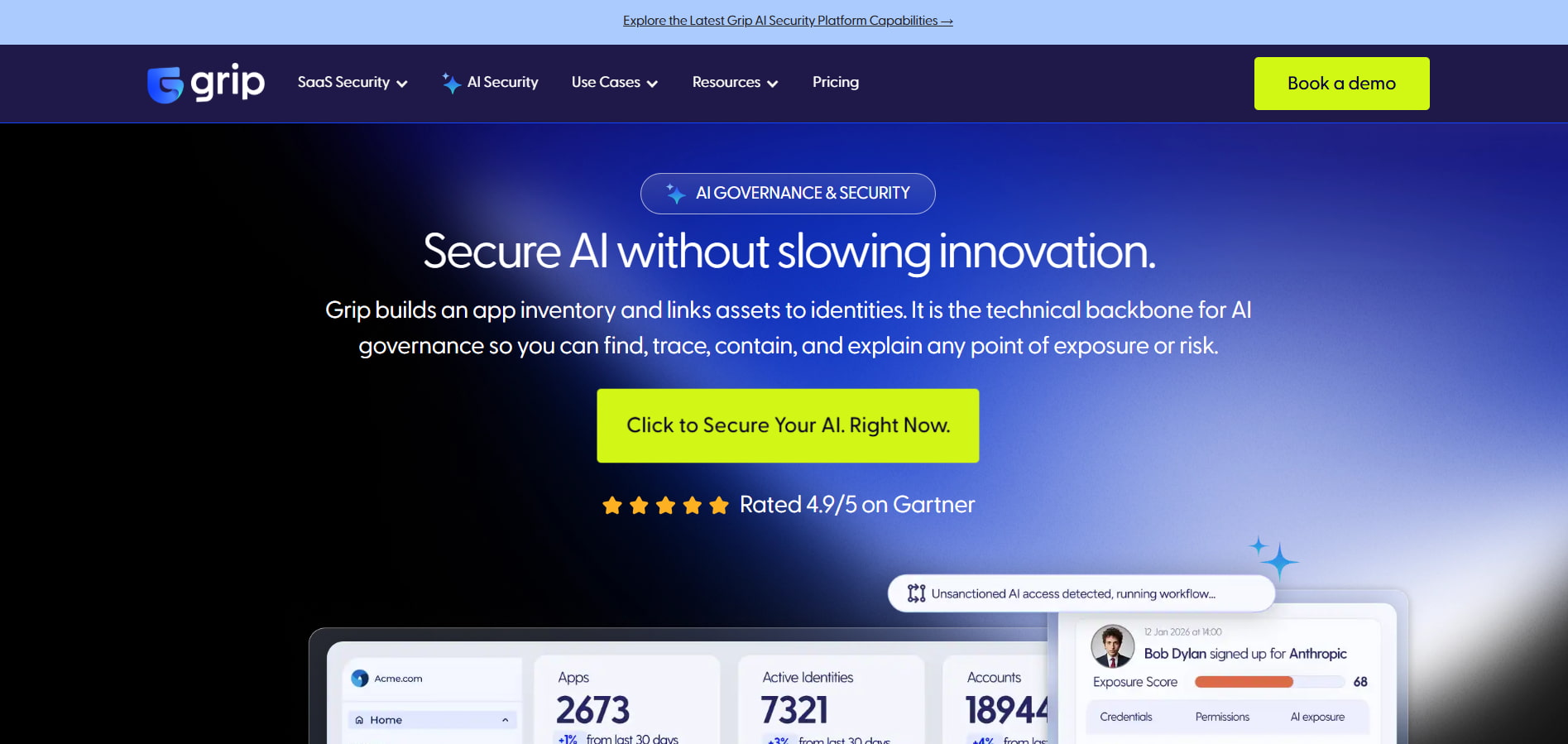
Grip Security takes an identity-first approach, connecting to email flows, browser activity, and IdP/SSO data to build a living identity graph across users, agents, applications, and data, no agents or network changes required. It's fast, broad discovery, surfacing unapproved or shadow AI services other tools miss.
Key Features:
- Builds a living identity graph across users, agents, applications, and data by connecting to email flows, browser activity, and IdP/SSO data
- Agentless discovery surfaces unapproved or shadow AI services in minutes, with no network changes required
Grip Security Is for You If:
- Unsanctioned application and AI sprawl is your primary concern, and you want broad, agentless discovery in minutes
- You want a strong identity-first story: who introduced a service, how it authenticates, what permissions it holds
- You're comparing shadow discovery tools and don't want a browser extension or endpoint agent involved
Grip Security Is Not for You If:
- MCP-specific governance, like mapping what an agent can do with a tool once connected, is what you need most
- Your environment already has solid application discovery, and the gap is specifically agentic risk once agents are known
- You want agent behavior and data access unified into one risk graph rather than an identity and app inventory
4. Adaptive Shield (CrowdStrike Falcon Shield)
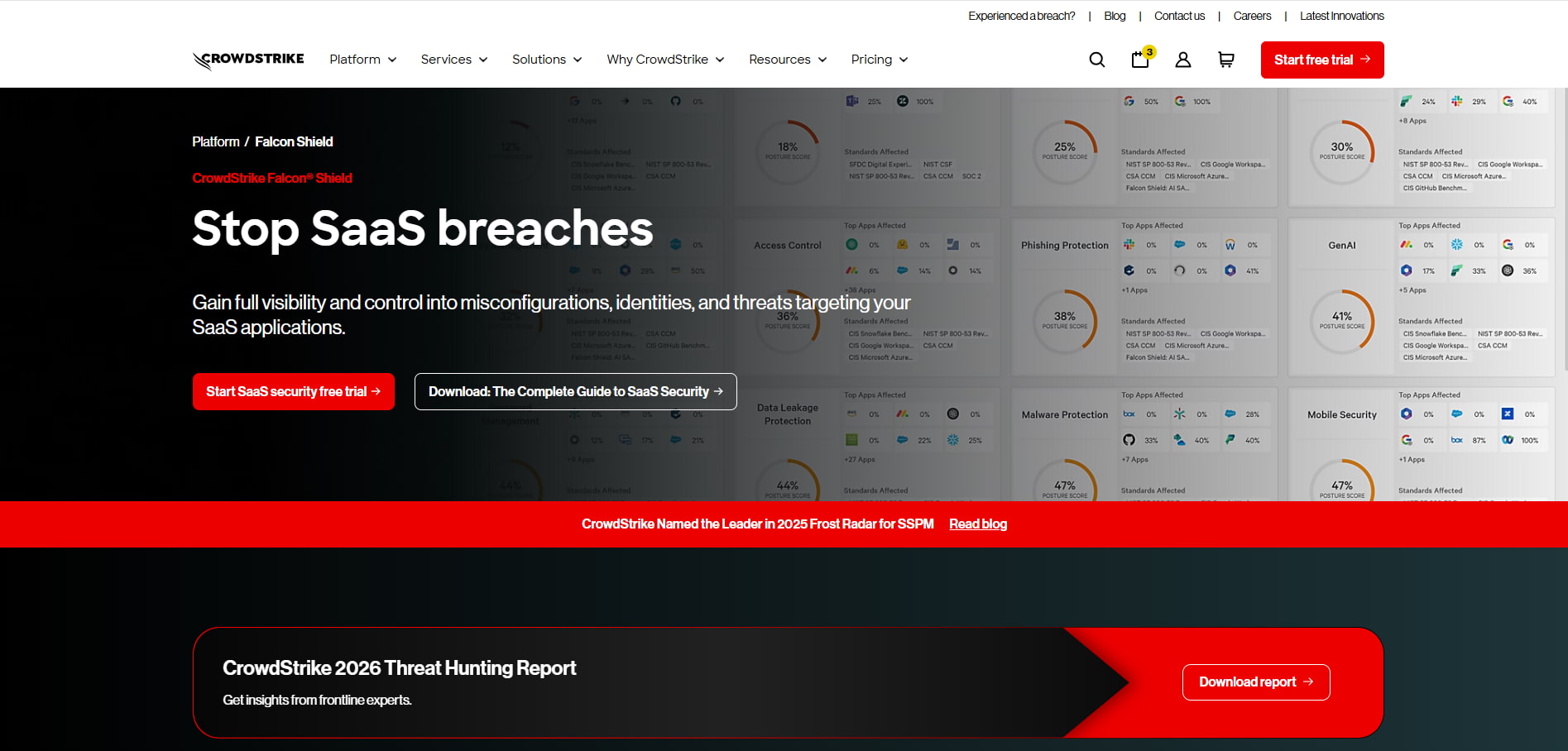
Falcon Shield grew out of CrowdStrike's acquisition of Adaptive Shield and stays rooted in SaaS security posture management, continuous checks across 200+ applications including Microsoft 365, Salesforce, and GitHub, connected agentlessly via OAuth. CrowdStrike has layered in centralized AI agent visibility, mapping each agent to its creator and access, feeding SaaS telemetry into Falcon Next-Gen SIEM alongside endpoint and identity signals.
Key Features:
- Continuous SaaS security posture checks across 200+ connected applications, including Microsoft 365, Salesforce, and GitHub, connected agentlessly via OAuth
- Centralized AI agent visibility maps each agent to its creator and access, feeding SaaS telemetry into Falcon Next-Gen SIEM
Adaptive Shield Is for You If:
- You're already a CrowdStrike Falcon customer and want SaaS and agent visibility correlated with telemetry you already run
- SaaS misconfiguration and non-human identity drift matter as much to you as agent-specific risk
- You want SaaS and agent signals feeding directly into a SIEM rather than a separate console
Adaptive Shield Is Not for You If:
- You're not on the CrowdStrike platform, since much of the value comes from that correlation
- MCP protocol-specific threats like tool poisoning are your main concern; the platform's roots are in SaaS posture, not MCP behavior
- You need deep non-human identity governance as a standalone capability, not one part of a broader picture
5. Wiz
Wiz secures MCP from the cloud infrastructure side through AI-SPM, an extension of its agentless CNAPP foundation. It discovers AI services and MCP connections across major clouds, validates whether endpoints are actually live and reachable, and maps findings into the Wiz Security Graph alongside identity, network, and runtime context, so exposed MCP servers surface as real attack paths, not theoretical ones.
Key Features:
- Agentless AI-SPM discovers AI services and MCP connections across major cloud providers, built on Wiz's CNAPP foundation
- Validates whether MCP endpoints are actually live and reachable, mapping findings into the Wiz Security Graph alongside identity, network, and runtime context
Wiz Is for You If:
- You're already running Wiz or another CNAPP-style platform and want MCP exposure mapped into the same cloud risk graph
- Your MCP servers run primarily in cloud environments Wiz already covers, and you want live, validated exposure data
- You want AI risk treated as part of a broader cloud security posture rather than a separate tool
Wiz Is Not for You If:
- Your MCP servers run mainly on local machines or on-prem over stdio, outside what a cloud-native CNAPP discovers
- You need agent-to-identity governance across SaaS applications rather than cloud infrastructure exposure
- You're not already committed to Wiz's broader platform, since AI-SPM isn't sold as a standalone product
MCP Security Tools Comparison Overview
Deployment model and MCP coverage vary sharply across these five platforms, and that gap matters more than any feature list. Here's how each one actually connects to your environment and what it sees once it's there.
The Runners-Up: Why These MCP Security Tools Didn't Make Our Top Picks
Several platforms touch MCP security without earning a top-five spot, usually because the coverage is narrower or newer than what made this list. Here are three worth knowing about.
- Lasso Security is purpose-built for MCP and agentic AI security, with an Intent Security Framework for behavioral baselining and an open-source MCP Gateway. It's strong on runtime threat detection, but built as a dedicated AI security point product rather than a unified agent, identity, and application governance platform.
- Palo Alto Networks Prisma AIRS scans MCP servers and agent artifacts for supply chain risk through its Prisma AIRS MCP Server, and intercepts malicious calls in real time. It's powerful for organizations already inside the Palo Alto ecosystem, but less suited as a standalone MCP governance layer.
- Varonis Atlas inventories agents, models, tools, and MCP servers with deep data sensitivity and permissions context inherited from the Varonis Data Security Platform. It's a strong data-first angle, but its core strength is data exposure risk rather than MCP protocol-level threat detection.
What MCP Security Actually Requires Beyond Gateway Inspection
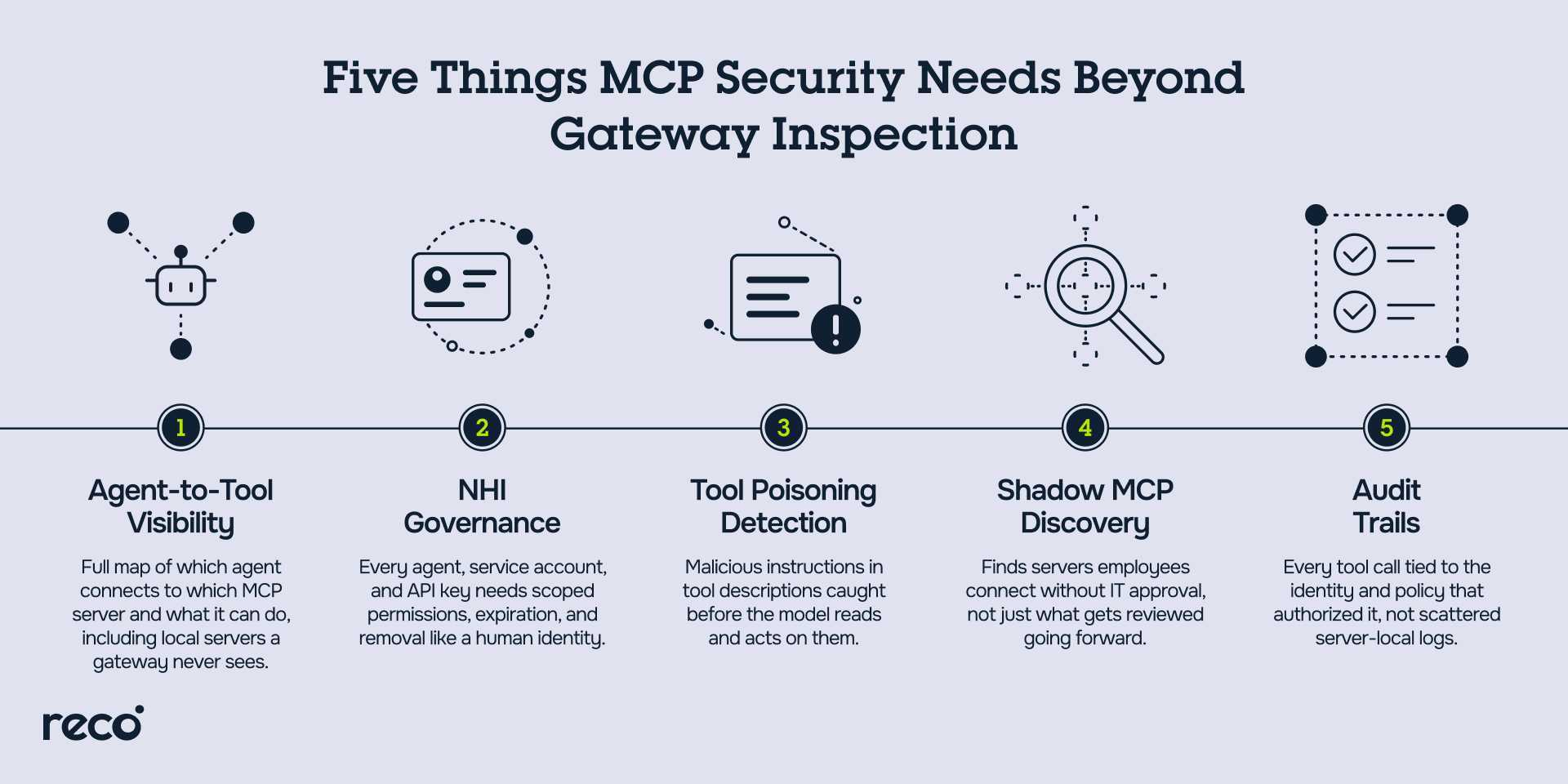
A gateway checks traffic. Real MCP security requires five capabilities that traffic inspection alone can't deliver.
- Agent-to-Tool Connection Visibility Across Every MCP Server in the Environment: A full map of which agent connects to which MCP server, what tools it exposes, and what that agent can actually do with them, including local servers a gateway never sees.
- Identity Governance for Non-Human Identities Connecting Through MCP: Every agent, service account, and API key needs the same lifecycle discipline as a human identity, scoped permissions, expiration, and removal when access is no longer needed.
- Detection of Tool Poisoning and Prompt Injection Before They Reach Agent Context: Malicious instructions hidden in tool descriptions or schemas have to be caught before the model reads them, not after it's already acted on them.
- Shadow MCP Discovery for Servers Employees Connect Without IT Approval: Most MCP servers in an environment were never reviewed. Discovery has to find what's already running, not just what gets approved going forward.
- Audit Trails Mapping Every MCP Tool Call to the Identity and Agent That Made It: Centralized logging has to tie every tool call to the identity and policy that authorized it, since scattered, server-local logs can't be reassembled into a real chain of events after an incident.
How to Choose an MCP Security Tool for Your Environment
The right tool depends less on feature count and more on how it handles four specific questions. Here's what to check before you commit to one.
- Whether It Discovers MCP Servers You Did Not Sanction as Well as the Ones You Did: Most MCP servers in an environment were never approved in the first place, so a tool that only inventories what IT already knows about is solving half the problem.
- Whether It Governs the Identity Behind the Agent, Not Just the Traffic Through the Gateway: Network-layer tools see connections, not the permissions, ownership, or lifecycle of the identity making them, and that identity context is what actually lets you scope down or revoke access.
- How Quickly It Can Add Coverage for New MCP Servers as They Enter the Environment: Teams adopt new MCP servers weekly, so a platform that takes a quarter to onboard a new integration is always behind what's already running in production.
- Whether It Produces Compliance Evidence for EU AI Act Article 12 and ISO 42001 Obligations: High-risk AI systems must technically support automatic event logging over the system's full lifetime, not manual documentation after the fact, so the tool needs to generate that evidence on its own, not just raise internal alerts nobody outside security ever sees.
How Reco Graph Maps Every MCP Connection Into a Governable Risk Surface
Reco lists MCP support as a core interface capability, not an afterthought, and its own research names the specific risks MCP introduces: identity drift, weak authentication, data leakage, and invisible access that bypasses traditional monitoring. Here's how Reco Graph actually closes that gap.
- Every MCP Connection Gets Mapped the Moment It Appears: Identity, permission, connection, and event data all feed into one governable risk surface through Reco Graph.
- MCP Is a First-Class Connection Type, Not a Workaround: "Agent ready MCP" is built directly into Reco's platform alongside API-first development, not bolted on after the fact.
- New MCP Servers Get Covered in Days, Not Months: Reco Factory adds new MCP and agent coverage in 3 to 5 days through a no-code, agentless, read-only engine.
- The Exact Risks MCP Introduces Are What the Graph Is Built to Catch: Identity drift, weak authentication, data leakage, and invisible access that bypasses traditional monitoring get surfaced and remediated before they become incidents.
Conclusion
The developer who connects an MCP server to a production workflow late on a Friday afternoon is not being reckless. She's doing what developers do, shipping. The problem is MCP adoption is moving faster than most security teams can observe and govern it, with each unreviewed connection widening the gap. Microsoft, Grip, Adaptive Shield, and Wiz each cover part of the risk: network activity, shadow SaaS, application posture, or cloud exposure.
But none was designed around the relationship that matters most here. Reco was built around exactly that, using Reco Graph to map agent-to-tool connections, identify risky access paths, and drive remediation instead of adding another alert to the queue. The right choice depends on where your MCP servers run and which systems they touch. What's no longer defensible is leaving those connections unmonitored and hoping the gap closes on its own.
FAQs
What is an MCP security tool and how does it differ from a traditional API security platform?
An MCP security tool governs the relationship between an agent, an MCP server, and the identity behind that connection, not just the traffic between them. Traditional API scanners test stateless request-response cycles and miss what MCP introduces.
- Governs agent-to-tool relationships, not isolated endpoints
- Tracks the identity behind every connection, human or non-human
- Covers local, stdio-based servers that never generate traffic to scan
Reco governs that identity layer through identity and access governance, mapping every human and non-human identity in one view.
Why are MCP gateways not sufficient on their own for securing enterprise AI agent environments?
A gateway only sees what passes through it, and a large share of MCP activity never does. Local servers and unsanctioned connections stay invisible to network-layer tools alone.
- Local MCP servers over stdio generate no network traffic to inspect
- Unsanctioned servers connected without IT approval sit entirely outside gateway visibility
Reco's application discovery covers what gateways miss, pulling from API, IdP, CASB, browser, and network sources at once.
How do MCP security tools detect tool poisoning and prompt injection attacks before they reach an agent?
Detection has to happen before the model reads a tool's description or schema, since agents treat that content as trustworthy by default.
- Scans tool descriptions and schemas for embedded instructions before the model processes them
- Flags deviations from expected tool behavior instead of relying on the model to self-detect manipulation
How does Reco discover and govern MCP servers that employees connect without IT approval?
Reco finds MCP servers the moment they connect, across every source an employee might use to introduce one, then governs what happens after.
- Discovers agents and MCP servers via API, IdP, CASB, browser, and network sources
- Maps each connection's identity, permissions, and data access into Reco Graph
- Extends coverage to new servers in 3 to 5 days instead of a quarterly cycle
That path runs through application discovery and Reco Factory working together.


%201.svg)


.svg)