
Non-Human Identities for AI Agents: How to Govern Access at Enterprise Scale


What Are Non-Human Identities for AI Agents?
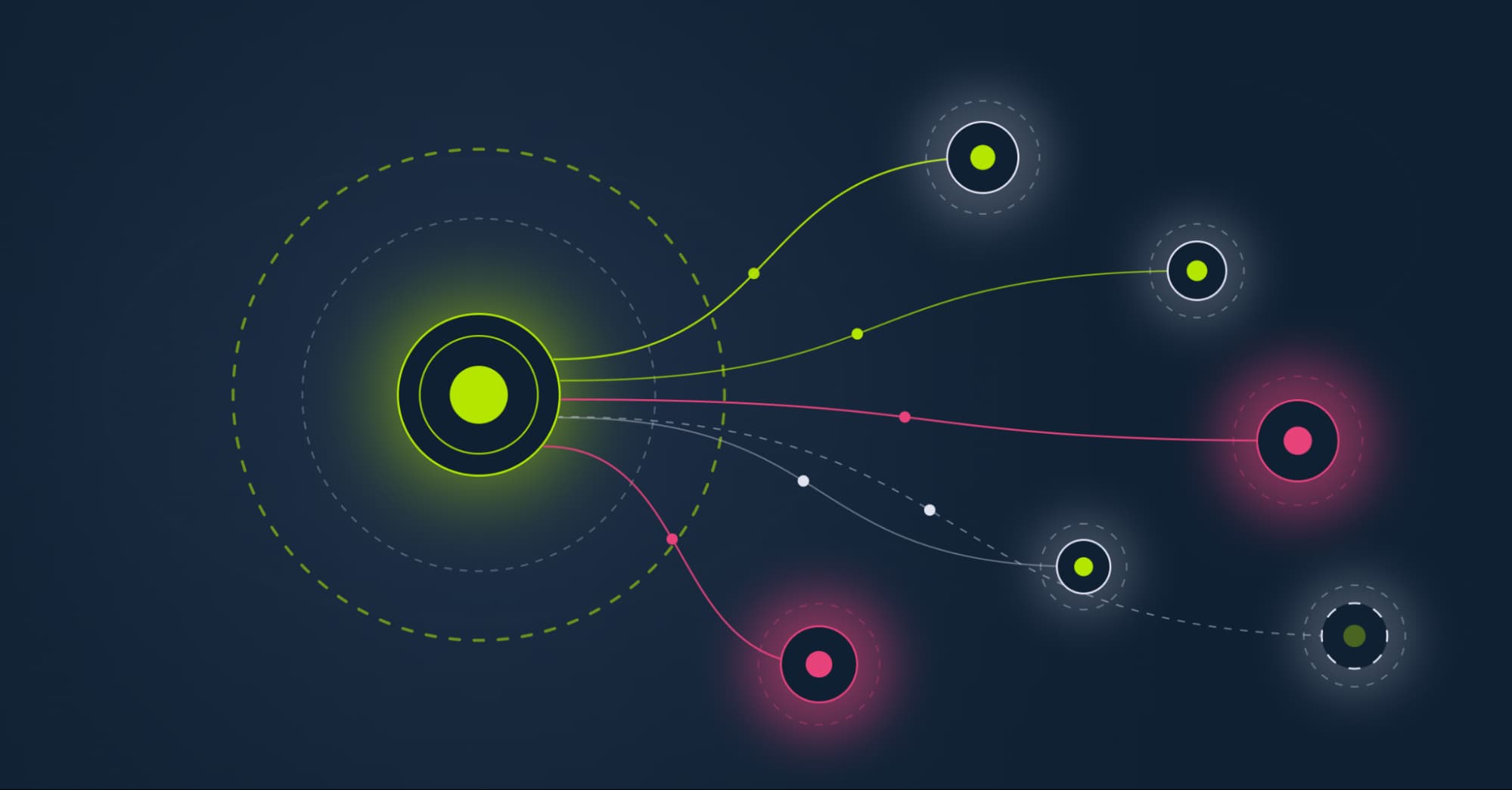
Non-human identities for AI agents are the digital identities and credentials that allow agents to authenticate, access SaaS applications, call APIs, and interact with enterprise data without direct human involvement. These identities can rely on OAuth tokens, service accounts, API keys, workload identities, and other machine-to-machine authentication methods.
What makes AI agents different from traditional NHIs is how they use access. A service account typically performs a fixed and predictable task, while an AI agent can plan actions, select tools, interact with multiple systems, and adapt its behavior as a task evolves. This autonomy makes access harder to predict and increases the need for continuous visibility, least-privilege enforcement, and lifecycle governance.
How Non-Human Identities Are Reshaping Identity Security
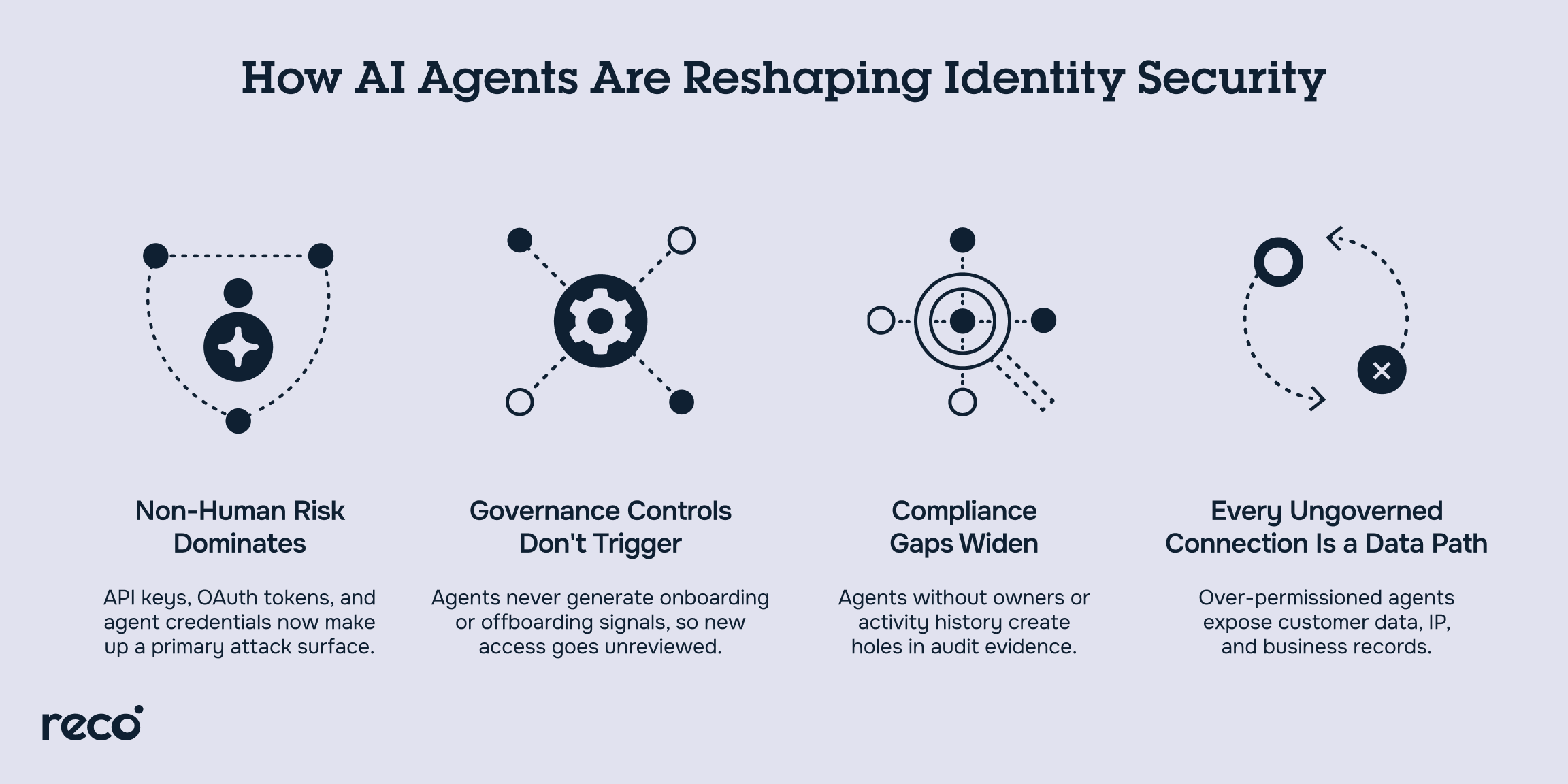
AI agents are changing identity security from a human-centric challenge to a machine-centric one. As autonomous agents connect to more SaaS applications and enterprise systems, non-human identities are becoming a primary source of access risk, demanding the same level of governance as human users.
- Identity-Based Risk Is Increasingly Non-Human: API keys, OAuth tokens, service accounts, and other machine credentials already make up a substantial part of the enterprise identity landscape, and as organizations deploy more AI agents, this expands an attack surface many security teams still struggle to inventory. Gartner projects that by 2028, 25% of enterprise generative AI applications will experience at least five minor security incidents per year, up from 9% in 2025.
- AI Agents Accumulate Access Without Triggering Governance Controls: Human access reviews are tied to events like onboarding or offboarding, signals AI agents never generate, so new permissions and integrations can be added without triggering a formal review.
- Compliance and Audit Requirements Extend to Agent Identities: When an AI agent has no assigned owner, defined business purpose, or traceable activity history, demonstrating effective access governance becomes significantly harder and can create gaps in audit evidence.
- Sensitive Data Exposure Grows With Every Ungoverned Agent Connection: Every SaaS application and API connected to an over-permissioned or compromised agent is another potential path to customer data, intellectual property, or business records.
Types of Non-Human Identities Used by AI Agents
AI agents can authenticate and act through several types of non-human identities, each suited to different access patterns and carrying different security risks. Choosing the right identity type is essential for limiting privileges, maintaining auditability, and managing access throughout the agent’s lifecycle.
How to Choose the Right Identity for Your AI Agent: Practical Examples
The right identity model depends on whose authority an AI agent uses when it takes action. An agent acting for a specific user requires delegated access, while an autonomous agent needs its own non-human identity. Some agents use both models and must keep those identity contexts separate.
Example 1: An AI Agent Acting on Behalf of a User
Consider a scheduling assistant that reads a user's calendar, creates meeting invites, and responds to invitations. Because the agent is acting under the user's authority, it should use delegated access rather than a standing identity with independent privileges.
A common approach is an OAuth access token limited to the scopes required for the task, such as calendar access rather than full mailbox permissions. Tokens should be short-lived where possible, and logs should preserve both the agent's identity and the user whose authority was delegated. Granting broader scopes increases the potential impact of token theft, agent misuse, or compromised instructions.
Example 2: An Autonomous AI Agent Using Its Own Identity
A cost-optimization agent that monitors cloud infrastructure and automatically scales resources is not acting for a specific user. It operates continuously and should authenticate through a dedicated workload identity or service account.
Permissions should match the agent's function. The identity might be allowed to read billing data and modify specific compute resources while being denied access to IAM policies, network configuration, and unrelated workloads. As the agent's responsibilities expand, permissions should be reviewed to prevent privilege accumulation and ensure the identity cannot create credentials, modify roles, or delegate access unnecessarily.
Example 3: An AI Agent Combining Human and Non-Human Identity Contexts
Some AI agents operate under different identity contexts during the same workflow. A procurement agent might check an employee's approval authority using delegated access, then use its own service identity to submit an approved transaction to an accounts payable system.
These contexts should remain separate. Actions performed under human authority should use delegated credentials, while autonomous system-to-system actions should use a dedicated non-human identity. Logs should record which identity authorized each action so security teams can determine who approved it, which permissions were used, and whether the agent operated within its intended authority.

Dr. Tal Shapira
Cofounder & CTO at Reco

Tal is the Cofounder & CTO of Reco. Tal has a Ph.D. from Tel Aviv University with a focus on deep learning, computer networks, and cybersecurity and he is the former head of the cybersecurity R&D group within the Israeli Prime Minister's Office. Tal is a member of the AI Controls Security Working Group with CSA.

Expert Insight: Design the Identity Boundary Before You Deploy the Agent
In my experience, one of the most common mistakes is choosing credentials after the agent has already been built. Before deployment, define whose authority the agent will use, which systems it can access, and how that access can be revoked.
- Separate Delegated and Autonomous Access: Use user-delegated credentials for actions performed on behalf of a person and a dedicated non-human identity for system-to-system actions.
- Design for Revocation From Day One: Make sure security teams can disable the agent's access without disrupting unrelated users, applications, or workloads.
- Preserve Identity Context in Logs: Record the agent, the credential used, the user or service that authorized the action, and the resource accessed.
The Key Test Is Simple: If an agent behaves unexpectedly, you should be able to identify its access, trace its actions, and revoke its permissions without first reconstructing how it was deployed.
Why AI Agents Make Non-Human Identity Governance Harder
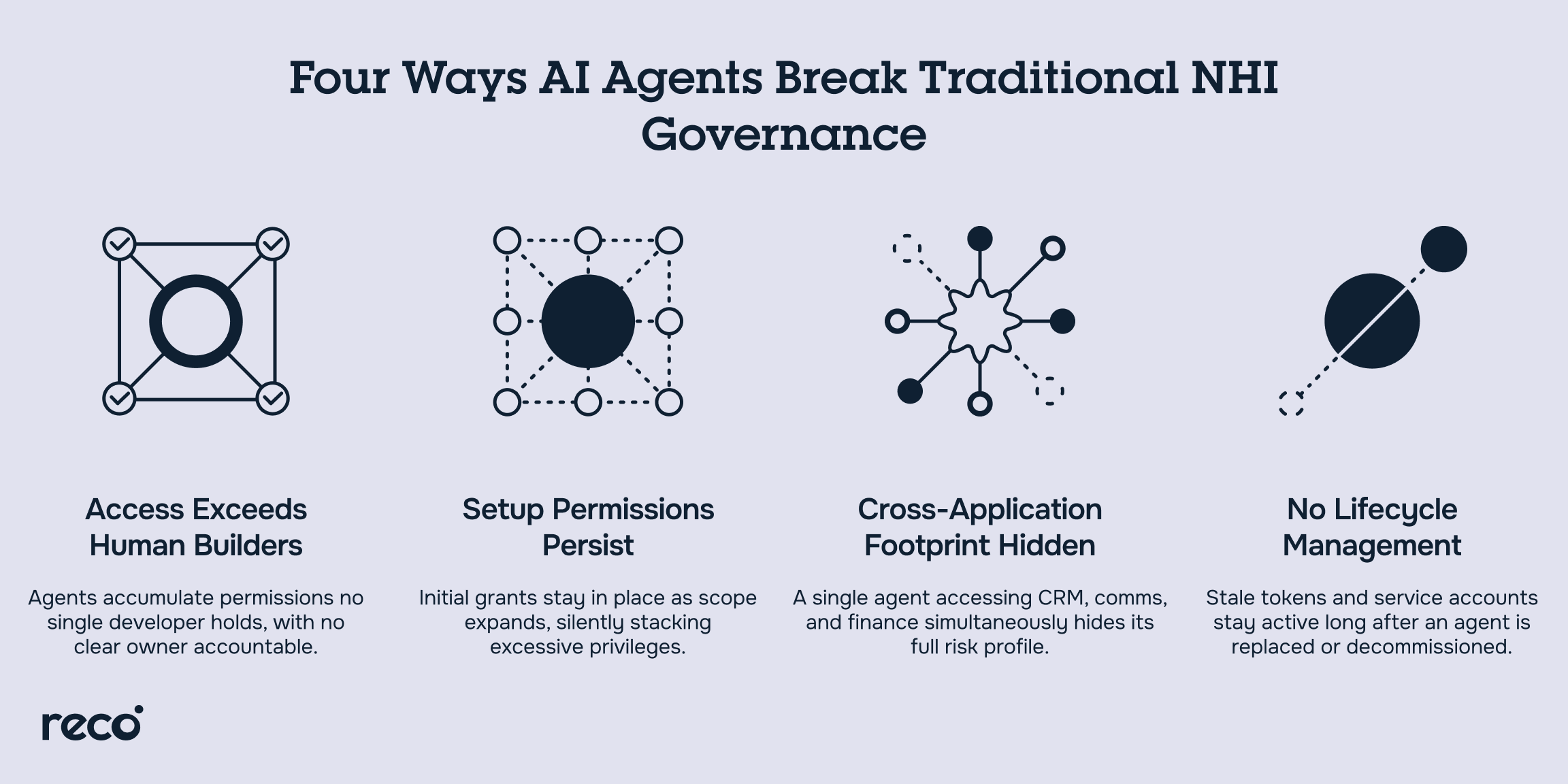
Traditional NHI governance assumes predictable workloads, defined permissions, and manageable lifecycles. AI agents break those assumptions by operating autonomously, expanding across applications, and changing how they use access over time.
- Agents Can Have More Access Than the Humans Who Built Them: An AI agent can accumulate permissions across applications and systems that exceed the access held by any single developer or team responsible for it. Without clear ownership, security teams may struggle to determine who approved that access, who should review it, and who is accountable when the agent operates beyond its intended scope.
- Permissions Granted at Setup Persist as the Agent's Scope Expands: Agents often receive permissions during initial deployment that remain in place as new tasks, tools, and integrations are added. Without recurring access reviews, obsolete and excessive privileges accumulate, increasing the agent's attack surface and the potential impact of compromise.
- Agent Identities Operate Across Multiple SaaS Applications Simultaneously: A single AI agent can maintain access to CRM platforms, communication tools, file storage, and financial systems at the same time. Reviewing access within each application separately can hide the agent's full cross-application footprint and prevent security teams from identifying excessive permissions or dangerous combinations of access.
- Agent Identities Lack Consistent Lifecycle Management: Human identities typically follow established onboarding, access review, and offboarding processes. Agent identities often lack equivalent controls, leaving credentials, tokens, and service accounts active after an agent is replaced, reconfigured, or decommissioned. These stale identities expand the attack surface and create access paths that security teams may no longer know exist.
Common Security Risks for Non-Human Identities
When non-human identities are compromised, over-permissioned, or left unmanaged, they can provide persistent access to sensitive applications and data. AI agents increase these risks by operating continuously and connecting to multiple systems at machine speed.
- Excessive Privileges Retained Beyond Their Original Purpose: Permissions granted for an agent's initial task can remain active as its responsibilities change. These unnecessary privileges increase the potential blast radius if the agent or its credentials are compromised.
- Credential Theft and Token Hijacking: API keys, OAuth tokens, and service account credentials are valuable targets because attackers can use them to impersonate trusted agents and access connected systems. Long-lived credentials and weak rotation practices increase the window in which stolen access can be exploited.
- Identity Sprawl Across SaaS Applications: As agents connect to more applications, they accumulate credentials, tokens, service accounts, and access relationships that security teams may struggle to inventory. Unowned or undocumented identities can remain active without regular reviews or effective monitoring.
- Shadow AI Creates Unreviewed Access Paths: AI agents deployed outside approved IT and security processes can introduce new SaaS integrations, credentials, and data flows without formal review. These unknown connections create blind spots where sensitive data may be accessed or transferred outside established governance controls.
How to Govern Non-Human Identities for AI Agents: Best Practices
Effective governance requires continuous controls across the entire agent identity lifecycle, from discovery and provisioning to monitoring and decommissioning. The following practices help security teams maintain visibility, enforce appropriate access, and reduce identity risk as AI agent deployments scale.
How Reco Improves Visibility and Control Over Non-Human Identities
Reco gives security teams visibility and control over human and non-human identities across the SaaS environment, including agents, tokens, service accounts, and access relationships that traditional identity tools may not fully capture.
- Unified Discovery of Non-Human Identities Across the SaaS Environment: Reco's application discovery continuously identifies SaaS applications, AI agents, and connected identities across 260+ apps, including those introduced outside formal IT approval processes.
- Cross-Identity Risk Visibility: Reco correlates human and non-human identities through identity and access governance, surfacing risks that can remain hidden when identities and permissions are reviewed in isolation.
- Overpermissioned and Orphaned Agent Identities Identified Continuously: Reco's identity and access governance helps security teams identify agent identities with excessive privileges or access that remains active after an agent is no longer in use.
- Toxic Access Path Detection and Remediation: Through data exposure management, Reco identifies combinations of identities, permissions, and access relationships that create risky paths to sensitive data and enables teams to remediate them from the platform.
- Reco Graph Maps Identities, Permissions, and Connections: Reco Graph provides a continuously updated view of identities, permissions, applications, and access relationships across the SaaS environment, giving security teams the context needed to identify risk and strengthen SaaS posture management and compliance.
- Real-Time Threat Detection Across Human and Non-Human Identities: Reco's identity threat detection and response capabilities monitor activity and permission changes, helping security teams detect suspicious behavior and investigate identity-based threats across the SaaS environment.
Conclusion
AI agents change how work gets done, but they do not change who is responsible for securing enterprise access. Every agent that reads sensitive data, calls an API, modifies a record, or triggers a workflow does so through an identity with permissions that someone must discover, govern, and ultimately own.
The challenge is that traditional identity programs were built around people and predictable workloads. AI agents operate differently. Their access can span applications, change as their responsibilities grow, and remain active long after the original business need has disappeared. Governing them requires continuous visibility into which identities exist, what they can access, how their permissions change, and whether that access is still justified.
The enterprises that scale AI safely will not be the ones that give agents the broadest access or deploy them the fastest. They will be the ones that can answer, at any moment, which agents have access, what they can reach, who is accountable for them, and how quickly that access can be revoked.
FAQs
What makes AI agent identities harder to govern than traditional service accounts?
Traditional service accounts typically perform fixed, predictable tasks defined by the applications or workloads that use them. AI agents can operate more autonomously, selecting tools, adapting execution paths, and interacting with different systems as their tasks evolve.
- Service accounts usually have stable permission requirements, while an agent's access needs can change as its responsibilities expand.
- Agents can connect to multiple SaaS applications simultaneously, making their full access footprint harder to assess.
- Agents with sufficient privileges may be able to request additional access, create credentials, or use existing identities in ways that expand their attack surface.
How do non-human identities create compliance gaps for security and audit teams?
Non-human identities create compliance gaps when organizations cannot demonstrate who owns an identity, why it has access, what actions it performed, or whether that access is still required.
- Agent identities without clear ownership are difficult to tie to a documented business purpose.
- Excessive permissions and stale credentials can remain active without recurring access reviews.
- Incomplete activity logs make it harder to demonstrate effective access controls and investigate unauthorized activity.
For a closer look at maintaining visibility into security posture and compliance across SaaS environments, see Reco's SaaS Posture Management and Compliance page.
How does Reco discover and govern non-human identities across SaaS environments?
Reco helps security teams discover and govern human and non-human identities across the SaaS environment, providing visibility into applications, agents, service accounts, permissions, and access relationships.
- Application discovery identifies SaaS applications and connected identities, including shadow applications introduced outside formal IT approval.
- Identity and access governance helps teams identify excessive permissions, orphaned identities, and risky access.
- Reco Graph maps relationships between identities, applications, permissions, and data to provide broader context for investigation and remediation.
What is cross-identity risk and why does it matter when securing AI agents?
Cross-identity risk emerges when relationships between human identities, non-human identities, permissions, applications, and sensitive data create exposure that is difficult to detect when each identity or application is reviewed separately.
- An overpermissioned agent can create a risky access path to sensitive data through its connections with users, applications, and other identities.
- Reviewing one application or identity type at a time can hide risks that only become visible when access relationships are correlated.
- Detecting cross-identity risk requires visibility into identities, permissions, applications, and sensitive data across the SaaS environment.
Reco's Data Exposure Management capabilities help security teams identify risky access paths to sensitive data and prioritize remediation.

Gal Nakash
%201.svg)
ABOUT THE AUTHOR
Gal is the Cofounder & CPO of Reco. Gal is a former Lieutenant Colonel in the Israeli Prime Minister's Office. He is a tech enthusiast, with a background of Security Researcher and Hacker. Gal has led teams in multiple cybersecurity areas with an expertise in the human element.
Gal is the Cofounder & CPO of Reco. Gal is a former Lieutenant Colonel in the Israeli Prime Minister's Office. He is a tech enthusiast, with a background of Security Researcher and Hacker. Gal has led teams in multiple cybersecurity areas with an expertise in the human element.