


AppOmni Alternatives: 6 Platforms Worth Evaluating in 2026


AppOmni built its reputation on deep, platform-specific visibility into Salesforce, ServiceNow, and Microsoft 365, making it a go-to for enterprises standardizing third-party security. But the environment security teams manage has moved past what that catalog-bound model covers. Employees are adopting new third-party tools, and teams are deploying agents faster than most security programs can track, with Gartner predicting that 40% of enterprise applications will include task-specific agents by the end of 2026, up from less than 5% in 2025.
Each of these additions carries its own identities and data access paths, most sitting outside what AppOmni's catalog can see. This guide breaks down where AppOmni holds up, where it falls short, and six platforms worth evaluating in 2026.
AppOmni Overview: Deep Telemetry Within a Curated Catalog
AppOmni's early reputation centered on Salesforce, then expanded into a broader set of business-critical platforms. That focus still defines how it performs today, strong where its catalog reaches, limited everywhere else.
- Strong Within Its Catalog: Its API-based architecture delivers genuine depth for Salesforce, ServiceNow, and Microsoft 365, continuously monitoring configurations and permissions and flagging misconfigurations before they turn into exposure, backed by FedRAMP authorization for regulated industries.
- Limited Outside It: Coverage depends on native connectors, so newer and long-tail platforms fall outside its visibility. AgentGuard now adds real-time agent behavior monitoring and remediation actions like blocking prompts and revoking access, though this coverage is still limited to platforms already inside AppOmni's catalog.
- Agent Governance Still Maturing: AppOmni has added an Agent Inventory and AgentGuard for real-time agent monitoring, but this coverage is newer and narrower than dedicated agent-first platforms, and still depends on the same connector-by-connector model.
What Moves Security Teams Beyond AppOmni
AppOmni's architecture was built around a defined set of business-critical connectors, and that design choice shapes everything it can and cannot see. These are the specific limitations pushing security teams to look at alternatives.
- Catalog Limits That Leave New Third-Party Tools and Agents Uncovered: Coverage depends entirely on which platforms AppOmni has built native connectors for, so newer third-party tools, long-tail platforms, and emerging agent platforms sit outside its visibility until a connector exists.
- Event-Driven Telemetry That Cannot See Cross-Platform Identity Risk: AppOmni's model tracks configuration and permission events within each connected platform, but it was not built to correlate identity and access risk as it moves across multiple platforms at once.
- Agent Governance Limited to Sanctioned Connectors: AppOmni's Agent Inventory and AgentGuard only cover agents inside its supported catalog, so agents running through unconnected or long-tail tools remain invisible.
- FedRAMP Focus That May Not Matter for Every Team: AppOmni's architecture and roadmap are shaped in part by its FedRAMP Moderate ATO, which is valuable for regulated and federal buyers but largely irrelevant for commercial teams that don't require it.
- Integration Speed That Cannot Match the Pace of Agent Adoption: Adding a new connector or agent tool to AppOmni's catalog runs on a connector-development timeline, which struggles to keep up with how quickly employees and vendors introduce new agent capabilities.
Top AppOmni Alternatives: TL;DR
A quick side-by-side before the full breakdown below.
6 AppOmni Alternatives Worth Evaluating in 2026
Each of these platforms takes a different approach to closing the gaps AppOmni's catalog-bound model leaves open. Below is a closer look at what each one does well, who it fits, and where it falls short.
1. Reco
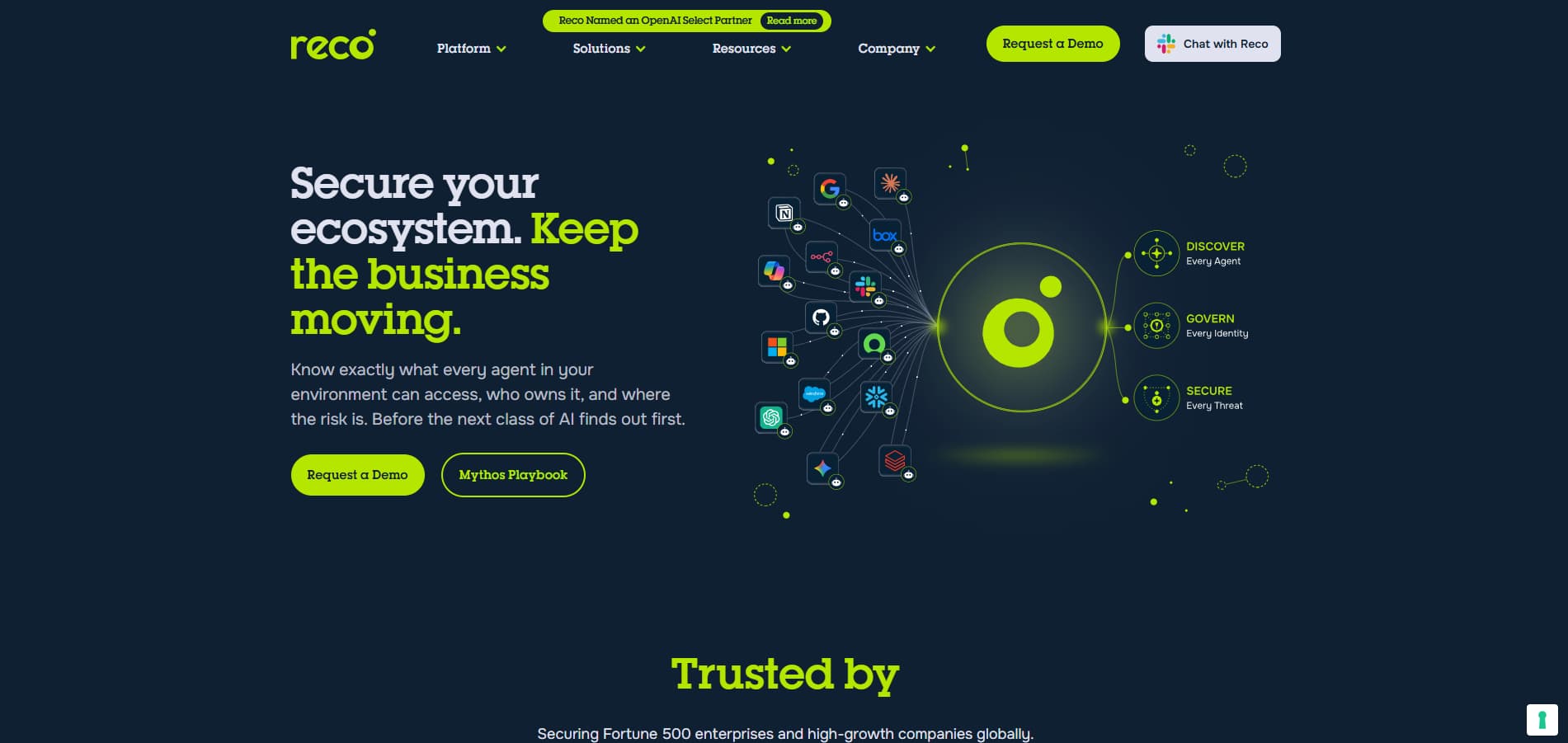
Reco is an Agent Security Platform that unifies third-party posture management with identity governance and agent discovery, closing the gap between what a catalog-bound tool sees and what a modern third-party and agent environment actually contains. It takes an identity-first approach, mapping human and non-human identities, including agents, to surface risk that event-driven telemetry alone would miss, while powering identity and access governance across the full third-party estate rather than a fixed list of supported connectors.
Reco Is for You If:
- You need visibility into agents and non-human identities, not just sanctioned third-party tools
- Your third-party estate has outgrown what a fixed integration catalog can realistically cover
- You want identity governance and posture management in one platform instead of stitched-together point tools
Reco Is Not for You If:
- Your environment is small, stable, and limited to a handful of well-supported enterprise platforms
- You are only looking for basic misconfiguration scanning with no identity or agent component
- You're looking for a narrow, single-purpose point tool rather than a consolidated platform approach
What Customers Say: One G2 reviewer noted that Reco "maintains airtight posture and compliance even as apps and AI Agents are added" to the environment.
2. Adaptive Shield (Now CrowdStrike Falcon Shield)
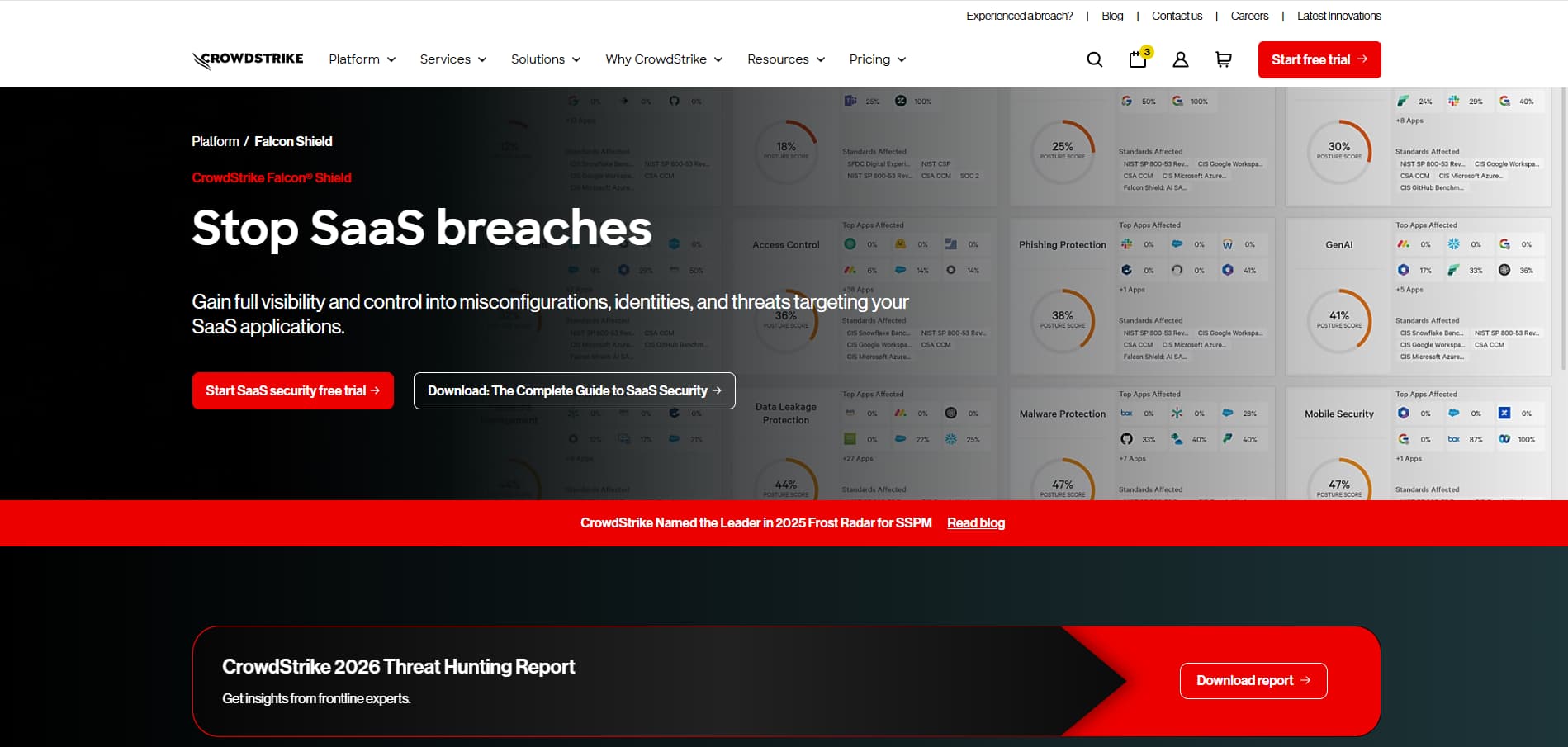
Adaptive Shield, acquired by CrowdStrike and now branded Falcon Shield, offers broad SSPM coverage with strong compliance reporting and native integration into the CrowdStrike XDR ecosystem. The platform connects to over 200 third-party platforms out of the box, continuously scanning for misconfigurations and connecting agentlessly via OAuth and feeding SaaS telemetry into the broader Falcon platform for one-click remediation.
Adaptive Shield Is for You If:
- You are already standardized on CrowdStrike and want third-party posture in the same console
- Compliance reporting is a top priority
- Your coverage needs align with its existing connector list
Adaptive Shield Is Not for You If:
- You need deep identity threat detection or behavior analytics
- You are not invested in the CrowdStrike ecosystem
- You want dedicated agent-first identity governance rather than SSPM with compliance reporting as the core offering
What Customers Say: One G2 reviewer said Adaptive Shield "truly transformed our approach to SaaS security."
3. Obsidian Security
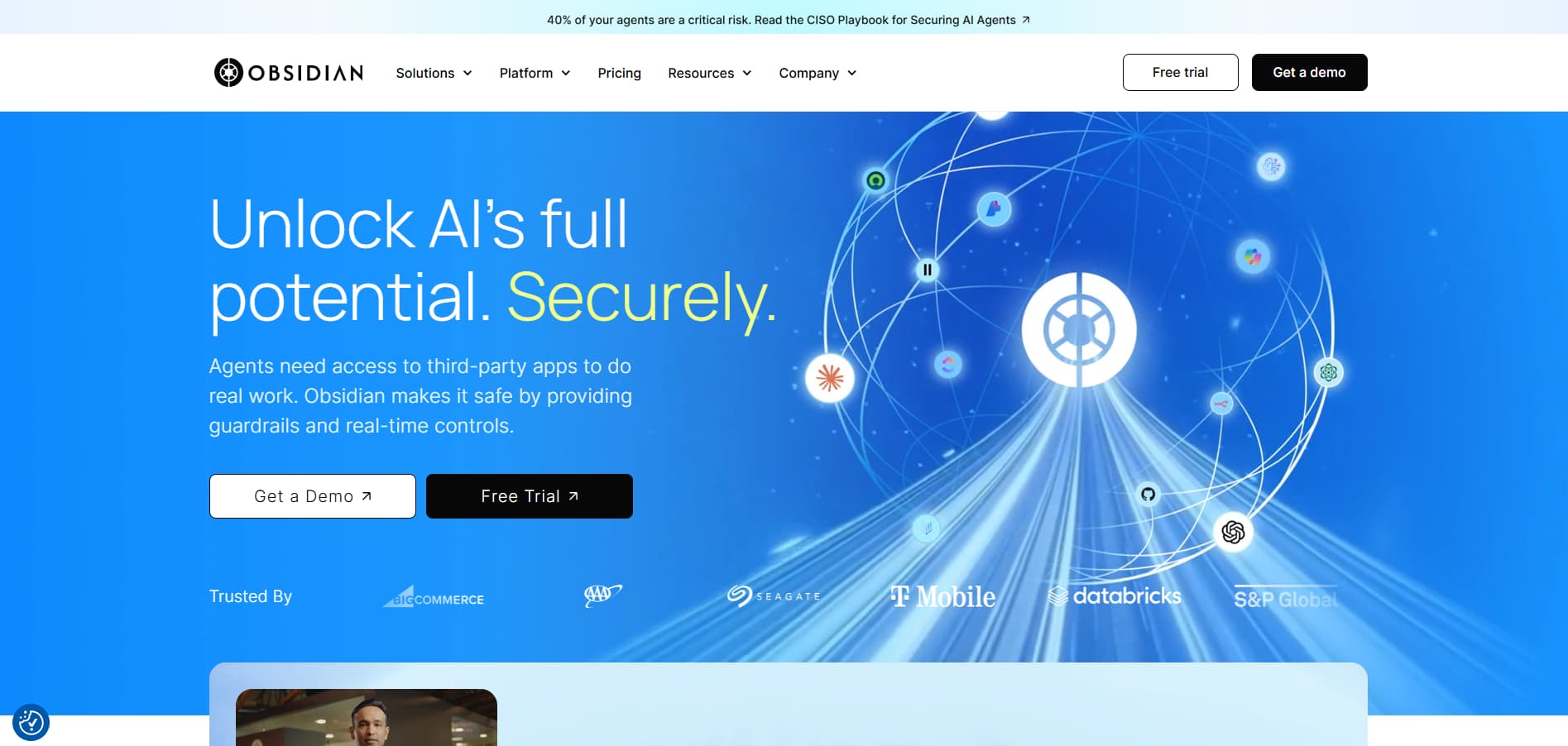
Obsidian combines SSPM with UEBA and AI agent security, positioning itself as a unified security intelligence layer. Its platform correlates identity, configuration, and activity data across connected platforms to flag account takeover, session hijacking, abnormal service-account behavior, and AI agent risks as they happen.
Obsidian Is for You If:
- Insider risk and behavioral anomaly detection are top priorities
- You want threat intelligence layered on top of posture management
- Your core need is monitoring account and identity behavior over time
Obsidian Is Not for You If:
- You need strong remediation capabilities built into the platform
- Shadow discovery and data inventory are a primary requirement
- Broad, wall-to-wall configuration enforcement matters more than behavioral analytics
What Customers Say: One G2 reviewer called Obsidian a "standout in the category" among SSPM tools they had used.
4. Grip Security
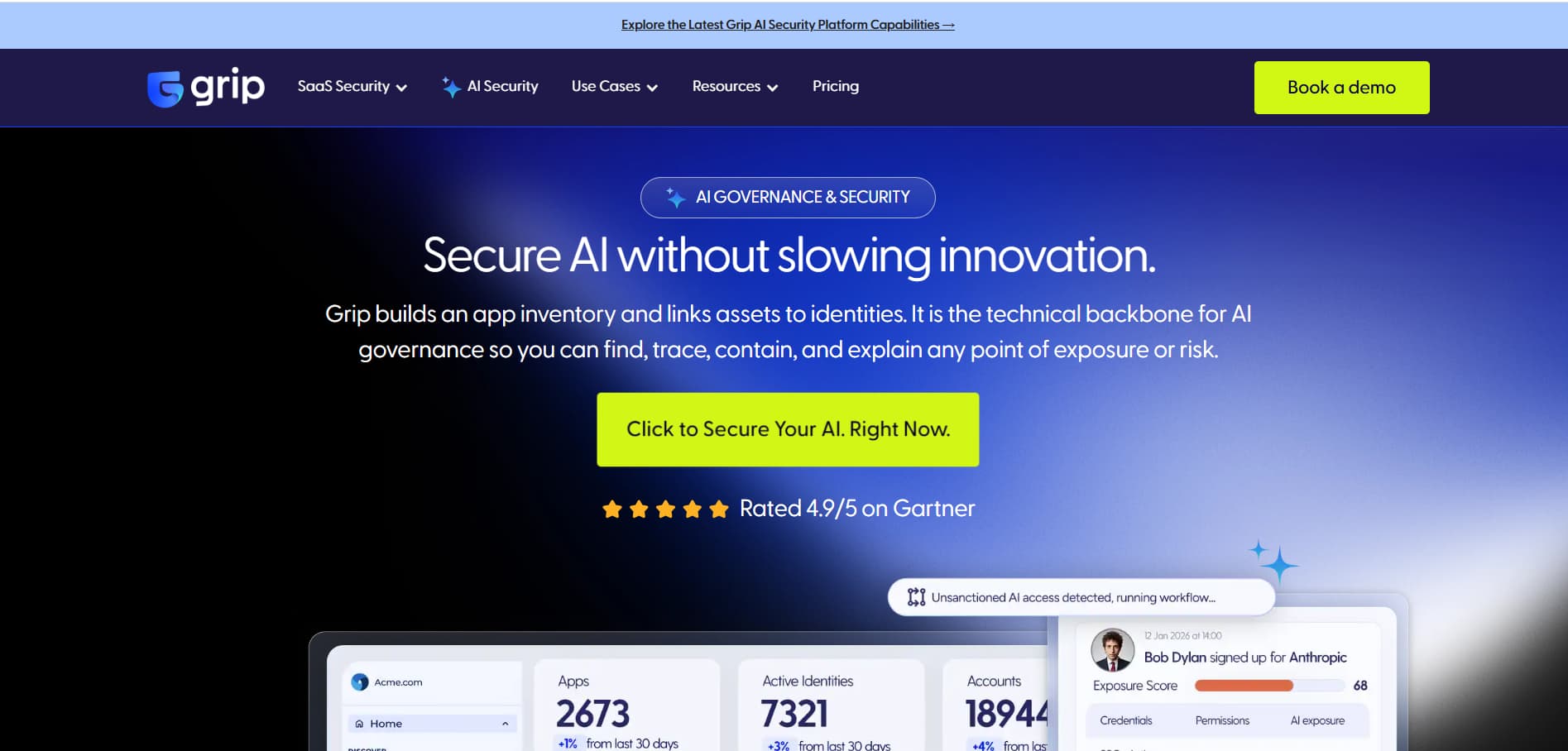
Grip approaches third-party security from the identity layer outward, scanning email flows, browser activity, and IdP data to build a live inventory of every platform employees connect to, sanctioned or not. That discovery-first model has made it a common entry point for teams that need to see the scope of their third-party sprawl before deciding what to fix.
Grip Is for You If:
- Shadow IT and unmanaged discovery is your immediate priority
- You want an agentless, lightweight deployment
- Building a fast, comprehensive third-party inventory matters more right now than deep remediation
Grip Is Not for You If:
- You need sensitive data exposure analysis or remediation
- Deep configuration management is a core requirement
- ITDR capabilities are a must-have
What Customers Say: One reviewer said Grip's proactive threat management "reduces the risk of breaches."
5. DoControl
DoControl focuses on third-party DLP and automated remediation, connecting to data access, identity, and third-party OAuth events across major platforms to close exposure at scale. Its conditional-logic workflows let teams trigger bulk remediation, like pulling access from thousands of files at once, without manually working each finding one by one.
DoControl Is for You If:
- Reducing sensitive data exposure at scale is your top priority
- You want automated, no-code remediation workflows rather than manual cleanup
- Business context from your IdP, HRIS, and EDR matters for prioritizing risk
DoControl Is Not for You If:
- Deep misconfiguration coverage across a wide catalog is the main need
- You need mature compliance framework support out of the box
- Shadow AI visibility inside the browser is a requirement
What Customers Say: One customer said DoControl "freed up our resources to focus on other things" by automating workflows they could trust to run as configured.
6. Valence Security
Valence addresses third-party supply chain risk by mapping OAuth tokens, third-party integrations, and platform-to-platform connections, giving teams visibility into the connective tissue between third-party systems that most posture tools overlook. The platform pairs that discovery with remediation options ranging from one-click fixes to business-user collaboration, so findings don't just sit in a queue waiting for security to act on them.
Valence Is for You If:
- Third-party and non-human integration risk is a core concern
- OAuth token sprawl across connected platforms needs mapping and control
- You want remediation options that involve business users, not just security teams
Valence Is Not for You If:
- You need built-in behavior analytics or ITDR
- Data exposure and risk insight need to go deeper than integration mapping
- Native remediation for data exposure specifically is the priority
What Customers Say: One Gartner Peer Insights reviewer said work that "took us weeks to analyze and uncover in the past now happens in minutes with Valence.”
What We Looked For in Each Alternative
To build this list, we evaluated each platform against the specific gaps AppOmni's catalog-bound model leaves open, not just general third-party security capability.
- Identity Coverage Depth: Whether the platform governs human and non-human identities, including agents, or only tracks platform-level configurations.
- Discovery Breadth: How well the tool surfaces shadow third-party tools and shadow agents outside a fixed, vendor-maintained catalog.
- Remediation Capability: Whether findings translate into automated or guided action, or stop at flagging risk for a team to resolve manually.
- Deployment and Integration Speed: How quickly the platform can onboard new connectors or agent tools relative to how fast they're adopted.
- Compliance Fit: Whether the platform supports the frameworks and reporting a given organization actually needs, rather than a one-size-fits-all certification.
Notable Tools That Didn't Make the List
A few other platforms come up often in third-party security conversations. Here's why they didn't make the primary six.
- Spin.ai: Strong on backup, ransomware recovery, and posture management through its SpinOne platform, but its core differentiator is business continuity, not the identity or remediation depth the six featured tools compete on.
- Wing Security: Offers SSPM, ITDR, and shadow IT visibility with expanding agent discovery, but its remediation maturity and large-enterprise readiness still trail the platforms featured above.
- Zscaler: Delivers SSPM as part of its broader Zero Trust Exchange, strong on inline access controls, but it complements platform-level posture tools rather than replacing them as a dedicated third-party security platform.
AppOmni vs Alternatives at a Glance
What Enterprise Teams Should Expect From an AppOmni Alternative
Whichever platform a team chooses, these are the baseline capabilities worth confirming before committing to it.
- Agent Discovery and Agentic Posture Management Across the Full Environment: The platform should inventory every agent in use, not just connectors, and assess their permissions and behavior as a distinct risk category.
- Identity and Access Governance Across Human and Non-Human Identities: Coverage should extend to service accounts, OAuth grants, and agents, not only employee logins.
- Shadow Third-Party and Shadow Agent Detection Beyond the Sanctioned Catalog: Discovery should automatically surface unsanctioned tools and agents, without waiting for a native connector to be built.
- Cross-Platform Risk Visibility That Connects Identities, Permissions, and Data: Risk should be assessed across platform boundaries rather than in isolated per-platform silos, since real exposure often lies in the connections between systems.
- Integration Speed for New Connectors and Agent Tools in Days, Not Quarters: Onboarding a new connector or agent tool should keep pace with how fast the business adopts them, not lag on a connector development cycle.
- Compliance Alignment Including ISO 42001 and EU AI Act Coverage: With EU AI Act transparency obligations already in force and high-risk system deadlines approaching, platforms should map controls to both established frameworks like ISO 42001 and current AI-specific regulation.
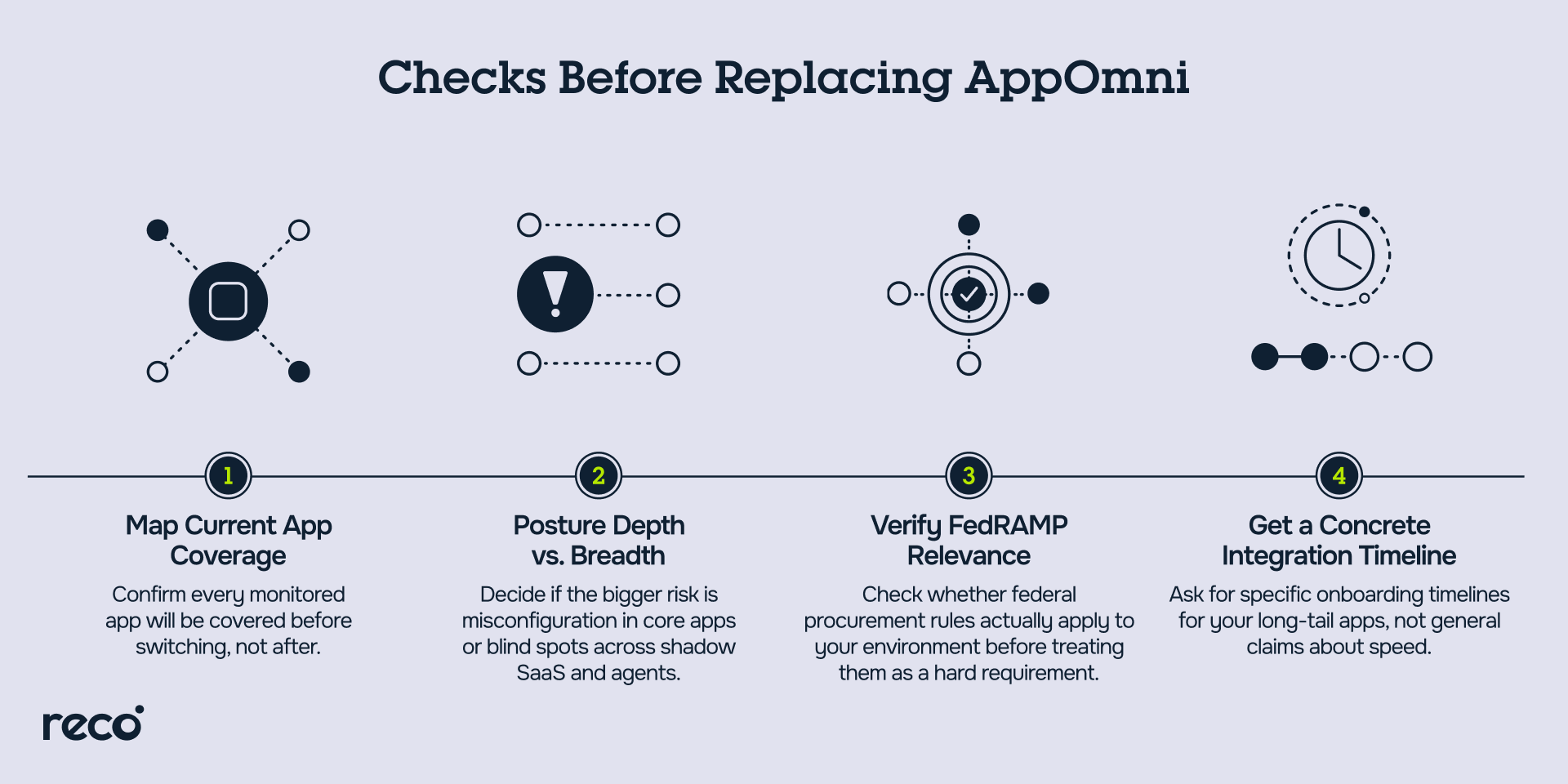
Before You Switch: What to Confirm Before Replacing AppOmni
Switching third-party security platforms isn't a like-for-like swap, and skipping this step tends to surface gaps months into a deployment rather than during evaluation. A few practical checks worth working through before committing.
- Mapping AppOmni's Per-Connector Coverage to Broader Discovery: Confirm every platform AppOmni currently monitors will be covered by the alternative, so you're not trading known visibility for unknown gaps.
- Whether Your Primary Risk Is Posture Depth or Breadth and Agent Visibility: Decide if the bigger exposure is misconfiguration within core platforms or blind spots across shadow third-party tools and agents, since that shapes which platform actually fits.
- FedRAMP Requirements and Whether They Actually Apply to Your Organization: Check whether federal procurement rules genuinely govern your environment before treating FedRAMP authorization as a hard requirement.
- Integration Timeline for Platforms Outside AppOmni's Supported Catalog: Get a concrete onboarding timeline for your specific long-tail platforms and agent tools, not a general claim about integration speed.
Conclusion
AppOmni still earns its place for teams whose third-party footprint stays within Salesforce, ServiceNow, and Microsoft 365, and whose priority is deep, auditable posture management within a federally compliant framework. That fit narrows fast for organizations managing a sprawling third-party estate, shadow agent tools, and autonomous agents that a fixed catalog was never built to see.
The six alternatives in this article each solve a different piece of that gap, from Grip's fast shadow discovery to DoControl's automated remediation to Valence's OAuth mapping. For teams that need identity governance, agent visibility, and posture management in one platform rather than stitched-together point tools, Reco is built specifically to close that gap.
Whichever direction a team takes, the test stays the same: can the platform account for everything now touching sensitive data, human, non-human, and increasingly autonomous alike?
FAQs
What is the difference between SSPM and agent security, and why do enterprises need both?
SSPM focuses on configurations and permissions within known third-party platforms, while agent security governs a different category entirely: autonomous agents with their own identities and data access that sit outside traditional platform-level monitoring. Enterprises need both because identity and access governance has to extend to non-human identities, not just employee logins, for either layer to actually close the gap.
How do third-party security platforms handle shadow agents and unsanctioned agent tools that employees adopt without IT approval?
Approaches vary. Discovery-first tools scan email, browser, and IdP data to surface unsanctioned platforms, while identity-first platforms trace shadow agent usage back to what it can actually access once connected. That kind of discovery matters most when new agent tools are appearing faster than any catalog can absorb them.
- Agentless discovery tools focus on fast, broad visibility
- Identity-first platforms connect shadow agent usage to the access and data it can reach
- Coverage speed matters more than coverage depth in this specific case
What should security teams prioritize when evaluating AppOmni alternatives, coverage depth or breadth across the full third-party estate?
The right answer depends on where the actual risk sits. Teams with a small, stable footprint may prioritize depth, while teams managing a sprawling or fast-changing third-party estate need breadth first, though most enterprise environments now need both.
- Depth matters most for regulated, high-stakes platforms with complex configurations
- Breadth matters most when shadow third-party tools and agents are the bigger unknown
- Needing both is what's pushing teams toward consolidated platforms over point tools
How does Reco's identity-first approach differ from AppOmni's event-driven telemetry model for detecting cross-platform risk?
AppOmni tracks configuration and permission events largely within each connected platform, with Marlin AI now adding some cross-app alert correlation. Reco starts from identity instead, mapping how a single human or non-human identity moves across multiple platforms, which is what makes its identity threat detection and response catch risk that lives in the connections between systems rather than within any one platform.
How quickly can Reco add coverage for a new platform or agent tool that AppOmni does not currently support?
Reco's onboarding is built to move at the pace new platforms and agent tools actually get adopted, rather than waiting on a connector development cycle for each one, an approach reflected in products like its Reco Factory.
- New integrations are designed to activate in days, not quarters
- Coverage extends to agent platforms as they emerge, not just pre-approved catalogs
- This speed is core to closing the gap that fixed-catalog tools consistently fall behind on


%201.svg)


.svg)