
OpenAI Daybreak and Codex Security, Explained


What Are OpenAI Daybreak and Codex?
OpenAI Daybreak is a cybersecurity initiative that combines OpenAI models, Codex Security, and security partner integrations to help organizations identify, validate, and prioritize software vulnerabilities. According to OpenAI, Daybreak supports activities such as threat modeling, vulnerability discovery, exploit validation, patch validation, dependency risk analysis, detection, and remediation guidance within software development workflows. Organizations can request a Daybreak assessment to analyze code repositories, identify attack paths, and prioritize potentially exploitable vulnerabilities.
Codex Security is the agentic harness used within Daybreak to perform security analysis and remediation workflows. OpenAI describes Codex Security as an agentic harness that uses subagents to scan repositories, identify vulnerabilities, validate findings in isolated environments, generate and test patches, and return evidence to enterprise systems. Within the Daybreak architecture, Codex Security enables automated threat modeling, vulnerability validation, patch testing, and remediation workflows.
How OpenAI Daybreak Works
OpenAI Daybreak begins by analyzing a code repository and building an editable threat model that maps potential attack paths. It then uses OpenAI models and Codex Security to identify vulnerabilities, validate likely exploitability in isolated environments, and prioritize findings based on real-world risk. The platform can also generate and test patches before returning audit-ready evidence and remediation guidance to security and development teams.
Key Features of OpenAI Daybreak and Codex Security
OpenAI Daybreak and Codex Security combine AI-driven analysis, vulnerability validation, and remediation workflows to help organizations identify and address software security issues more efficiently. Key capabilities include:
- Threat Modeling: Builds editable threat models from code repositories to identify potential attack paths.
- Vulnerability Discovery: Analyzes repositories to identify security weaknesses and high-impact vulnerabilities.
- Exploit Validation: Tests likely vulnerabilities in isolated environments to determine whether findings are potentially exploitable.
- Patch Generation and Testing: Generates potential fixes and validates patches before remediation efforts move forward.
- Dependency Risk Analysis: Evaluates software dependencies to identify potential security risks introduced by third-party components.
- Audit-Ready Evidence and Remediation Guidance: Returns evidence, findings, and recommendations that security and development teams can use for remediation and reporting.
OpenAI Daybreak vs. Traditional Application Security Tools
Traditional application security tools and the OpenAI Daybreak approach software security from different starting points. While SAST and DAST tools are typically designed to identify vulnerabilities through scanning, Daybreak combines threat modeling, vulnerability validation, and remediation workflows within an AI-assisted process.
How Codex Agents Expand the Enterprise AI Attack Surface
As organizations adopt AI-assisted development tools, Codex agents and similar systems increasingly interact with repositories, development environments, and enterprise systems. Each new access path widens the attack surface and introduces security, governance, and visibility challenges that require deliberate oversight.
Codex Agents as New Non-Human Identities
Codex agents act on enterprise resources and perform tasks on behalf of users or teams, but they do not behave like traditional user accounts. From a security perspective, they should be treated as non-human identities that require visibility, monitoring, and access governance - the same lifecycle controls that frameworks such as the OWASP Non-Human Identity Top 10 apply to service accounts and machine credentials. Unmanaged agent identities accumulate quietly, and at scale, they become a meaningful blind spot for security teams.
Permissions, Access Paths, and Data Exposure From Codex Deployments
To perform analysis and remediation tasks, Codex Security may require access to repositories, development environments, and connected systems. Security teams should evaluate every permission granted and keep access aligned with the principle of least privilege. Excessive permissions widen the blast radius of any compromise, increasing the risk of unauthorized access, unintended actions, or unnecessary exposure of sensitive data.
Shadow AI Risk When Codex Is Used Outside Approved Workflows
Codex can introduce governance gaps when it is adopted outside approved security and development processes. Teams may connect it to repositories or workflows without centralized oversight, leaving security teams without a complete picture of where AI agents operate. Clear governance policies and active monitoring of AI tool adoption reduce shadow AI risk and maintain consistent security controls across the environment.

Gal Nakash
Cofounder & CPO at Reco

Gal is the Cofounder & CPO of Reco. Gal is a former Lieutenant Colonel in the Israeli Prime Minister's Office. He is a tech enthusiast, with a background of Security Researcher and Hacker. Gal has led teams in multiple cybersecurity areas with an expertise in the human element.

Expert Insight: Govern the Agent Before You Review the Code
One pattern I've repeatedly seen when reviewing AI and SaaS security programs is that organizations spend significant time evaluating AI-generated code but far less time evaluating the permissions of the AI agents that produce it. In many cases, the larger risk is not the code itself but the access the agent accumulates over time.
When assessing tools such as Codex, I recommend focusing on three areas first:
- Which repositories, SaaS applications, and data sources can the agent access?
- What permissions has the agent inherited through users, service accounts, or integrations?
- Can every action performed by the agent be monitored and audited?
Treat AI agents as non-human identities from day one. Once permissions, ownership, and visibility are established, it becomes much easier to manage the security risks associated with AI-assisted development.
Takeaway: Controlling access early is far easier than untangling excessive permissions after AI agents become embedded in development workflows.
Security Risks Created by AI-Powered Code Generation and Research Tools
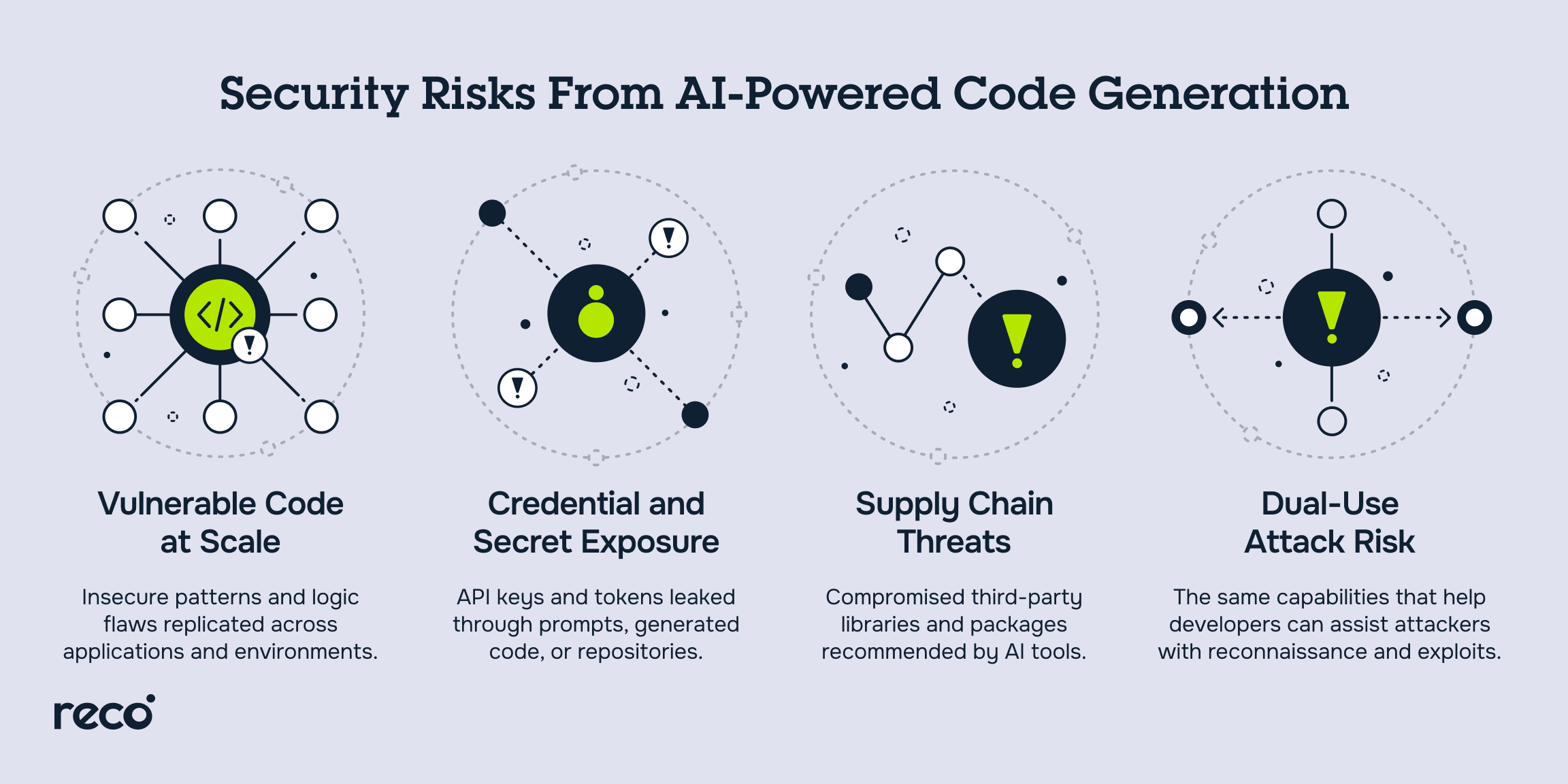
AI-powered development tools can accelerate software delivery, but they can also introduce new security challenges when outputs are not properly reviewed. Security teams should pay close attention to the following risks:
- Vulnerable Code Patterns Introduced at Scale: AI-generated code can contain insecure coding patterns, logic flaws, weak input validation, or insecure defaults. When developers rely heavily on generated code, these issues can be replicated across multiple applications and environments.
- Credential and Secret Exposure in AI-Generated Code: Developers may inadvertently expose API keys, tokens, credentials, or other sensitive information through prompts, generated code, configuration files, or repositories. Without proper controls, these exposures can create opportunities for unauthorized access.
- Software Supply Chain Threats From AI-Assisted Development: AI tools often recommend third-party libraries, packages, and code snippets. If these dependencies contain security weaknesses or originate from compromised sources, they can introduce additional risk into the software supply chain.
- AI-Assisted Attack Techniques Enabled by Models Like Codex: The same capabilities that help developers analyze code and identify vulnerabilities can also assist attackers with reconnaissance, vulnerability research, and exploit development. This dual-use nature makes governance and oversight critical when deploying advanced AI development tools.
How to Govern AI Agents in SaaS
Controls reduce risk, but governance decides whether AI agents stay visible, accountable, and within policy as their numbers grow. As tools such as Codex spread across development and business workflows, organizations need a framework for how agents are deployed, monitored, and retired, not just what they do.
Establish Clear Ownership From Day One
Every AI agent should have an identifiable owner responsible for approving its use, reviewing its access, and evaluating whether it still serves a business purpose. Without ownership, agents can remain active long after projects end, creating visibility and accountability gaps that become increasingly difficult to manage as adoption grows.
Govern Access Across Connected SaaS Applications
AI agents rarely operate within a single environment. A coding agent may interact with repositories, ticketing systems, cloud platforms, documentation tools, and collaboration applications simultaneously. Governance should therefore focus on the full scope of an agent's access across the SaaS ecosystem, ensuring permissions remain aligned with business requirements and are reviewed regularly.
Manage AI Agents Throughout Their Lifecycle
AI governance should extend beyond deployment. Organizations need processes for reviewing agent activity, reassessing access requirements, and removing agents that are no longer needed. Treating governance as an ongoing lifecycle rather than a one-time approval process helps prevent unnecessary access accumulation and reduces long-term security exposure.
Maintain Continuous Visibility
Governance depends on visibility. Security teams should be able to identify which agents exist, what systems they can access, who owns them, and how their activity changes over time. Continuous visibility enables organizations to detect policy violations, investigate unusual behavior, and maintain control as AI adoption expands across the enterprise.
How to Secure Codex and AI Agents Across the Enterprise: Best Practices
As organizations adopt AI-assisted development tools, security teams need controls that address visibility, access management, monitoring, and governance. The practices below provide a practical framework for managing Codex deployments and other AI-powered workflows.
How Reco Improves Visibility Into AI Agent and SaaS Security Risks
Codex agents and AI tools rarely operate in isolation: they connect to the SaaS applications where enterprise data already lives. Reco addresses the risks named above by making every AI agent, identity, and connection visible across the SaaS environment, and then governing what each can access.
- Unified Discovery Across Every AI Agent and SaaS App: Reco's application discovery continuously surfaces every connected app, SaaS-to-SaaS integration, and AI agent across 225+ supported applications, along with the identities and data tied to each. New applications are brought into coverage within days through the SaaS App Factory, so visibility keeps pace with how quickly teams adopt new tools.
- Human and Agentic Identity Risk Detection: Because agents act on enterprise resources without behaving like user accounts, they need the same oversight as human identities. Reco's identity and access governance unifies human and non-human identities, mapping permissions and roles so over-permissioned or dormant access becomes visible and reviewable.
- Shadow AI and Third-Party AI Tool Discovery: AI tools adopted outside approved workflows create the visibility gaps described earlier. Reco detects embedded AI features, third-party AI connections, and shadow AI usage automatically, tying each tool to the users and data it touches so security teams can govern adoption rather than discover it after the fact.
- Least-Privilege Enforcement and Overpermissioned Agent Detection: Excessive permissions widen the blast radius of any compromised agent. Reco surfaces over-permissioned identities and access paths, and its data exposure management identifies where sensitive data is reachable, giving teams the context to scope access down to what each agent actually needs.
- 1,000+ Pre-Built Detections for AI Agent Threats: Rather than building detection logic from scratch, teams inherit a library of more than 1,000 pre-built detections through Reco's identity threat detection and response, with alerts on data theft, account compromise, and configuration drift, and automated response through existing tools.
- Knowledge Graph for Full AI Risk Context Across the Environment: Reco's Knowledge Graph correlates apps, identities, permissions, and actions into business context, tracking how those relationships change over time and flagging anomalies. This is what turns raw discovery into prioritized, explainable risk rather than a flat list of findings.
Conclusion
OpenAI Daybreak and Codex Security represent a move toward AI-driven application security, bringing threat modeling, vulnerability validation, and remediation into a single workflow. As organizations adopt these capabilities, security teams must also account for the new risks they introduce.
AI agents can accumulate permissions, interact with enterprise systems, and access the SaaS applications where sensitive data resides. Managing that risk requires visibility into every agent, identity, integration, and access path. Reco gives security teams visibility at scale, mapping what each agent can reach and surfacing risky activity before it leads to data exposure or security incidents.
FAQs
What is the difference between OpenAI Daybreak and Codex, and do they address different security problems?
Daybreak and Codex Security work together rather than solving separate problems. Daybreak is the broader cybersecurity initiative; Codex Security is the agentic harness that performs the work inside it.
- Daybreak combines OpenAI models, Codex Security, and partner integrations to identify, validate, and prioritize software vulnerabilities.
- Codex Security runs the subagents that scan repositories, validate findings in isolated environments, and test patches.
- Daybreak is the program and workflow; Codex Security is the engine that executes threat modeling, validation, and remediation within it.
How should enterprise security teams govern AI agents that are created or deployed through AI-assisted development tools?
Treat agents as non-human identities from the moment they are deployed, not after they are embedded in workflows. Governance rests on knowing what exists, constraining what it can do, and watching what it does.
- Inventory every agent and integration, including the systems each one can reach.
- Scope each agent to least-privilege access and review entitlements on a set cadence.
- Monitor and log agent activity continuously to investigate anomalous behavior.
- Assign ownership, rotation, and decommissioning for every agent identity.
What compliance or regulatory frameworks apply to organizations using AI-powered code generation tools in production environments?
No single framework governs AI code generation specifically, but several existing standards apply to the identities, data, and access involved.
- NIST CSF 2.0 and NIST SP 800-53 cover access control and machine-identity governance.
- The OWASP Non-Human Identity Top 10 maps risks specific to service accounts, machine credentials, and AI agents.
- PCI DSS 4.0 extends account management, least privilege, and periodic access review to non-human identities.
- SOC 2, GDPR, and HIPAA impose access-control, auditability, and data-protection obligations that AI-generated code and agents must meet.
How does Reco discover and govern Codex agents and other AI integrations that connect to enterprise SaaS applications?
Reco discovers AI agents and integrations as part of continuous SaaS discovery, then ties each to the identities and data it touches.
- Surfaces every connected app, SaaS-to-SaaS integration, and AI agent automatically.
- Maps what each agent can access and flags overpermissioned or anomalous behavior.
- Brings newly adopted tools under coverage quickly rather than after the fact.
Reco's application discovery continuously surfaces every AI agent and connection across the SaaS environment, so security teams see what exists before it becomes a risk.
Does Reco cover non-human identities created by AI agents alongside traditional human user identities?
Yes. Reco unifies human and non-human identities in one view rather than treating agents as a separate problem.
- Governs AI agents and service accounts with the same controls applied to human users.
- Maps permissions and roles so over-permissioned or dormant access is visible and reviewable.
- Supports least-privilege enforcement across both identity types.
Reco's identity and access governance unifies human and non-human identities under a single set of controls, keeping permissions visible and reviewable as agents multiply.

Tal Shapira
%201.svg)
ABOUT THE AUTHOR
Tal is the Cofounder & CTO of Reco. Tal has a Ph.D. from the school of Electrical Engineering at Tel Aviv University, where his research focused on deep learning, computer networks, and cybersecurity. Tal is a graduate of the Talpiot Excellence Program, and a former head of a cybersecurity R&D group within the Israeli Prime Minister's Office. In addition to serving as the CTO, Tal is a member of the AI Controls Security Working Group with the Cloud Security Alliance.
Tal is the Cofounder & CTO of Reco. Tal has a Ph.D. from the school of Electrical Engineering at Tel Aviv University, where his research focused on deep learning, computer networks, and cybersecurity. Tal is a graduate of the Talpiot Excellence Program, and a former head of a cybersecurity R&D group within the Israeli Prime Minister's Office. In addition to serving as the CTO, Tal is a member of the AI Controls Security Working Group with the Cloud Security Alliance.