

Reco vs Obsidian Security: Which SaaS Security Platform Is Right for You in 2026?

Reco Overview
Reco is an AI Agent Security Platform built for enterprises whose SaaS environments have outgrown traditional SaaS Security Posture Management. The platform secures more than 225 applications across the full SaaS lifecycle, with continuous monitoring spanning human identities, non-human identities, AI agents, and SaaS-to-SaaS integrations.
Reco is designed for enterprises operating large, fast-moving SaaS environments where AI adoption, shadow SaaS, and autonomous workflows create exposure that legacy SSPM tools were never built to manage. Instead of treating SaaS security as a periodic posture review, Reco approaches it as a continuous governance challenge spanning discovery, identity risk, configuration management, data exposure, and AI-driven activity.
Obsidian Security Overview
Obsidian Security is a browser-based SaaS security platform that detects threats and surfaces access risks through browser, email, and IdP signal correlation across a narrower set of core business applications such as Salesforce, Google Workspace, and Microsoft 365.
The platform reflects an earlier generation of SaaS security architecture centered on user behavior, account compromise, and browser-level access monitoring inside federated enterprise applications. It is typically adopted by organizations operating a smaller set of core SaaS apps where the primary security focus remains browser-based detection rather than broader governance of AI agents, non-human identities, shadow SaaS, and autonomous SaaS-to-SaaS activity.
The Core Strategic Difference: Securing the Future vs. the Past
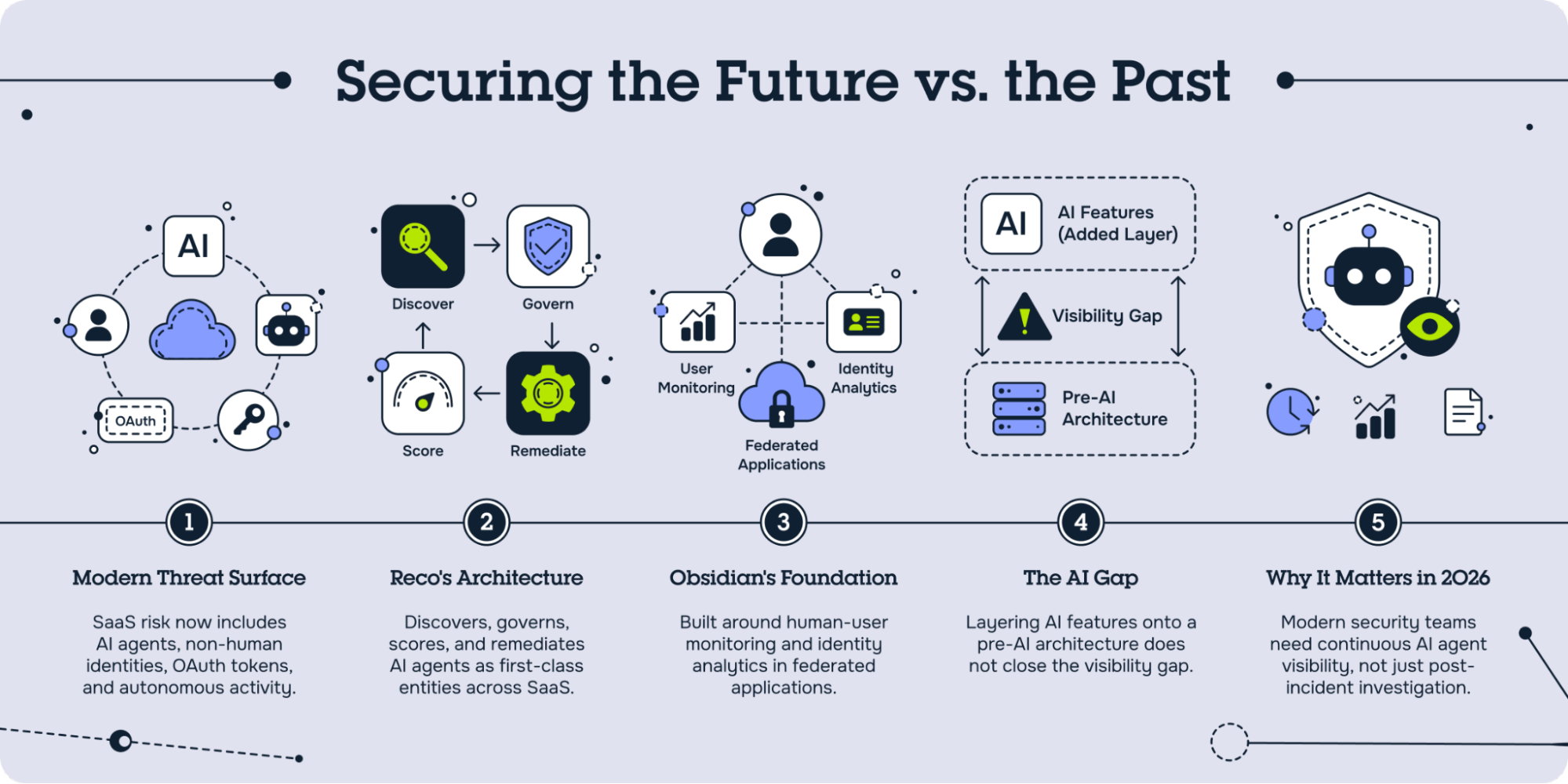
What each platform was architected to secure tells you everything. One was built for the SaaS environment enterprises operate today. The other was built for the one they used to.
Reco: AI Agent Security and the Modern SaaS Threat Surface
The SaaS attack surface is no longer defined only by users logging into applications. It now includes AI agents, non-human identities, OAuth tokens, and autonomous SaaS-to-SaaS activity operating outside traditional identity and endpoint controls.
Reco was built around this shift. The platform treats AI agents and non-human identities as first-class entities to discover, govern, score, and remediate - not edge cases added onto an older security model. AI-driven activity is continuously mapped to ownership, risk, and data exposure across the SaaS ecosystem.
Obsidian: Static SSPM Built for a Pre-AI World
Obsidian Security was designed around an earlier SaaS operating model centered on human-user monitoring inside a narrower set of federated applications. Its core architecture remains focused on identity analytics, behavioral monitoring, and investigation of user-centric threats.
Adding AI-related functionality onto that foundation does not fundamentally change the model itself. The platform remains more closely aligned with a pre-AI SaaS environment where user compromise, not autonomous activity, defined the primary security concern.
Why the Distinction Matters for Enterprise Security in 2026
Enterprises now operate hundreds of SaaS applications, many introduced outside centralized security review, while AI adoption continues accelerating across business workflows.
Choosing a platform designed for the pre-AI era means accepting visibility and governance gaps that expand alongside the SaaS environment itself. Modern security teams need continuous visibility into AI agents, non-human identities, and SaaS automation, and not just investigation of user behavior after risk appears.
Reco vs Obsidian Security: Core Platform Differences
The two platforms differ across foundational areas that define what each can realistically secure inside a modern SaaS environment.
Reco vs Obsidian Security: Feature Comparison
Here’s a feature-level comparison of how each platform approaches modern SaaS security operations:
One of the biggest operational differences appears in remediation. Reco can directly reduce exposure through revoked permissions, disabled integrations, and orchestrated enforcement workflows, while more detection-centric platforms often depend on separate systems and manual response processes to close risk. For security teams already overloaded with alerts, that distinction has a direct impact on operational scale and remediation backlog.
Reco vs Obsidian Security: Architecture and Integration Model
Platform architecture and integration design determine how deeply a SaaS security platform can see across the modern SaaS estate, and how consistently that visibility scales over time.
Agentless Deployment vs. Integration-Based Setup
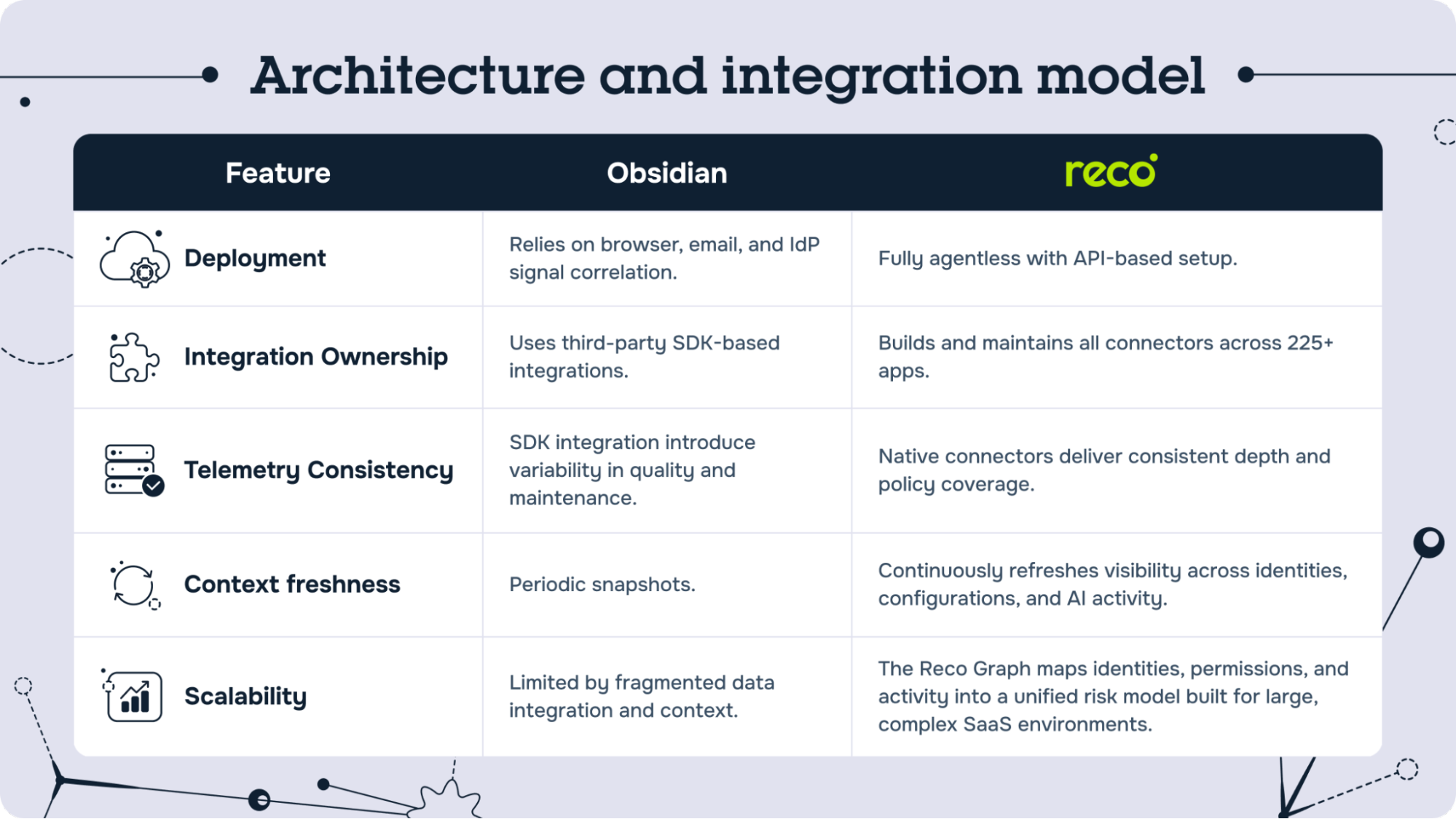
Reco is fully agentless, with API-based deployment that begins returning security visibility within hours without endpoint agents, browser extensions, or network proxies.
Obsidian Security relies on an integration-based deployment model combined with browser, email, and IdP signal correlation, increasing operational complexity and time to value.
Integration Ownership: Who Builds and Maintains the Connectors?
Reco builds and maintains its own connectors, delivering consistent telemetry depth and policy coverage across more than 225 applications. The SaaS App Factory expands coverage rapidly while maintaining the same integration model across the platform.
Obsidian's Reliance on Third-Party-Authored App Integrations (SDK)
Part of Obsidian's application coverage depends on integrations developed outside its core engineering team through SDK-based extensibility. This creates variability in telemetry depth, integration quality, and long-term maintenance consistency across the supported SaaS environment.
Depth and Freshness of Context Across SaaS Ecosystems
Reco's native integrations continuously collect context across identities, configurations, integrations, and AI activity, allowing security teams to monitor SaaS risk with continuously refreshed visibility instead of periodic snapshots.
Scalability Across Large, Complex SaaS Environments
The Reco Graph maps identities, permissions, integrations, and activity into a unified SaaS risk model designed for large multi-instance and AI-heavy environments. This architecture allows Reco to scale across complex SaaS ecosystems where point-by-point detection approaches struggle to maintain visibility.
Reco vs Obsidian Security: Licensing Model
Licensing structure shapes how a SaaS security platform scales financially as the SaaS environment grows.
- Reco’s App-Based Licensing - Pay Per Application, Not Per Instance: Reco licenses by application rather than deployment instance, allowing enterprises to scale across multiple Salesforce orgs, Workday tenants, and Microsoft 365 environments without multiplying connector costs.
- Obsidian’s Instance-Based Licensing - Costs Grow With Every New Salesforce or Workday Instance: Obsidian uses an instance-based licensing model where each additional SaaS deployment expands the licensing footprint and long-term cost.
- Why Licensing Architecture Reflects Platform Philosophy: Reco's app-based model aligns with large, fast-moving SaaS environments, while instance-based licensing reflects a narrower operational model built around a smaller set of core applications.
- Total Cost of Ownership at Enterprise Scale: Reco scales more predictably across complex enterprise SaaS estates, while instance-based pricing compounds cost as organizations expand across business units, tenants, and regions.
Reco vs Obsidian Security: Ease of Use and Time to Value
Deployment speed, operational efficiency, and investigation workflow design have a direct impact on SaaS security outcomes at scale.
Reco vs Obsidian Security: Use Cases and Ideal Customers
Each platform aligns with a different SaaS security operating model.
Best Fit for AI Agent Security and Modern SaaS Sprawl
Reco. Enterprises adopting AI agents, shadow AI, and autonomous workflows need a platform designed for continuous visibility into non-human activity across the SaaS environment.
Best Fit for Organizations Still Focused on Traditional SSPM
Obsidian. Organizations covering only 3-6 federated SaaS applications, focused primarily on identity monitoring and user-centric threats, align more closely with Obsidian's operational model.
Suitability for Security Teams Managing Compliance and Governance
Reco. Continuous posture monitoring and broad application coverage make Reco better suited for enterprise-wide governance and compliance programs.
Fit for Enterprises With Complex, Multi-Instance SaaS Environments
Reco. App-based licensing and native-built integrations scale more efficiently across large multi-instance SaaS estates without compounding operational and licensing complexity.
Reco vs Obsidian Security: Which Platform Should You Choose?
The right platform depends on how broadly your organization defines SaaS security and how much of that risk now extends beyond traditional user monitoring.
Choose Reco If
- You Need Visibility and Control Over AI Agents and Shadow AI: Reco treats AI agents, autonomous workflows, and shadow AI as first-class entities across the SaaS environment.
- You Want a Platform That Owns and Maintains Its Own Integrations: Reco builds and maintains its own connectors with consistent telemetry depth and policy coverage across applications.
- You Are Scaling Across Multiple SaaS Apps and Want Predictable Licensing: App-based licensing scales more efficiently across large multi-instance SaaS environments.
- You Need Lifecycle Coverage From Discovery Through Remediation: Reco combines discovery, governance, posture management, data exposure visibility, and remediation inside a unified platform.
Choose Obsidian If
- Your Scope is Focused on a Smaller Set of Core SaaS Apps: Obsidian aligns more closely with identity-centric monitoring across federated enterprise applications.
- AI Agent Risk is Not Yet a Priority for Your Security Program: Obsidian's architecture remains centered primarily on user behavior and account compromise detection.
- You Are Comfortable With a Third-Party-Maintained Integration Ecosystem: Some application coverage depends on integrations developed outside Obsidian's core engineering team.
- You Do Not Have a Managed Browser and Need a Browser Security Solution: Obsidian's browser-based detection model fits organizations relying on browser signals for SaaS threat visibility in the absence of a managed enterprise browser deployment.
Why Reco Is Built for the Future of AI Agent Security
Reco's architecture is aligned with how enterprise SaaS environments actually operate in 2026, not how they looked when traditional SSPM was designed.
- AI Agent Security, Visibility Into What Obsidian Can't See: Every AI agent, shadow AI tool, and autonomous workflow is mapped to an owner, purpose, risk score, and data access path.
- Deep, Natively-Owned Integrations Across the Full SaaS Stack: Reco builds and maintains every connector, delivering consistent telemetry depth and policy coverage across 225+ applications.
- Flexible, App-Based Licensing That Scales With Your Environment: Pay per application, not per instance, with predictable cost as Salesforce orgs, Workday tenants, and Microsoft 365 environments expand.
- Faster Time to Value With Agentless Deployment: API-based connections activate in hours, with full security visibility returning the same day.
- Unified Lifecycle, Discover → Score → Govern → Remediate: Discovery, identity governance, posture management, data exposure visibility, and remediation in one platform - not stitched across detection tools and external workflows.
Conclusion
Reco and Obsidian Security reflect two different generations of SaaS security architecture. Obsidian was built during an earlier SaaS model centered on identity analytics and user-centric threat detection across a narrower set of federated applications. Reco is built for the SaaS environments enterprises actually operate in today, where AI agents, non-human identities, shadow SaaS, and autonomous SaaS-to-SaaS activity continuously reshape the attack surface.
For organizations operating a small SaaS footprint with security programs focused primarily on user behavior and account compromise, Obsidian may still fit. For enterprises managing large, fast-moving SaaS environments, securing SaaS in 2026 requires the lifecycle coverage, AI agent visibility, native-built integrations, scalable licensing model, and automated remediation capabilities that Reco was architected to deliver.
What is the difference between SSPM and AI agent security?
SSPM focuses primarily on SaaS posture management, configuration monitoring, and identity hygiene across federated applications. AI agent security extends visibility and governance to autonomous activity, non-human identities, shadow AI, and SaaS-to-SaaS workflows operating across the modern SaaS environment.
Why does integration ownership matter for SaaS security platforms?
Vendor-maintained integrations deliver more consistent telemetry, detection depth, and long-term maintenance across applications. Third-party or SDK-based integrations can introduce variability in visibility, update cadence, and coverage quality across the SaaS environment. Reco's SaaS App Factory keeps connector ownership native across the full app inventory.
How does instance-based vs. app-based licensing affect the total cost of ownership?
App-based licensing keeps costs more predictable as enterprises expand across multiple Salesforce orgs, Workday tenants, and Microsoft 365 environments. Instance-based licensing increases cost with every additional deployment, compounding spend as SaaS estates grow.
How does Reco provide visibility into shadow AI and AI agent risks?
Reco continuously discovers shadow AI tools, embedded AI features, autonomous workflows, and AI-driven SaaS connections across the environment, with visibility into ownership, activity, risk, and data exposure.
Can Reco automate remediation for SaaS misconfigurations and identity risks?
Yes. Reco supports automated remediation through revoked OAuth access, disabled integrations, conditional policies, and orchestrated workflows across ITSM, SIEM, and SOAR platforms, tied directly to identity and access governance enforcement.
What are the biggest challenges in securing modern SaaS environments at scale?
- Visibility gaps across rapidly expanding SaaS environments
- AI agents and non-human identities operating outside traditional controls
- OAuth integrations creating SaaS supply chain exposure
- Configuration drift across hundreds of applications
- Alert volume exceeding investigation and remediation capacity
