

Top 6 Agent Runtime Security Platforms in 2026: An In-Depth Comparison


An agent that summarizes a sales pipeline on Monday can export it to an external drive on Tuesday if its existing permissions allow it, using the same OAuth grant and no new approval. A posture review might flag those permissions as excessive, but it won’t tell you the export happened. Only runtime visibility does.
Agent runtime security ties those actions to the identities, permissions, and data involved, so teams can tell legitimate work from misuse when both use valid credentials. The best agent runtime security platforms bring enough context to make that call and let security teams intervene.
Why Runtime Is Where Agent Risk Actually Lands
Approvals, OAuth grants, and configuration checks establish an agent’s permitted access. Runtime monitoring reveals how it uses that access.
- Permissions Show Reach. Activity Shows Use: An agent with CRM read access and drive write access can copy customer records between them, but the grants won’t show whether it did. Where telemetry exists, activity records reveal the operations, resources, and destinations, and task context separates legitimate work from misuse.
- Agent Actions Can Outpace Manual Review: Without approval gates, an agent can execute several tool calls before an analyst sees its activity, and scheduled access reviews can’t catch each operation as it happens. Stopping a harmful action takes controls that block it before execution, while alerts support containment afterward.
- Delegated Access Can Exceed the Task: Microsoft Graph’s delegated Files.ReadWrite.All permits broad file operations, subject to the signed-in user’s underlying permissions. Scope reviews reveal potential exposure, while runtime activity shows whether the agent touched files its task never needed.
- Unapproved Agents Can Gain Access Before Security Reviews Them: Where consent policies allow it, employees can connect agent integrations without administrator approval. Consent records expose those connections, and API activity reveals what the agent does next.
Best Agent Runtime Security Platforms in 2026: TL;DR
6 Best Agent Runtime Security Platforms in 2026
Each platform below is assessed on runtime coverage, identity context, and enforcement. Coverage reflects vendor documentation as of October 2026.
1. Reco

Reco uses identity and permission context to evaluate agent activity at runtime. The Reco Graph links activity to the agent involved, its access, and the applications it can reach. This helps security teams assess actions that use valid credentials but may exceed the agent’s intended task.
Key Features:
- Context-Aware Policies: Block, warn, redact, allow, or log supported activity using custom rules or built-in policies informed by the agent’s identity and access.
- Multiple Enforcement Points: Apply runtime controls through app-native hooks, endpoint controls, and browser security, using your own gateway or Reco’s.
- Containment and Access Controls: Use an agent kill switch to stop activity, with options to reduce permission scope, revoke tokens, and route findings for investigation.
Best For: Teams securing connected agents across business applications, particularly where delegated user access creates risks that prompt inspection alone cannot explain.
Limitations: Reco is built around the full agent ecosystem, connecting runtime activity to identities, permissions, and applications, so teams that only need prompt filtering for a single LLM app may find the platform goes well beyond their immediate scope.
2. Palo Alto Networks Prisma AIRS
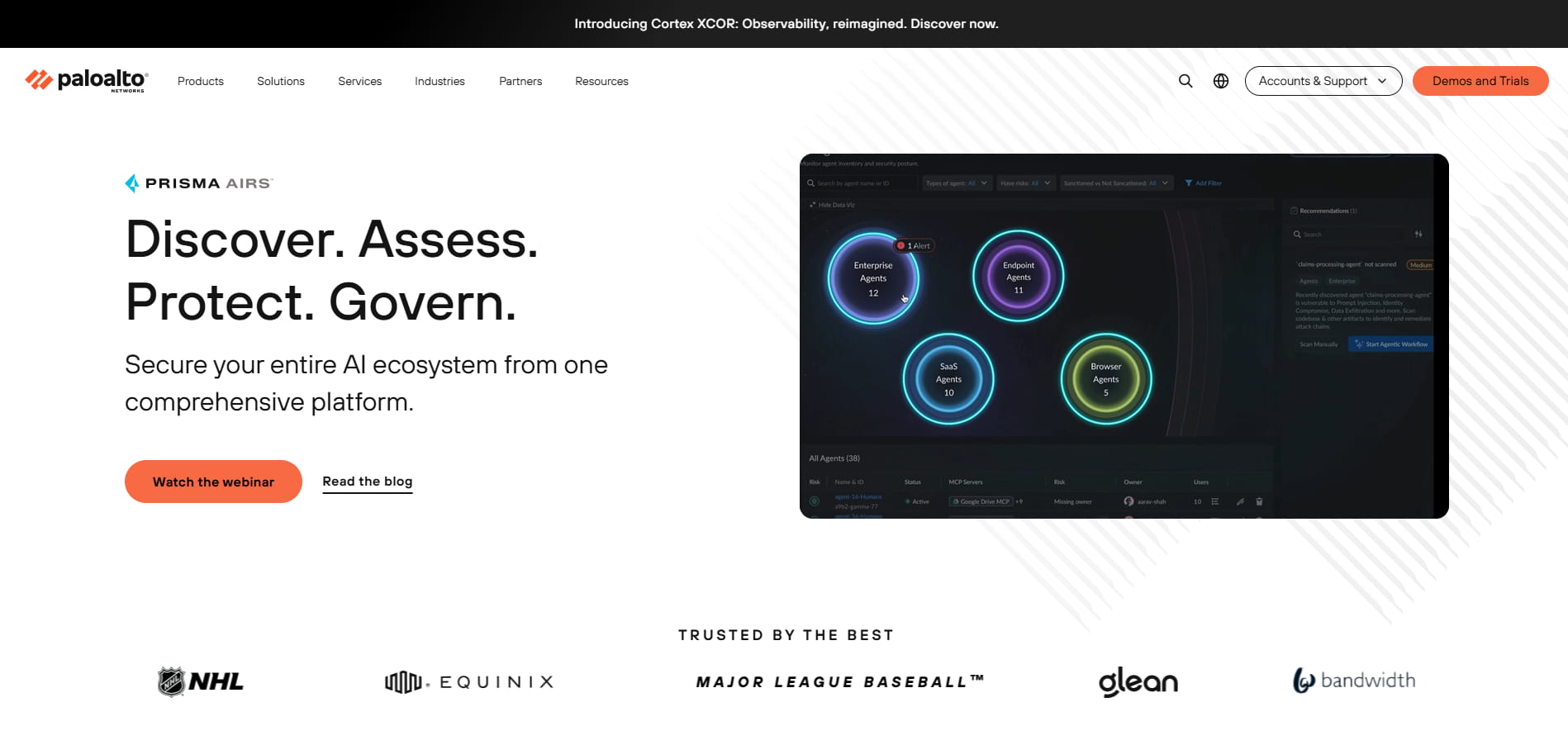
Prisma AIRS combines runtime protection with agent identity controls, red teaming, and model security. Runtime inspection runs in 2 deployment modes, Network Intercept through a software firewall and API Intercept integrated into application code. Its AI Gateway centralizes access controls and inspection for traffic routed through it.
Key Features:
- Runtime Threat Inspection: Detects and blocks prompt injection, memory poisoning, tool misuse, and sensitive data leakage in inspected AI traffic.
- Agent Identity and Access: An AI Gateway add-on gives registered agents unique identities and OAuth 2.1 credentials, enforces MCP tool access policies, and logs agent and user identities where applicable.
- Agent Red Teaming: Tests agents against adversarial scenarios, including tool misuse and memory poisoning, and provides remediation guidance.
Best For: Teams building AI applications and agents that need traffic inspection, centralized access controls, and adversarial testing.
Limitations: Protection covers only traffic routed through its enforcement points. Data masking and contextual grounding require the API Intercept deployment, and Agent Identity Security is a separately licensed add-on.
3. Zenity
Zenity combines agent discovery, posture management, and runtime defense across SaaS, cloud, and endpoint deployments. It analyzes agent execution paths and applies inline controls on supported platforms, including Microsoft Copilot Studio and Microsoft Foundry.
Key Features:
- Behavioral Detection and Response: Analyzes tool calls, memory access, data usage, and control flow to detect suspicious or unintended behavior, including when individual inputs appear harmless.
- Runtime Boundaries: Evaluates agent actions against policy, allowing or blocking them, or stopping the agent, at supported enforcement points.
- Exposure Management: Validates exploitable attack paths, assigns risk scores, and supplies fixes that teams can apply through Runtime Boundaries.
Best For: Enterprises securing agents built by business users and developers across platforms such as Copilot Studio, Microsoft Foundry, Salesforce Agentforce, and Amazon Bedrock.
Limitations: Runtime visibility and blocking depend on the agent platform and deployment method. Confirm which actions can be inspected, blocked, or modified in each environment.
4. Microsoft Defender
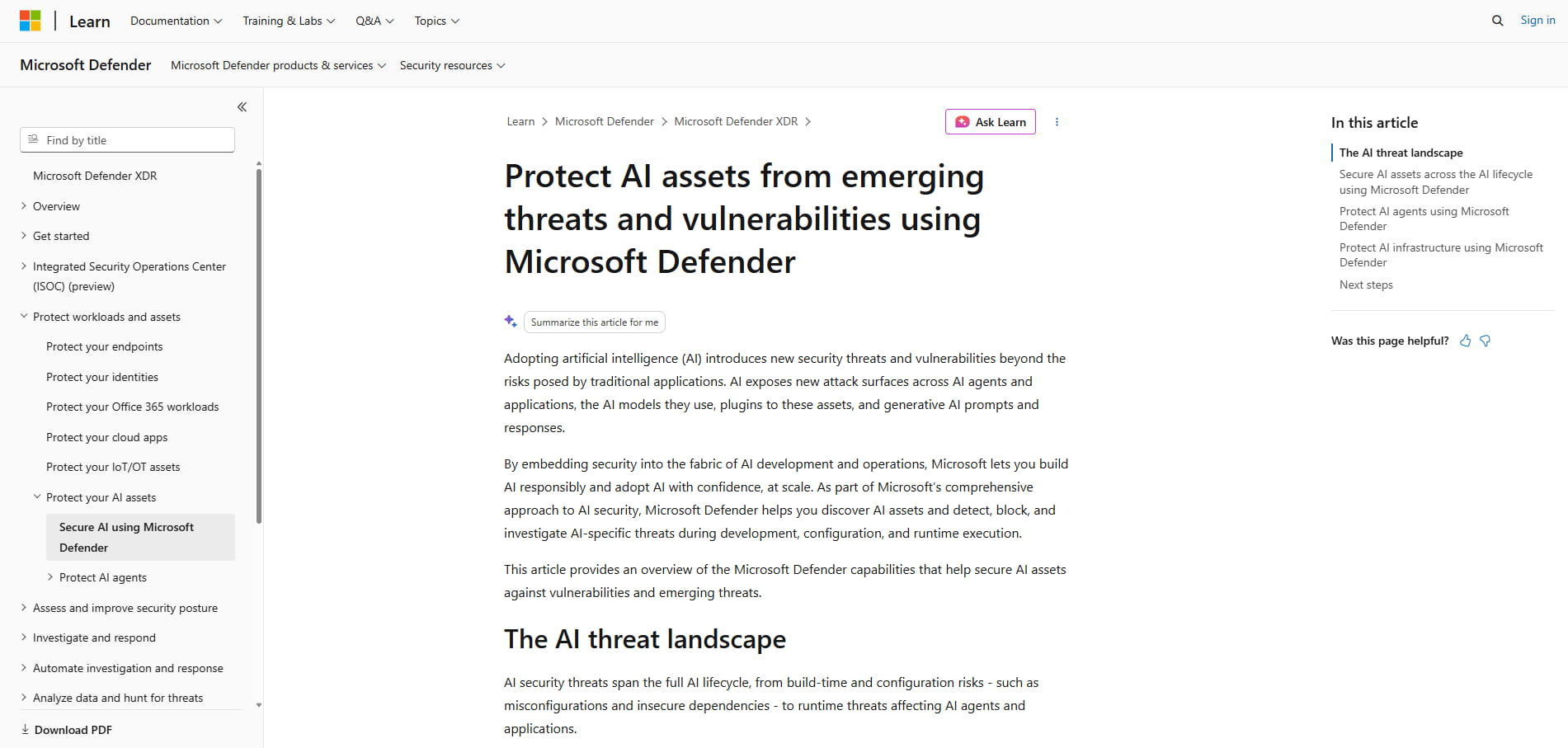
Microsoft Defender combines AI agent discovery, posture assessment, runtime protection, and investigation within its existing security portal. Runtime policies can audit supported activity or block matching threats before an action executes.
Key Features:
- Real-Time Protection: Evaluates tool invocations for Copilot Studio agents and requests, responses, tool invocations, and tool responses for Foundry agents. Custom blocking rules stop interactions that match supported threat scenarios, such as secret exfiltration and malicious content propagation.
- Discovery and Posture Assessment: Integrates with Agent 365 to inventory managed agents, with prebuilt Advanced Hunting queries that flag misconfigurations, risky settings, and excessive permissions, plus security recommendations for supported agent types. Supported local agents use a separate Defender for Endpoint onboarding path.
- Threat Investigation: Records audited and blocked activity as queryable behaviors for hunting and custom detections, while near-real-time alerts surface for agents in audit mode.
Best For: Microsoft-centric organizations that want protection for supported cloud and local agents within existing Defender workflows.
Limitations: Copilot Studio and Foundry runtime protection are in preview, cloud rules audit by default until custom blocking rules are added, and Agent 365 runtime tool protection depends on supported Work IQ MCP integrations.
5. Obsidian Security
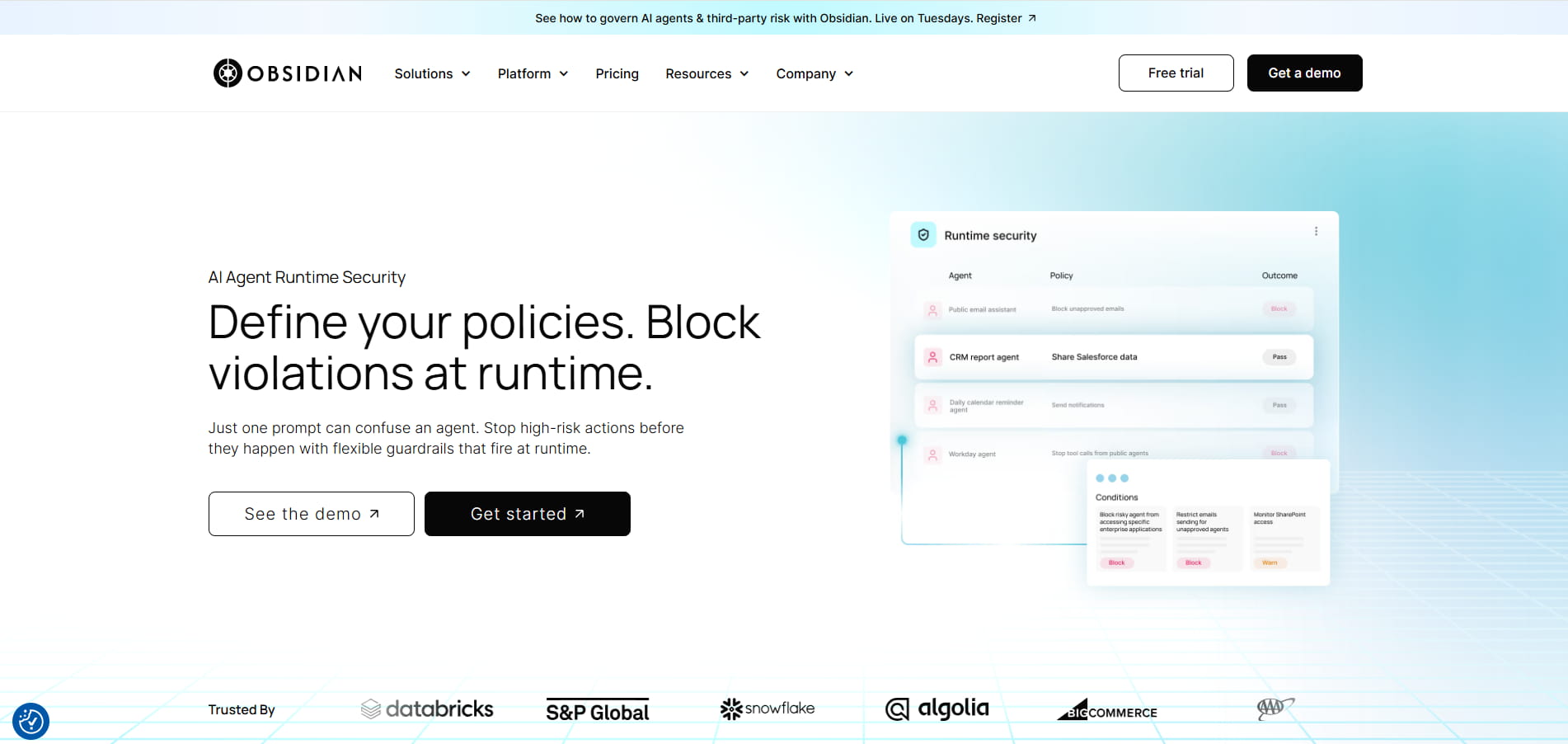
Obsidian Security connects agent activity with SaaS identity and application context. It maps agents to their user and service-account identities, effective permissions, and connected tools to identify risks that agent telemetry alone can miss. Supported runtime enforcement uses native APIs and webhooks rather than an inline proxy.
Key Features:
- Runtime Guardrails: Monitor, block, or require human approval for supported agent executions against configurable policies, including unexpected tool calls and risky data transfers.
- Effective-Access Mapping: Connects agents to application-level service accounts and permissions, exposing excessive access and privilege-escalation risks.
- Inventory and Governance: Inventories agents, MCP servers, LLMs, owners, and connected tools across supported platforms, and right-sizes the permissions agents hold against what they need.
Best For: Teams securing agents that interact with third-party business applications, particularly Claude and Microsoft Copilot deployments.
Limitations: As of August 2026, Obsidian documents runtime blocking for Claude and Microsoft Copilot only, with other platforms limited to discovery and governance until enforcement ships.
6. CrowdStrike Falcon Guardian

CrowdStrike Falcon Guardian connects AI agent activity with Falcon endpoint telemetry to support runtime detection, investigation, and response. Its endpoint controls complement broader AI protection across cloud, SaaS, and browser environments.
Key Features:
- Agent Discovery and Access Controls: Discovers known and shadow agents across supported Windows, macOS, and Linux endpoints, and controls which supported agent types can run.
- Runtime Visibility: Correlates prompts, identities, tool calls, MCP servers, and skill use with downstream processes and system actions for supported agents.
- Detection and Investigation: Reconstructs agent sessions and execution chains, assesses affected systems, and supports containment. Agent telemetry flows natively into Falcon Next-Gen SIEM for correlation and investigation.
Best For: Existing Falcon customers securing local and coding agents on managed endpoints.
Limitations: Detailed execution visibility depends on supported agents and endpoint telemetry, and the native AI Gateway is still labeled “coming soon,” so confirm availability separately for gateway and managed-response capabilities.
Agent Runtime Security Platforms: Comparison Overview
Runtime visibility and blocking vary by integration, agent type, and deployment method. Confirm both separately for each platform in your environment.
How to Choose an Agent Runtime Security Platform for Your Environment
The right platform depends on where your agents run and how much context each finding carries. These 5 checks narrow the shortlist.
- Map Which Agent Platforms Your Organization Runs and Which Produce Runtime Telemetry: Inventory the agents in use, from Copilot Studio and Agentforce agents to coding agents on developer laptops, and note which platforms expose hooks, audit logs, or APIs a security tool can read. Check visibility and enforcement separately, since audit logs may reveal completed actions, while blocking requires an integration that can intervene before or during execution.
- Assess Whether the Platform Monitors Actions or Just Inputs and Outputs: Prompt and response filtering can detect injection attempts and sensitive content, but it alone doesn’t establish which downstream actions executed. Ask whether the platform evaluates tool calls and downstream actions before they execute, and test it with an action that looks harmless at the prompt level.
- Confirm How the Platform Handles Shadow Agents That Were Never Registered: Agents connected through user consent or enabled inside existing tools can bypass IT approval and remain absent from the security team’s inventory. Check whether discovery depends on agents being onboarded to a registry, or whether it can surface them from consent grants, API activity, and endpoint signals.
- Verify That Runtime Findings Connect to Identity and Permission Context: An alert that an agent accessed 5,000 files is hard to triage without knowing whose delegated access it used and what scopes it holds. Look for findings that name the agent, the user or service identity behind it, its granted permissions, and the data involved.
- Test the Remediation Model: Manual Review, Automated Response, or Both: Some platforms only alert, others block inline, and many support both through monitor and enforce modes. Trigger a policy violation during the proof of concept and confirm what happens next, whether that’s a blocked action, a revoked token, a reduced scope, or a ticket in the SOC queue.
What Separates a Real Agent Runtime Security Platform From a Guardrail
Basic guardrails inspect model content, while runtime security adds action, identity, and permission context. Judge a product by what it controls, not its label.
How Reco’s Agent Runtime Connects Activity to Identity, Permissions, and Ecosystem Context
Reco evaluates runtime activity using the identity, permission, and connection context already held in the Reco Graph. Across supported integrations, security teams can connect an agent’s actions to who deployed it, whose access it uses, and the applications and MCP servers it can reach.
- Discover Agents and Connections: Application discovery identifies sanctioned and shadow agents, connected applications, and associated users, while Reco Factory extends coverage with new app and agent integrations built in hours.
- Map Identity, Permissions, and Reach: The Reco Graph connects agents with their identities, permissions and access, and application relationships. Posture and configuration findings add context about risks in connected applications.
- Evaluate Activity in Context: Agent Runtime evaluates prompts, actions, and events against that context to block, warn, redact, allow, or log activity. Controls include prompt injection detection and AI DLP, complementing broader data exposure management.
- Contain Threats and Guide Remediation: Teams can use a kill switch, reduce permission scope, revoke tokens, or route findings for investigation. Smart Remediation recommends permission, connection, or policy changes based on the access an agent needs, and Reco’s identity threat detection and response supports investigating suspicious identity activity.
Conclusion
Every platform in this article shows you something about your agents. The difference becomes clear when an agent does something unexpected with access nobody revoked. Test for that moment with an agent you already run. Have each vendor trace one action to its identity, permissions, and data, then trigger a policy violation and see what happens before it completes.
Valid credentials alone can’t show if an agent’s action is appropriate. Reco closes that gap by bringing identity and permission context into runtime decisions, so security teams can catch a valid credential doing the wrong thing and stop it.
FAQs
What is agent runtime security and how does it differ from agent posture management?
Agent runtime security evaluates activity during execution, while agent posture management assesses configurations, permissions, and potential exposure. The two answer different questions.
- Posture management reviews configurations, permissions, OAuth scopes, and exposure, then flags risky setups.
- Runtime security inspects prompts, tool calls, and data movement during execution, and can block an action before it completes.
- Mature programs use both, since posture shrinks the attack surface and runtime catches misuse of the access that remains.
Which types of attacks does agent runtime security protect against that perimeter tools miss?
Agent attacks can use approved APIs and valid credentials, making them difficult to distinguish from legitimate traffic through perimeter inspection alone. Depending on coverage, runtime security can detect or block threats such as
- Indirect prompt injection hidden in emails, documents, or web pages an agent retrieves
- Tool misuse, where a manipulated agent calls an authorized tool for an unauthorized purpose
- Data exfiltration through legitimate connections, such as exporting files to an external destination
- Malicious or unsanctioned MCP servers that feed the agent poisoned tool definitions or results
How does Reco’s Agent Runtime connect real-time activity to the identity and permissions behind each action?
Reco evaluates runtime events against the Reco Graph, which already maps how agents, identities, permissions, and applications relate. That context travels with each decision.
- Each action links to the agent, who deployed it, and whose access it uses.
- Policies can block, warn, redact, allow, or log activity based on the agent’s permissions and reach, including the MCP servers it connects to.
- Findings carry the context needed to reduce a scope or revoke a token, drawing on Reco’s identity and access governance capabilities.
Can agent runtime security platforms monitor agents that were never approved or registered through IT?
Many can, but coverage depends on how they discover agents. Platforms that read OAuth consent grants, API activity, browser activity, or endpoint signals can surface agents that never went through IT approval. Registry-based tools may miss agents outside their inventory, while platform-native discovery is limited to the environments it covers. Monitoring an unregistered agent is also different from blocking it, since enforcement still requires an integration that can intervene during execution.
How does Reco handle agent runtime monitoring across inherited third-party agents that security teams did not deploy?
Inherited agents arrive through vendor features or employee connections, often carrying broad delegated access. Reco treats them like any other agent in the Reco Graph.
- Across supported integrations, Reco discovers third-party and embedded agents, along with the users and access behind them.
- Reco applies its runtime policies and response options through the control points each third-party platform exposes.
- Coverage extends to new agent platforms through Reco Factory, which builds integrations in hours.
