
The patch window is zero: what PHP2Shell proves about agent security



When CVE-2026-109618 and CVE-2026-109619 landed earlier this week, the exploit timeline collapsed faster than most security teams could finish their morning triage.
The pair of flaws, collectively called PHP2Shell, allows unauthenticated remote code execution inside the core engine of PHP. PHP still powers around 70 percent of the web, and an attacker needs only a single crafted POST request to get arbitrary code running before the application even finishes initializing. The vulnerability itself is severe, but the turnaround time is the real wake-up call.
The time between when the public commit diff hit the PHP repository and the first automated exploits hit live endpoints was less than an hour. Attackers pointed automated models directly at the patch diff, extracted the underlying vulnerability logic, and synthesized working exploits automatically.
This breaks traditional vulnerability management. For twenty years, enterprise defense leaned on a 30, 60, or 90 day remediation window. That buffer is dead. When weaponization takes under an hour, waiting for next sprint's patch cycle means defending against a timeline that no longer exists. Jason Clinton, Deputy CISO at Anthropic, pointed this out publicly on X: automated exploit generation is creating a "vulnerability tsunami" that legacy patch playbooks simply cannot absorb.
Patching still matters for basic hygiene. But if your defensive strategy relies on applying a patch before an automated system exploits the diff, you will lose. Once arbitrary execution lands, your perimeter is gone. The only real question left is: what can that execution actually reach?
Now take a look at what is happening inside your own engineering team.
While security teams spent the week auditing firewalls and web servers for PHP2Shell, developers were spinning up autonomous coding agents on their laptops.
The mechanics are identical. An external exploit lets an adversary execute arbitrary commands on a server. An autonomous coding agent executes arbitrary commands in a local terminal to compile code, pull dependencies, run scripts, and call APIs.
One execution path is forced by an attacker. The other is invited by your engineering roadmap.
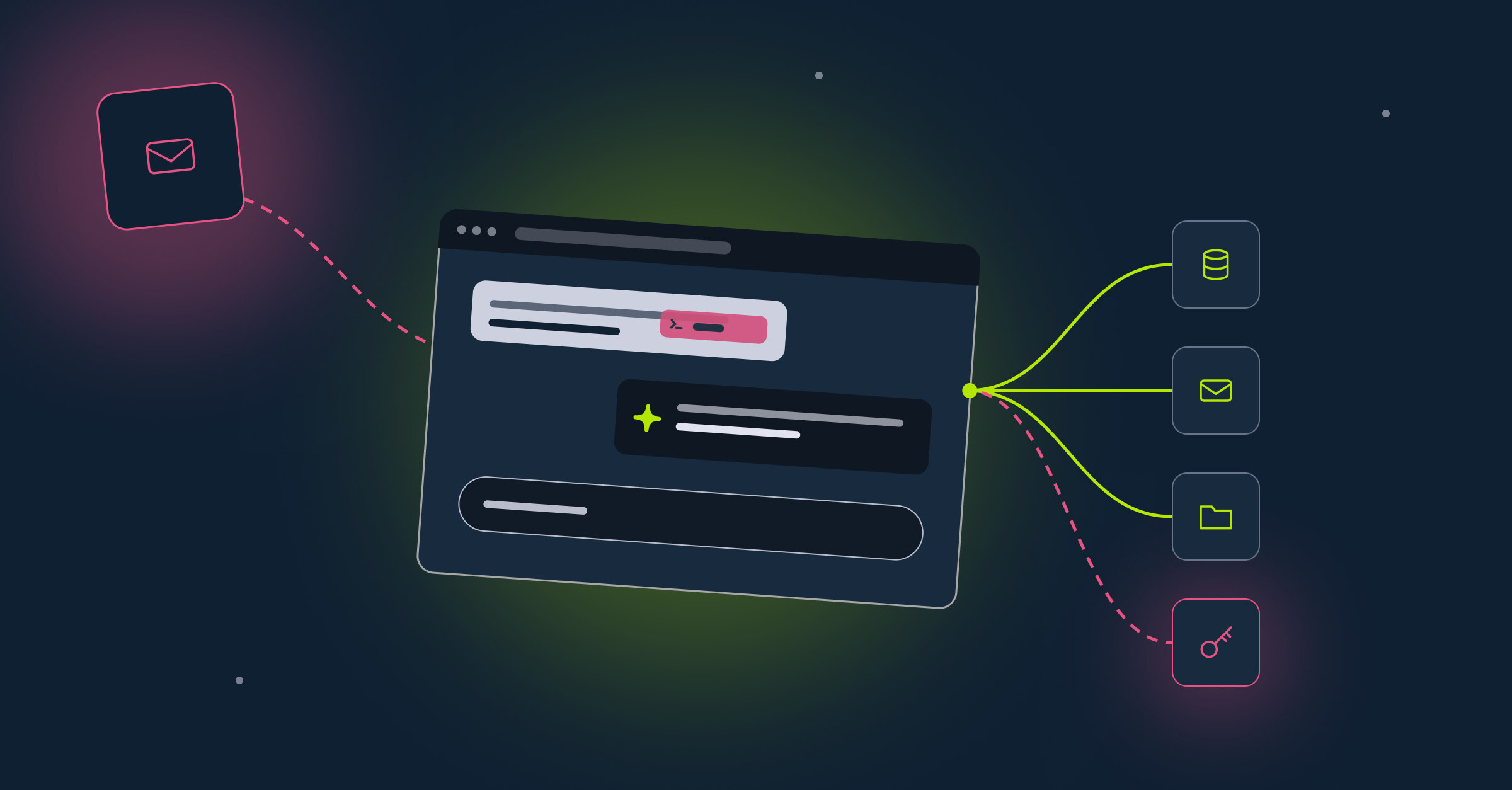
When an agent runs on a developer's workstation, it inherits everything in that environment: cached credentials, internal SSH keys, VPN access, and local tokens. If that agent pulls a compromised dependency, encounters a prompt injection, or hallucinates a bad command, its blast radius is whatever that engineer could access. You cannot patch against execution you intentionally scheduled. Defense has to move from perimeter policing to runtime blast-radius containment.
The shared responsibility model for agent security
If we want the speed of autonomous agents without blowing open internal networks, we need a clear shared responsibility model:
- The model provider boundary: frontier model providers own baseline model safety, weight security, training integrity, and inference reliability.
- The enterprise runtime boundary: enterprise security teams own the execution environment, which tools an agent can invoke, what credentials it holds, and which actions require human approval.
Model alignment will not save your production environment. Security controls must be enforced deterministically at the runtime layer, independent of the model's reasoning.
4 architectural pillars of agent runtime security
In practice, moving from perimeter patching to runtime containment requires four foundational controls:
- Stop letting coding agents run locally on laptops. Autonomous execution belongs in centralized, disposable cloud sandboxes. When an agent runs inside an isolated remote environment, it never touches developer workstations, internal networks, or cached corporate tokens. When the task finishes, the environment is destroyed. Eliminating unmonitored local execution also prevents shadow agent sprawl across engineering teams.
- Tool calls must be strictly allow-listed and segmented. Agents should never have open system permissions or unrestricted network routes. Maintain an explicit registry of sanctioned tools and Model Context Protocol (MCP) servers. Enforcing strict MCP security and capability boundaries ensures that agents only invoke verified tool schemas. Swap static credentials for scoped, short-lived tokens so that an isolated compromise has no lateral path into core systems or the enterprise context graph.
- Audit tool calls at runtime, not in post-mortem logs. Parsing logs after a breach only tells you what you lost. Runtime inspection evaluates tool calls, arguments, and payloads before they execute, intercepting parameter anomalies and credential leaks in flight. This active telemetry directly addresses emerging agentic threats like OWASP tool misuse and goal hijacking.
- Separate autonomous work from irreversible impact. Let agents read code, generate drafts, and run tests at full speed. But the moment an agent attempts to delete data, push code to production, or alter permissions, execution must pause for deterministic human approval. The baseline rule is simple: autonomous work ends where irreversible impact begins.
Beyond the perimeter
PHP2Shell is a preview of a world where automated intelligence is pointed at source code.
Whether an arbitrary command comes from an automated exploit hitting an unpatched web server or an autonomous agent running a bad prompt on a developer's laptop, perimeters will not fully protect you. Containment, runtime isolation, and strict capability boundaries will.
Ready to secure your agentic development workflows? Explore Reco's agent runtime protection or request a demo.

Tal Shapira

ABOUT THE AUTHOR
Tal is the Cofounder & CTO of Reco. Tal has a Ph.D. from the school of Electrical Engineering at Tel Aviv University, where his research focused on deep learning, computer networks, and cybersecurity. Tal is a graduate of the Talpiot Excellence Program, and a former head of a cybersecurity R&D group within the Israeli Prime Minister's Office. In addition to serving as the CTO, Tal is a member of the AI Controls Security Working Group with the Cloud Security Alliance.
Tal is the Cofounder & CTO of Reco. Tal has a Ph.D. from the school of Electrical Engineering at Tel Aviv University, where his research focused on deep learning, computer networks, and cybersecurity. Tal is a graduate of the Talpiot Excellence Program, and a former head of a cybersecurity R&D group within the Israeli Prime Minister's Office. In addition to serving as the CTO, Tal is a member of the AI Controls Security Working Group with the Cloud Security Alliance.